King Ethelbert Statue in Canterbury: A Royal Landmark
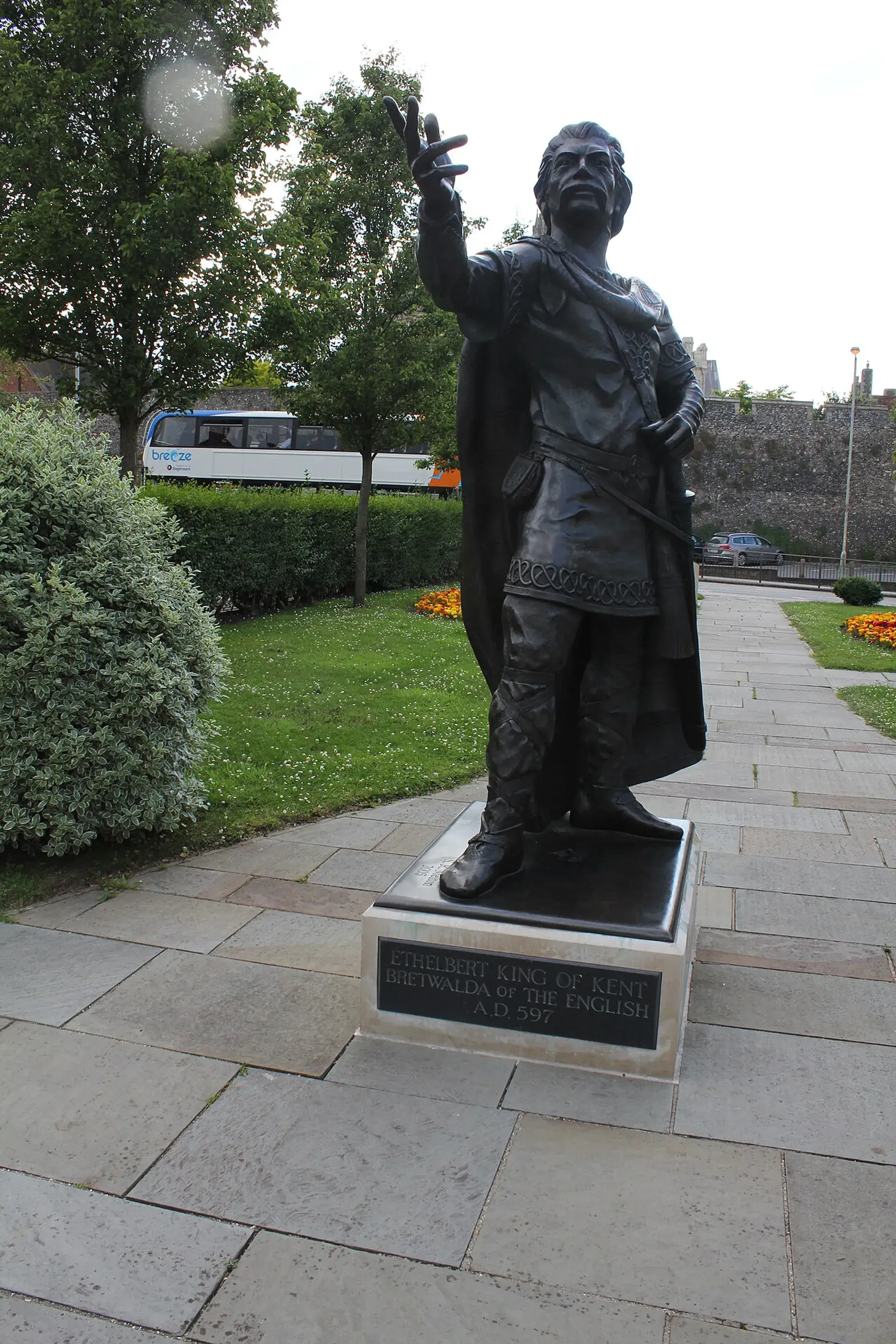
On Lady Wootton's Green in Canterbury, a bronze statue of King Ethelbert stands as a monument to a pivotal moment in English history. Positioned opposite a statue of his wife, Queen Bertha, the sculpture captures the king at the dawn of Christianity in his kingdom. The statues are located in front of the Fyndon Gate of St Augustine's Abbey, forming a visual link between Canterbury's historic sites.
A Moment of Conversion
The statues, sculpted by Stephen Melton and unveiled on May 26, 2006, depict a supposed interaction in 597 CE. Queen Bertha, a devout Christian, is shown informing her then-pagan husband of the arrival of St Augustine in Kent. The figures face each other, with Ethelbert facing east and Bertha west, symbolizing the meeting of two worlds. The Canterbury Commemoration Society gifted the bronze and concrete sculptures to the city.
The Reign of a Bretwalda
King Ethelbert reigned over the kingdom of Kent from approximately 589 to 616 CE. He was a powerful ruler, recognized as 'Bretwalda,' or overlord, of the other Anglo-Saxon kingdoms south of the River Humber. His marriage to the Christian Frankish princess Bertha around 580 CE was a key event. A condition of their union was that Bertha be allowed to continue practicing her faith, for which she was accompanied by Bishop Liudhard and used the restored Roman building of St Martin's Church for worship.
The Arrival of Christianity
In 597 CE, Pope Gregory the Great dispatched St Augustine to convert the Anglo-Saxons. Wary of the missionaries, King Ethelbert insisted on meeting them in the open air, fearing they might use magic if they met indoors. Despite his initial caution, Ethelbert eventually converted, becoming the first Anglo-Saxon king to embrace Christianity. He provided Augustine with land to build churches, including the site for what would become Canterbury Cathedral. Ethelbert's decision to establish the Archbishop's seat in Canterbury, rather than London as Pope Gregory had instructed, secured the city's future as the spiritual heart of England. His law code, the oldest known text in Old English, included penalties for offenses against the Church.
Historical Accuracy in Bronze
The statues are noted for their historically meticulous details. Queen Bertha’s clothing is modeled on grave goods discovered in the tomb of the 6th-century Frankish Queen Arnegunde. King Ethelbert's hairstyle is based on images from coins of his son, Eadbald, while his sword, belt, and shoulder clasp are derived from artifacts found at the famous Sutton Hoo ship burial. This statue is one of three commemorating the king in Canterbury, with others located on the Cathedral's porch (1870) and the 'Screen of the Six Kings' inside the cathedral (c. 1460).
Location and Context
The statues are a prominent feature of Lady Wootton's Green, a public garden since 1896. The site is part of 'Queen Bertha's Walk,' a pedestrian route marked by 14 bronze plaques that trace the queen's traditional path between the city and St Martin's Church. The location serves as an accessible point of interest connecting the city centre with the grounds of St Augustine's Abbey.
FAQ
Why did King Ethelbert meet St. Augustine outdoors?
King Ethelbert, who was pagan at the time, insisted on meeting St. Augustine in the open air in 597 CE because he feared the Christian missionaries might use magic if they were to meet inside a building.
When did King Ethelbert rule Kent?
King Ethelbert reigned over the Kingdom of Kent from approximately 589 CE until his death in 616 CE. He was the first Anglo-Saxon king to convert to Christianity.
Where is the King Ethelbert statue located?
The statue is located on Lady Wootton's Green in Canterbury, positioned with a statue of Queen Bertha in front of the Fyndon Gate of St Augustine's Abbey.
Are the details on the King Ethelbert statue historically accurate?
Yes, the statue's details are based on historical and archaeological evidence. The king's sword, belt, purse, and shoulder clasp are modeled on finds from the Sutton Hoo ship burial, and his hairstyle is based on coins of his son, Eadbald.