Cardiff City Hall: The Dragon-Crowned Civic Center
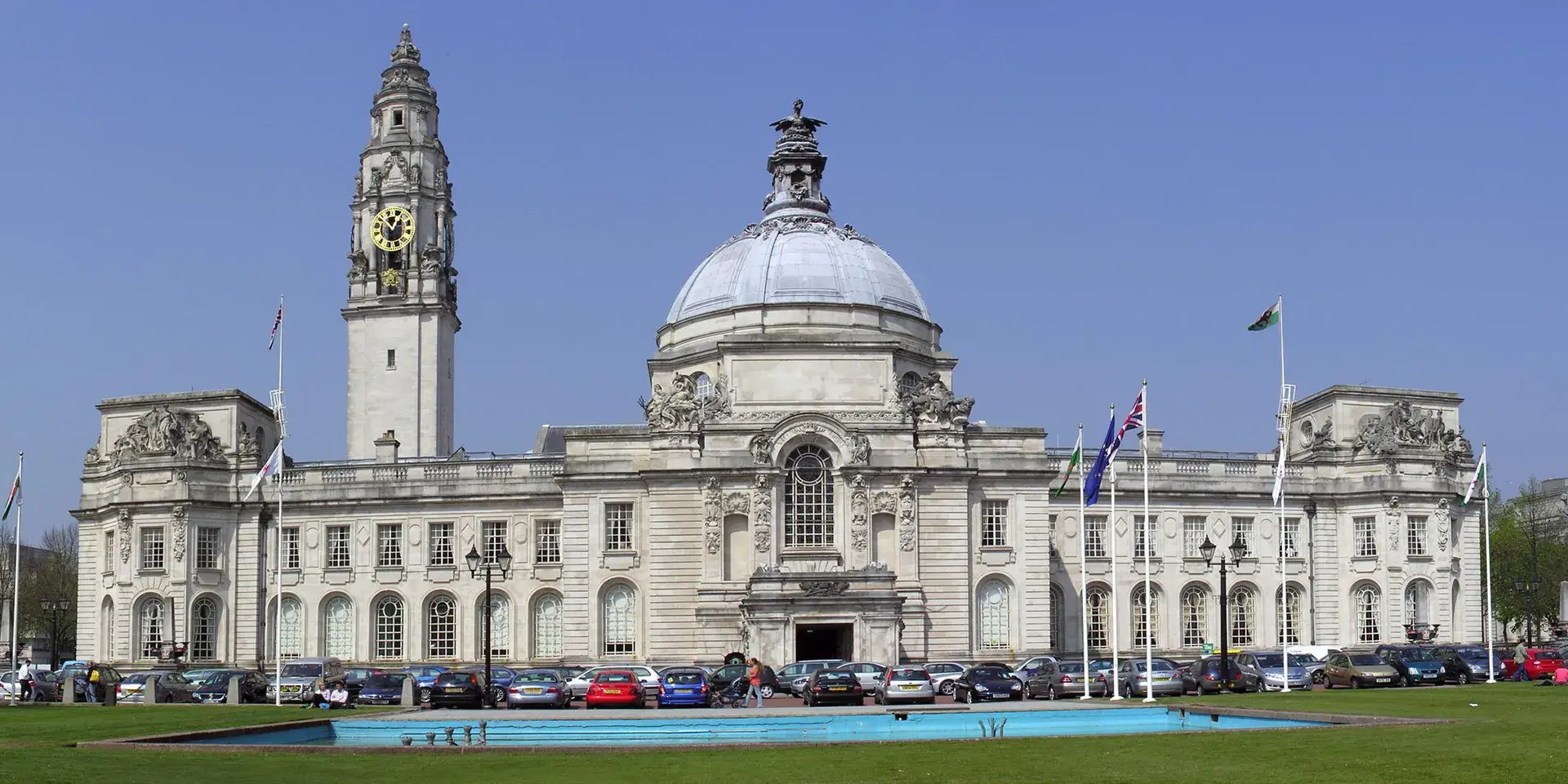
Cardiff City Hall stands as a defining landmark of the transition from a booming coal town to an official city. Crowned by a prominent Welsh dragon on its central lead-covered dome, the building anchors Cathays Park, an ambitious early 20th-century civic centre situated just north of Cardiff Castle and the city's main shopping boulevards.
A Civic Quarter Born from Coal
In the late 19th century, rapid expansion fueled by the South Wales coal boom transformed Cardiff into the largest town in Wales. Driven by this new wealth, the Cardiff Corporation purchased 59 acres of parkland from the 3rd Marquess of Bute in 1898. The goal was to establish a dedicated civic centre in the area known as Cathays Park.
While construction was underway, King Edward VII granted Cardiff city status in October 1905. This pivotal elevation meant the planned municipal building was formally renamed from a town hall to a full city hall just before its official opening ceremony in October 1906, which was led by the 4th Marquess of Bute.
Edwardian Baroque Grandeur
Designed by architects Henry Vaughan Lanchester, James A. Stewart, and Edwin Alfred Rickards, the Grade I listed building is an exceptional example of Edwardian Baroque architecture. The exterior is constructed from pale Portland stone, creating a striking contrast with the manicured lawns of Cathays Park.
During construction between 1900 and 1904, the builders, E. Turner & Sons, operated the world's first all-electrically operated building site. The massive project utilized eight 5-ton electric cranes to manoeuvre the heavy stone blocks into place.
The structure features a towering 194-foot (59-meter) asymmetrical clock tower. The tower's copper and tin hour bell bears the traditional Welsh phrase "Y gwir yn erbyn y byd" ("Truth against the world"). Atop the central dome sits the famous Welsh dragon, sculpted by Henry Charles Fehr.
The Marble Hall and Council Chamber
The interior of Cardiff City Hall is characterized by the gleaming Marble Hall, which is lined with columns of Sienna marble and features vaulted decorative plasterwork accented with gold leaf. In 1916, David Lloyd George unveiled the "Hall of Welsh Heroes" within this space. Financed by industrialist David Alfred Thomas (1st Viscount Rhondda), this collection of marble statues honors notable historical figures who were selected through a public vote run by the Western Mail newspaper.
The building's Council Chamber also defies British municipal norms. Instead of the typical semicircular seating layout, the chamber was designed with concentric circular seating situated beneath a prominent bronze chandelier designed by Rickards.
Modern Ceremonial Role
Today, Cardiff City Hall serves as a key administrative and ceremonial hub for Cardiff Council, although day-to-day administration is primarily handled at the nearby County Hall. The historic building functions as a premier civic venue, regularly hosting international conferences, civil wedding ceremonies, formal banquets, and public exhibitions.
FAQ
When was Cardiff City Hall built?
Construction on Cardiff City Hall took place between 1900 and 1904. The building officially opened in October 1906, shortly after Cardiff was granted city status in 1905.
How tall is the clock tower at Cardiff City Hall?
The asymmetrical clock tower at Cardiff City Hall stands at a height of 194 feet, or 59 meters.
Who are the statues in the Marble Hall?
The Marble Hall features the "Hall of Welsh Heroes," a collection of marble statues depicting notable Welsh historical figures. These figures were chosen by the public through a vote run by the Western Mail newspaper and unveiled in 1916.
What is the Welsh phrase on the clock tower bell?
The hour bell in the clock tower is inscribed with the traditional Welsh phrase "Y gwir yn erbyn y byd," which translates to "Truth against the world."