St John The Baptist Church: Cardiff's Medieval Gem
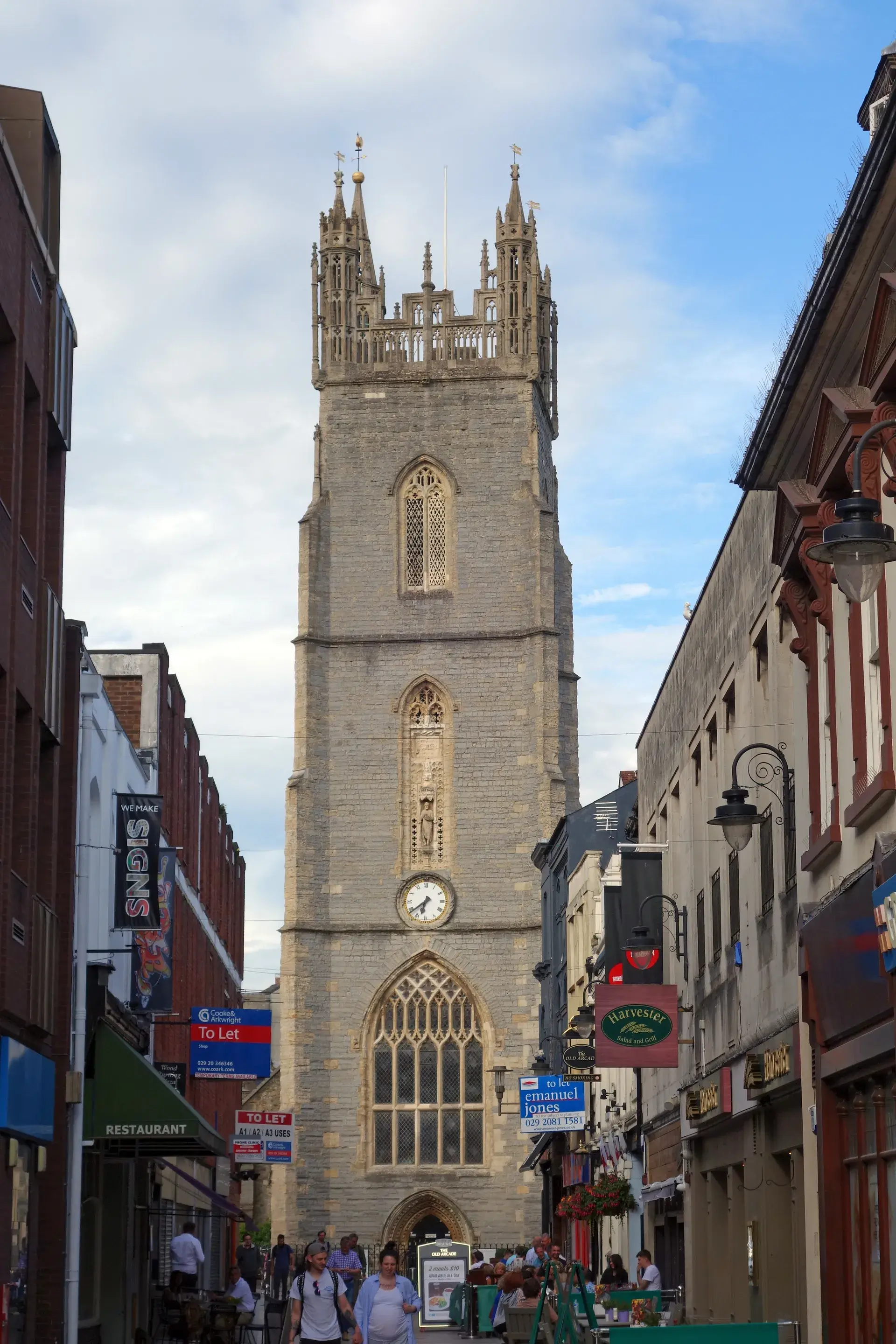
Situated between Cardiff Castle's medieval ramparts and the city's Victorian shopping arcades, the City Parish Church of St John the Baptist stands as a geographic anchor in the old town. Other than the castle itself, this Grade I listed building is the only surviving medieval structure in Cardiff's city centre. Its buff and grey limestone walls offer a stark visual contrast to the surrounding modern high-street shop fronts.
A History of Destruction and Rebirth
Founded around 1180 as a chapel of ease, the original church served the castle and town. It was completely destroyed during Owain Glyndŵr's Welsh rebellion in 1404. The structure was subsequently rebuilt later in the 15th century. In 1607, a devastating flood in the Bristol Channel undermined the foundations of St Mary's, the town's original parish church, elevating St John's to the role of Cardiff's primary civic church. To accommodate a surging industrial population, wide outer aisles constructed from Sweldon limestone were added between 1889 and 1891.
Architectural and Artistic Highlights
The church's defining feature is its 130-foot Perpendicular Gothic west tower. Completed around 1490, the four-stage tower is crowned with ornate, Somerset-style openwork pierced battlements and four corner pinnacles. Inside, the cool, silent stone interior provides an acoustic shift from the bustling shouts of the adjacent Central Market and is frequently filled with the resonant sounds of a restored 1894 "Father" Willis pipe organ.
The interior houses several notable historical artifacts. The Herbert Chapel contains a prominent Jacobean dual-effigy tomb dedicated to royal diplomat Sir John Herbert and his brother, Sir William Herbert. The sanctuary also features Pre-Raphaelite stained glass windows crafted by Morris & Co., showcasing apostle designs by William Morris, alongside a carved Victorian reredos created by Welsh sculptor Sir William Goscombe John.
The Hidden Vaults Underfoot
During the 1890s, a paved thoroughfare was constructed directly across the overflowing churchyard to connect Working Street with the nearby market. Today, numbered brass plaques embedded in the pavement mark the exact locations of family burial vaults resting beneath the pavement. The church retains ownership of this public path and observes a legal tradition of locking the gates every Good Friday to maintain its private property rights.
Modern Role and Cultural Impact
St John the Baptist continues to serve as Cardiff's active civic church and acts as the Priory Church for Wales of the Order of St John. Open daily to the public, the building hosts morning Eucharist, Choral Evensong, and lunchtime recitals, while also operating an on-site tea room and community initiatives. Its historic architecture has even caught the eye of television producers, serving as a filming location for the 2006 Doctor Who Christmas special, "The Runaway Bride."
FAQ
How old is St John the Baptist Church in Cardiff?
The original church was founded around 1180 but was destroyed in 1404. The current structure was largely rebuilt in the late 15th century, with its 130-foot Gothic tower completed around 1490.
What is the significance of the brass plaques outside St John's Church?
The numbered brass plaques embedded in the paved thoroughfare outside the church mark the precise locations of historical family burial vaults that lie directly beneath the pedestrian path.
Is St John the Baptist Church open to the public?
Yes, the church is open daily to the public for independent visits, regular morning Eucharist, Choral Evensong, and concerts. It also features an on-site tea room.