Chester Roman Amphitheatre: Britain's Largest Arena
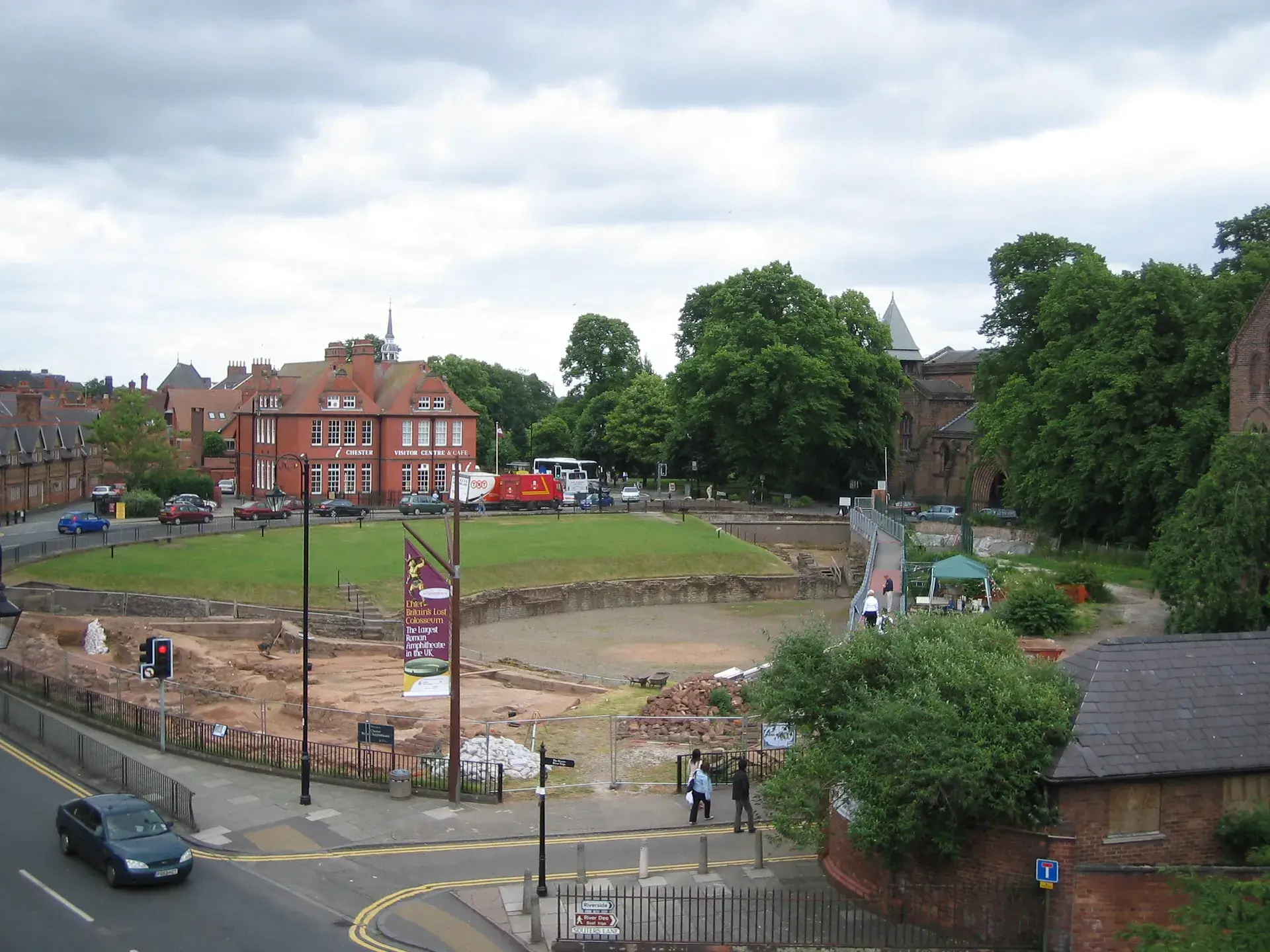
Gaze upon the exposed stone foundations of the Chester Roman Amphitheatre, the largest known example in Britain, where gladiators once fought and thousands cheered. The sheer scale of the structure has led historians to speculate that Chester, or Deva Victrix, may have been intended as the capital of Roman Britain. Its construction highlights the strategic importance of this legionary fortress on the edge of the empire.
Construction and Grandeur
The amphitheatre's history involves multiple phases of construction. The first structure was built in the late 70s AD by Legio II Adiutrix. Around 86 AD, Legio XX Valeria Victrix substantially rebuilt it, and a final, larger stone version was completed around 275 AD. This final iteration was an elliptical arena measuring 98 meters by 87 meters, with an outer wall up to 2.7 meters thick.
With a capacity estimated between 7,000 and 12,000 spectators, it was a major venue for both military and public life. The arena hosted troop maneuvers for the 20th Legion, gladiatorial combat, cock fighting, bull baiting, boxing, wrestling, and public executions. Its size and sophistication were unmatched by other amphitheatres in Britain, reflecting Chester's status as a key military headquarters.
Decline and Rediscovery
The amphitheatre's use fluctuated with military deployments. It fell into disuse around 120 AD when Legio XX was temporarily moved to Hadrian's Wall and was ultimately abandoned around 350 AD. After the Romans departed, its masonry was scavenged for other building projects, and the site became a shallow depression used for rubbish dumping and, in the post-Roman period, for bear fights and public punishments.
Buried by erosion and refuse for centuries, the amphitheatre was lost until its rediscovery in 1929 during construction work. Early excavations were led by Professor R. Newstead, followed by major digs in the 1960s by Hugh Thompson. More recent work between 2000 and 2006 by Dan Garner and Tony Wilmott has further enhanced the understanding of the site's complex history.
Archaeological Insights
Excavations have revealed fascinating details about life at the amphitheatre. A shrine dedicated to Nemesis, the goddess of retribution, was found at the north entrance—an unusual placement, as such shrines were typically located outside the main structure. A centurion named Sextius Marcianus is recorded as having dedicated an altar to the goddess here.
Finds of cheap Roman pottery decorated with images of gladiators have led to the theory that Chester may have been an early site for spectator souvenirs. Furthermore, while 1960s excavations suggested the first amphitheatre was timber-built, later investigations indicated that both major versions were primarily stone structures from their foundations up.
The Amphitheatre Today
Managed by English Heritage, the Chester Roman Amphitheatre is a Grade I listed building and a scheduled monument. Today, the northern half of the structure is exposed and accessible to the public free of charge during daylight hours. The southern half remains buried beneath modern buildings.
Visitors can view the excavated remains, including the shrine to Nemesis and various entrances. A large optical illusion mural helps convey the amphitheatre's original scale. The grounds serve as a popular public space and host military reenactments during the summer, making it a central feature on Chester's historic visitor routes.
FAQ
How big was the Chester Roman Amphitheatre?
The Chester Roman Amphitheatre is the largest discovered in Britain. It measured 98 meters (320 ft) by 87 meters (286 ft) and could hold between 7,000 and 12,000 spectators.
When was the Chester Roman Amphitheatre built?
The first amphitheatre on the site was built in the late 70s AD. It was significantly rebuilt around 86 AD and again around 275 AD, before being finally abandoned by the Romans around 350 AD.
Can you visit the Chester Roman Amphitheatre?
Yes, the excavated northern half of the site is managed by English Heritage and is open to the public daily during daylight hours, free of charge.
What was the amphitheatre used for?
It was a multi-purpose venue used for military training and drills by the Roman legions, as well as public entertainment spectacles such as gladiatorial combat, bull baiting, cock fighting, and public executions.