Eastgate Clock: Chester's Victorian Masterpiece
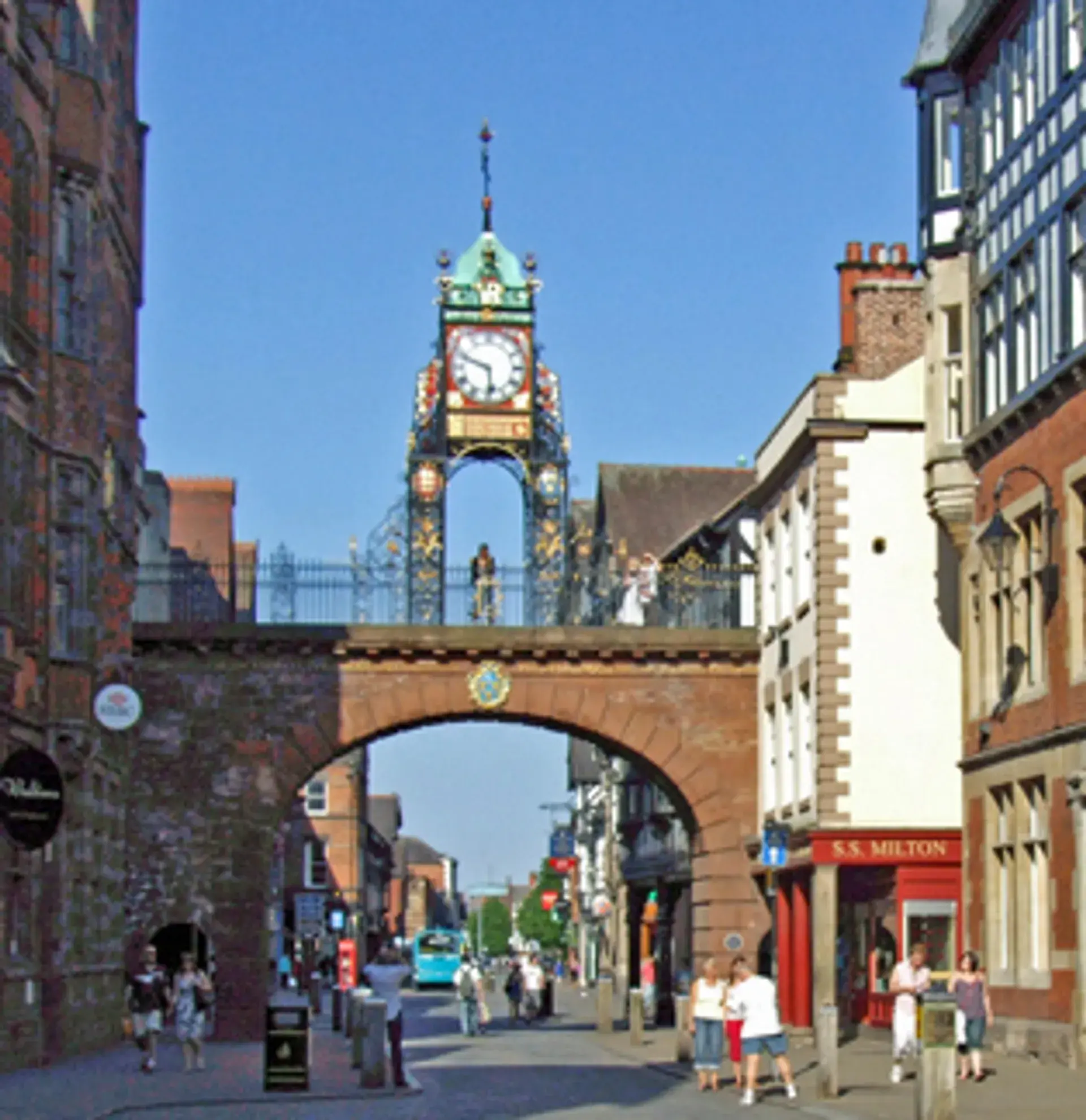
Perched above a Georgian archway, the iconic Eastgate Clock is a stunning Victorian masterpiece marking the entrance to Chester's historic Eastgate Street. As one of Chester's most recognizable landmarks, it is reputedly the second most photographed clock in England, surpassed only by Big Ben.
A History Spanning Millennia
The site of the Eastgate has served as the main eastern entrance to Chester since approximately AD 74, when it was the gateway to the Roman fortress of Deva Victrix. Over the centuries, the gateway was reconstructed multiple times, from a stone tower in the 2nd century to a probable 14th-century replacement.
The current three-arched sandstone structure is a Georgian gateway designed by Mr. Hayden. It was constructed between 1768 and 1769, financed by Richard Grosvenor, 1st Earl Grosvenor, to better accommodate coach traffic. The entire structure, including the later clock, was designated a Grade I listed building on July 28, 1955.
A Victorian Commemoration
While the gateway is Georgian, the ornate clock is a much later Victorian addition. It was built to commemorate Queen Victoria's Diamond Jubilee of 1897 and was officially unveiled on her 80th birthday, May 27, 1899.
The clock's intricate openwork iron structure was designed by prominent Chester architect John Douglas. An initial, more expensive stone design was rejected after a wooden model showed it would block daylight for neighboring properties. The final project was realized with funding for the faces and mechanism from local solicitor Edward Evans-Lloyd. The clock's mechanism was crafted by J. B. Joyce & Company, with ironwork by James Swindley and cast iron inscriptions by the Coalbrookdale Iron Company.
The Clock in the Modern Era
Today, the Eastgate Clock is a focal point of the city, serving as a popular meeting spot and an integral part of the Chester city walls walkway. The area around it is a lively hub of shops and cafes.
Over the years, the clock has seen several updates. In 1988, its faces were glazed to prevent the theft of its hands by souvenir hunters. The original wind-up mechanism, which required a technician to travel from Whitchurch weekly until 1974, was replaced by an electric one in 1992. In 1996, the clock faces were restored to their original colors. At night, a dynamic architectural lighting system illuminates its intricate details.
FAQ
Why was the Eastgate Clock built?
The Eastgate Clock was built to commemorate Queen Victoria's Diamond Jubilee, which occurred in 1897. The clock was unveiled in 1899 on the Queen's 80th birthday.
Is the Eastgate Clock older than the archway it sits on?
No, the clock is significantly newer than the archway. The current sandstone Eastgate was constructed between 1768 and 1769, while the Victorian clock was added on top in 1899.
Who designed the Eastgate Clock?
The clock's openwork iron structure was designed by Chester architect John Douglas. Its mechanism was crafted by J. B. Joyce & Company of Whitchurch.
How is the Eastgate Clock powered?
The clock was originally powered by a wind-up mechanism. In 1992, its original mechanism was replaced with an electric one.