Oxford's Bridge of Sighs: History & Architecture
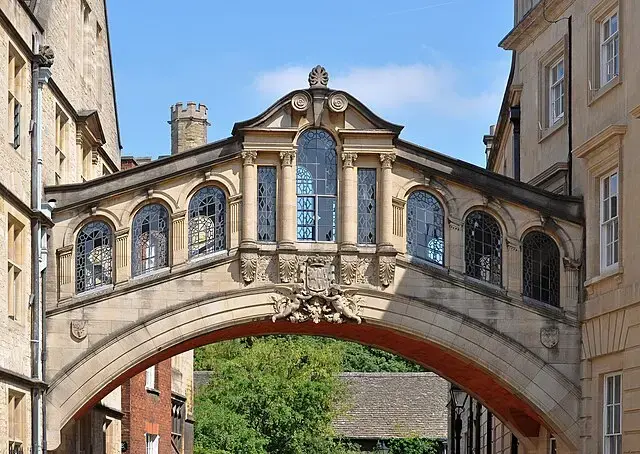
Officially known as Hertford Bridge, the Bridge of Sighs is a prominent architectural landmark in central Oxford. The Grade II listed covered skyway spans New College Lane immediately east of Catte Street. Positioned in the historic heart of the university, it stands adjacent to the Old Bodleian Library and the Sheldonian Theatre, just steps away from Radcliffe Square.
History and Construction
At the turn of the 20th century, Hertford College expanded north of New College Lane, dividing its campus into two separate areas. To unify the college grounds, administrators planned a covered pedestrian bridge linking the administrative Old Quadrangle to the south with the residential New Quadrangle to the north.
The initiative met significant institutional opposition from neighboring New College before approval was granted. Architect Sir Thomas Graham Jackson—who also designed buildings for Brasenose and Trinity colleges—was commissioned for the project. Construction concluded between 1913 and 1914, creating a functional elevated link over the public road.
Oxford self guided walking tour with Ciceru
1.5 hours10 stopsAudio guideStart any day, at your own paceTicket on your phone · 30-day refundArchitectural Design and Venetian Connections
The structure earned the colloquial moniker "Bridge of Sighs" due to its passing association with the famous covered bridge in Venice. However, its actual architectural design diverges from its namesake. With distinct window bays and a segmented arch spanning the narrow stone corridor of New College Lane, the bridge's profile bears a much closer resemblance to Venice's Rialto Bridge.
Access and Cultural Lore
The interior of the bridge is closed to the general public. It remains in daily private use exclusively for Hertford College fellows, students, and members traveling between the college's quadrangles. The exterior, framed between traditional ashlar and rubble-stone college walls, is freely visible from street level and ranks among the most photographed structures in Oxford. It has also served as a recurring filming backdrop for television dramas such as Inspector Morse and Endeavour.
A persistent Oxford urban legend claims the bridge was once closed to force Hertford students to take the stairs after a survey purportedly identified them as the university's heaviest cohort. College architecture refutes this myth: bypassing the bridge and using the street requires climbing fewer stairs than crossing through the skyway itself.
FAQ
Can the public visit the interior of the Bridge of Sighs?
No. The interior is private and restricted to Hertford College students, fellows, and members. Visitors can view and photograph the exterior from New College Lane and Catte Street.
Why was Hertford Bridge built?
It was completed between 1913 and 1914 to connect Hertford College's administrative Old Quadrangle with its residential New Quadrangle across New College Lane.
Does the bridge resemble the Bridge of Sighs in Venice?
Despite sharing a popular name with Venice's Bridge of Sighs, its segmented arch and window bays more closely resemble the design of Venice's Rialto Bridge.