Sheldonian Theatre: Wren’s Oxford Landmark
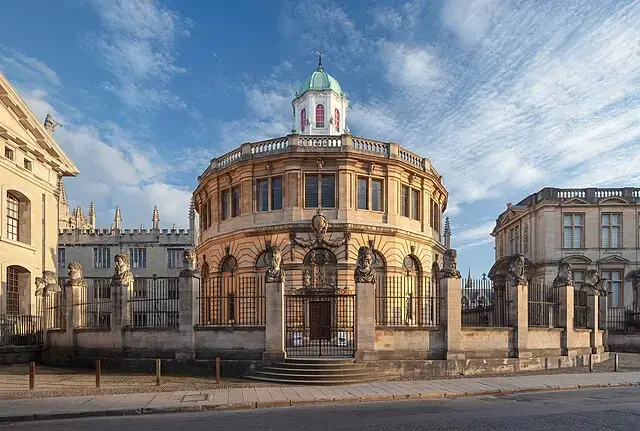
The Sheldonian Theatre on Broad Street in central Oxford stands as Sir Christopher Wren's first major architectural work. Constructed between 1664 and 1668 and opened in July 1669, the Grade I listed English Baroque building represents a defining moment in Oxford's urban development, marking a shift away from traditional inward-facing Gothic quadrangles toward classical civic architecture.
Origins and Purpose
Prior to the Sheldonian's completion, University of Oxford ceremonies—including matriculation, Latin degree conferments, and the raucous annual assembly known as "The Act"—were held inside the consecrated University Church of St Mary the Virgin. Over time, university leadership found the ribald speeches of student orators, such as the satirical mock orator Terrae Filius ("Son of the Earth"), inappropriate for a sacred house of worship. To relocate these secular proceedings, Gilbert Sheldon, then Warden of All Souls College and later Archbishop of Canterbury and Chancellor of the University, commissioned and funded the theatre at an expense exceeding £14,000.
To acquire the site in 1664, the university cleared seven widows' cottages, committing to pay a £14 perpetual annual charity annuity (£7 twice a year). This obscure financial arrangement survived into the 21st century, at one point briefly threatening site forfeiture when payments were temporarily overlooked.
Oxford self guided walking tour with Ciceru
1.5 hours10 stopsAudio guideStart any day, at your own paceTicket on your phone · 30-day refundArchitectural Innovation and Engineering
At the time of the commission, Wren served as Oxford's Savilian Professor of Astronomy. For the theatre's form, he drew inspiration from Sebastiano Serlio's 16th-century engravings of the ancient Roman D-shaped Theatre of Marcellus. Adapting an open-air classical amphitheatre to the unpredictable English climate posed an engineering challenge: an enclosed roof was required, but internal support pillars would obstruct sightlines for ceremonies.
Wren resolved this dilemma by calculating a self-supporting timber truss system spanning more than 70 feet (21 metres) across the auditorium. The structural achievement earned Wren acclaim within the Royal Society and the broader scientific community.
The Streater Trompe-l’œil Ceiling
Directly beneath Wren's roof trusses rests a 32-panel ceiling composition entitled Truth Descending upon the Arts and Sciences. Painted by King Charles II's court artist Robert Streater, the panels were completed in Whitehall and transported to Oxford via river barge in 1669.
The composition employs trompe-l'œil perspective to depict Truth banishing Ignorance, Envy, and Rapine. Painted ropes and gathered crimson drapery frame the sky scene, intentionally simulating the velarium—the Roman canvas awning drawn over ancient open-air arenas.
Presses, Performances, and Broad Street Herms
From its opening until 1713, the Sheldonian doubled as the headquarters of the Oxford University Press. Printing presses operated in the basement, while paper stock and printed books were stored within the vast timber roof space. Beyond academic and publishing roles, the hall established a performance tradition; in 1733, George Frideric Handel conducted the world premiere of his oratorio Athalia inside the theatre.
Outside, the boundary wall along Broad Street is defined by 17 bearded stone herms. Long referred to popularly as "Emperors"—a title popularized by Max Beerbohm’s 1911 satirical novel Zuleika Dobson—archival evidence indicates they were originally designed simply as generic classical terms. The current figures represent a third generation, carved between 1970 and 1972 by sculptor Michael Black to replace rapidly deteriorating Victorian carvings that poet John Betjeman once called "the mouldering busts," which had themselves replaced William Byrd's 1660s originals.
Current Role and Visiting
The Sheldonian Theatre remains the active ceremonial center of the University of Oxford. It hosts matriculation each autumn, degree congregations conducted in Latin throughout the academic year, and the annual Encaenia ceremony where honorary degrees are bestowed. It also functions as the official assembly chamber for Congregation, Oxford's governing body of academic and administrative staff.
On days when university ceremonies or private functions are not taking place, the theatre is open to the public with ticketed admission. Visitors can access the classical tiered auditorium, view Streater's ceiling, and ascend to the octagonal glass cupola for panoramic views across Oxford's skyline.
FAQ
Why was the Sheldonian Theatre built?
It was commissioned to provide a dedicated secular venue for Oxford University ceremonies. Previously held in the consecrated University Church of St Mary the Virgin, these events often involved rowdy, satirical student speeches that university authorities deemed unfitting for a church.
Who designed the Sheldonian Theatre?
It was designed by Sir Christopher Wren while he held the position of Savilian Professor of Astronomy at Oxford. It served as his first major architectural commission.
What does the Sheldonian Theatre ceiling depict?
Painted by Robert Streater, the 32-panel ceiling is titled 'Truth Descending upon the Arts and Sciences.' It shows Truth casting out Ignorance, Envy, and Rapine, framed by painted ropes and draperies designed to imitate an open Roman canvas awning.
Can the public visit the Sheldonian Theatre?
Yes. On non-ceremonial days, the theatre offers ticketed access for self-guided visits to the auditorium and the cupola, and also functions as a venue for concerts and public lectures.