Trier Self-Guided Walking Tour: 9 Stops in 2 Hours
Last updated: August 2026
Intro
Trier Self-Guided Walking Tour: 9 Stops in 2 Hours
Last updated: August 2026
Trier was a Roman imperial capital before it was a German city, and most of what the Romans built is still standing in the middle of it.
A black gate with thousands of holes chiselled out of its joints. A throne room with no pillars, heated so the emperor sat in the warmest part of it. A bath complex that never held water. A bridge the Wehrmacht wired with explosives in 1945 and failed to detonate.
Most visitors see three or four of these and go home. This route connects nine, in about two hours, on 4.15 km of flat ground, from the Porta Nigra to the house where Karl Marx was born.

Quick overview
Duration: 1h30 to 2h walking the exteriors, 3h30 to 4h30 if you go inside two or three sites
Distance: 4.15 km
Walking time excluding stops: 50 to 55 minutes
Stops: 9
Start: Porta Nigra
End: Museum Karl-Marx-Haus, Brückenstraße 10
Price: free to walk
Elevation: under 15 metres of change across the whole route
You can walk it from this page for nothing. The same nine stops also run as a self-guided tour inside the Ciceru app, with the story and a quiz question at each one, and a free 500 MB global eSIM so you are online the moment you land.
The route, and the one change we made to it
Trier's Roman sites sit in a rough arc, so the walk almost organises itself. Almost.
The obvious order sends you south to the Kurfürstliches Palais, back north to the Konstantin-Basilika, then south again down Weberbach. That is two unnecessary crossings of Konstantinplatz and a retraced block.
The fix is simple, and no other guide to Trier mentions it. Do the Basilika before the Palace. The southern brick wall of the Roman hall is the northern wall of the Palace, so the two share a courtyard. Walk out of the Basilika, into the Palace grounds, south through the Palastgarten, and you arrive at the Landesmuseum and the Kaiserthermen without repeating a single street.
Our order: Porta Nigra, Liebfrauenkirche, Konstantin-Basilika, Kurfürstliches Palais, Rheinisches Landesmuseum, Kaiserthermen, Barbarathermen, Römerbrücke, Karl-Marx-Haus.
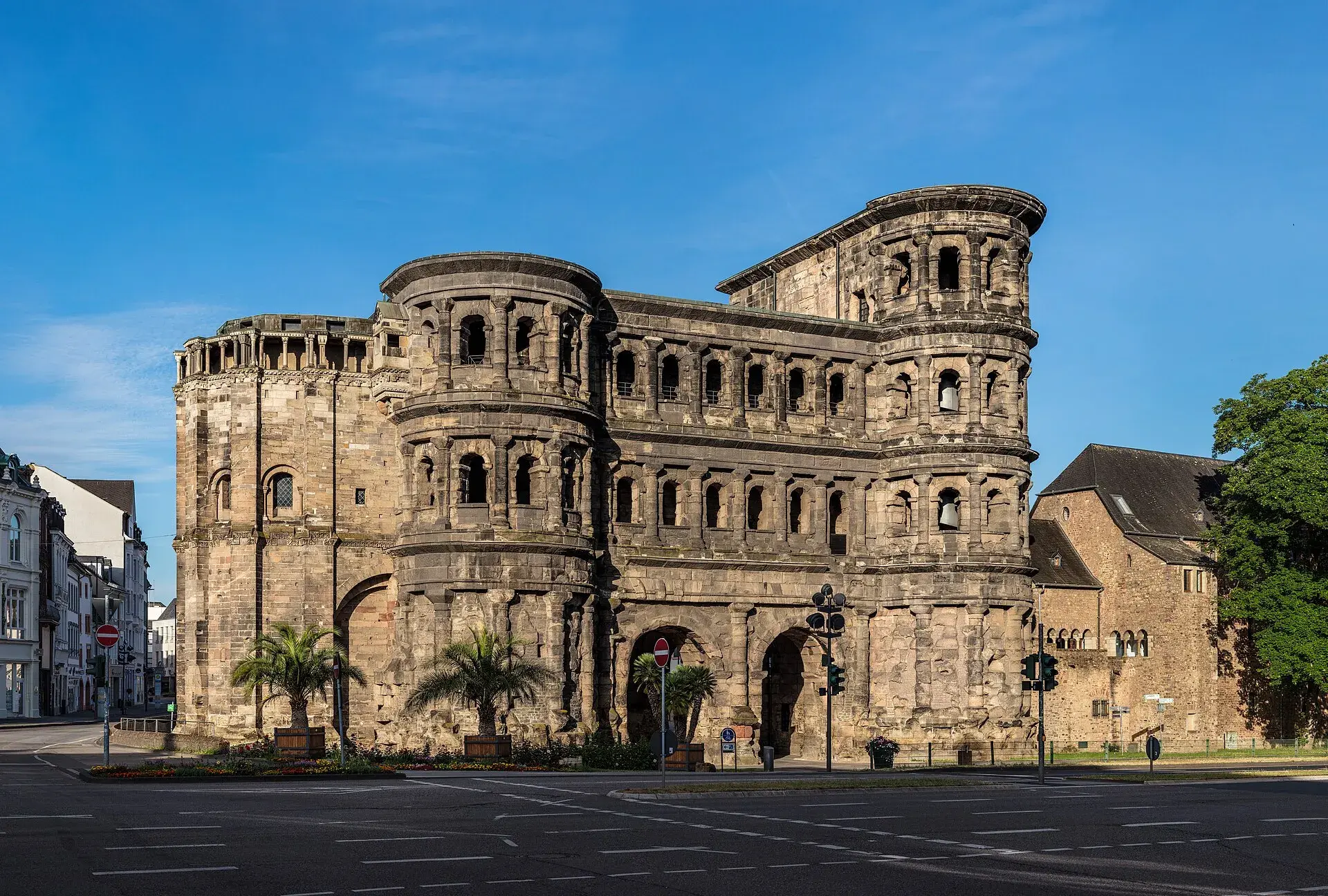
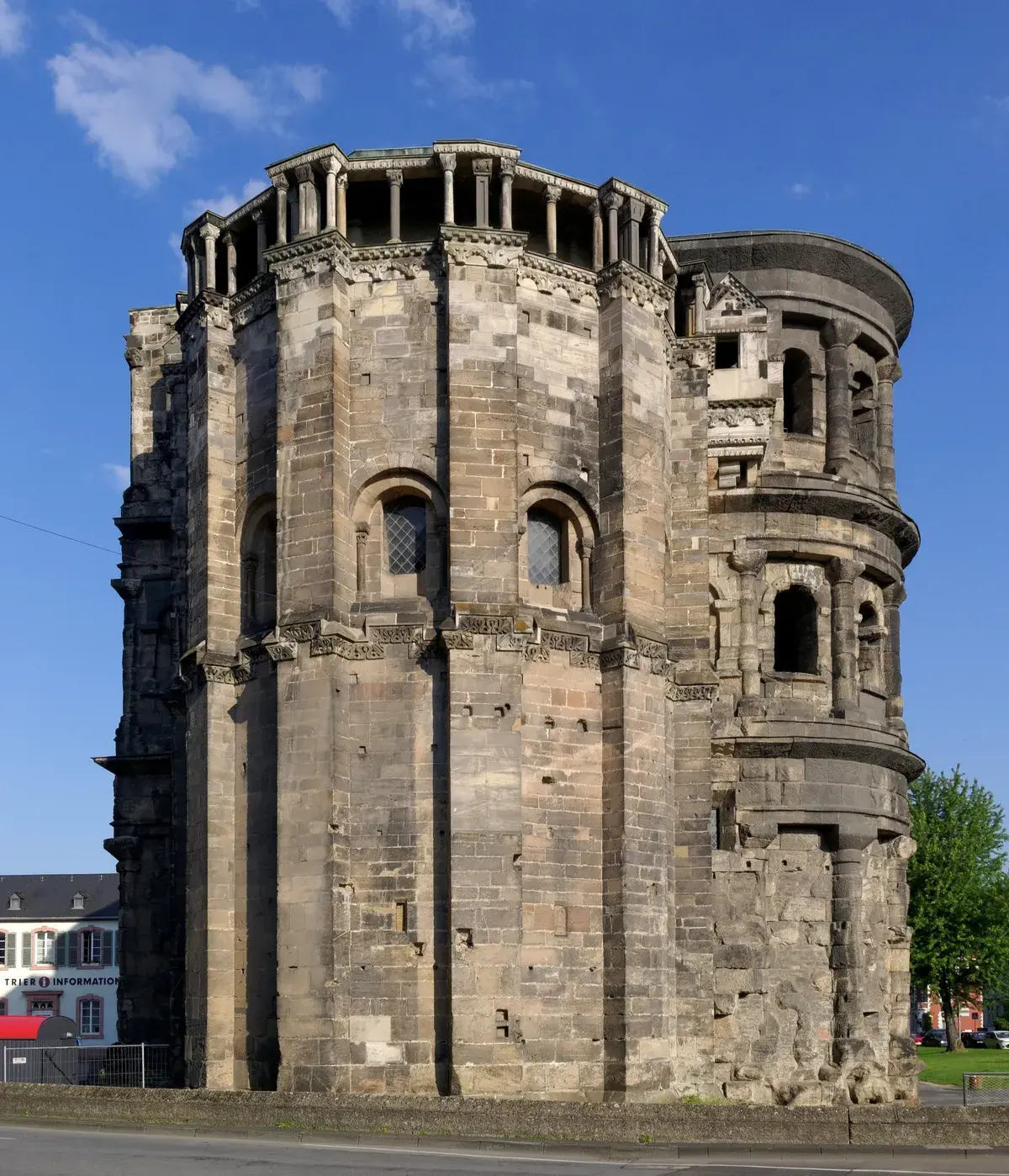
Stop 1: Porta Nigra
Simeonstraße 60. Free to look at, €6 to go inside.
Around 170 AD, Roman masons stacked roughly 7,200 blocks of pale Kordel sandstone with no mortar at all, holding them together with iron clamps set in poured lead. The stone was light coloured. Soot, grime and moss did the rest, and by the Middle Ages the city was calling it the Black Gate.
Look at the joints. The thousands of small rectangular holes are not decay. Metal was scarce in the early Middle Ages, so locals chiselled into the seams and pulled the iron clamps out to re-smelt them.
Open daily, 09:00 to 18:00 April to September, 09:00 to 17:00 in March and October, 09:00 to 16:00 November to February. The plaza is step-free. The upper galleries are reached by steep spiral stone stairs only.
Stop 2: Liebfrauenkirche
Liebfrauenstraße 2. Free. Roughly 8 to 10 minutes from the Porta Nigra, south down the Simeonstraße pedestrian zone and across the Hauptmarkt.
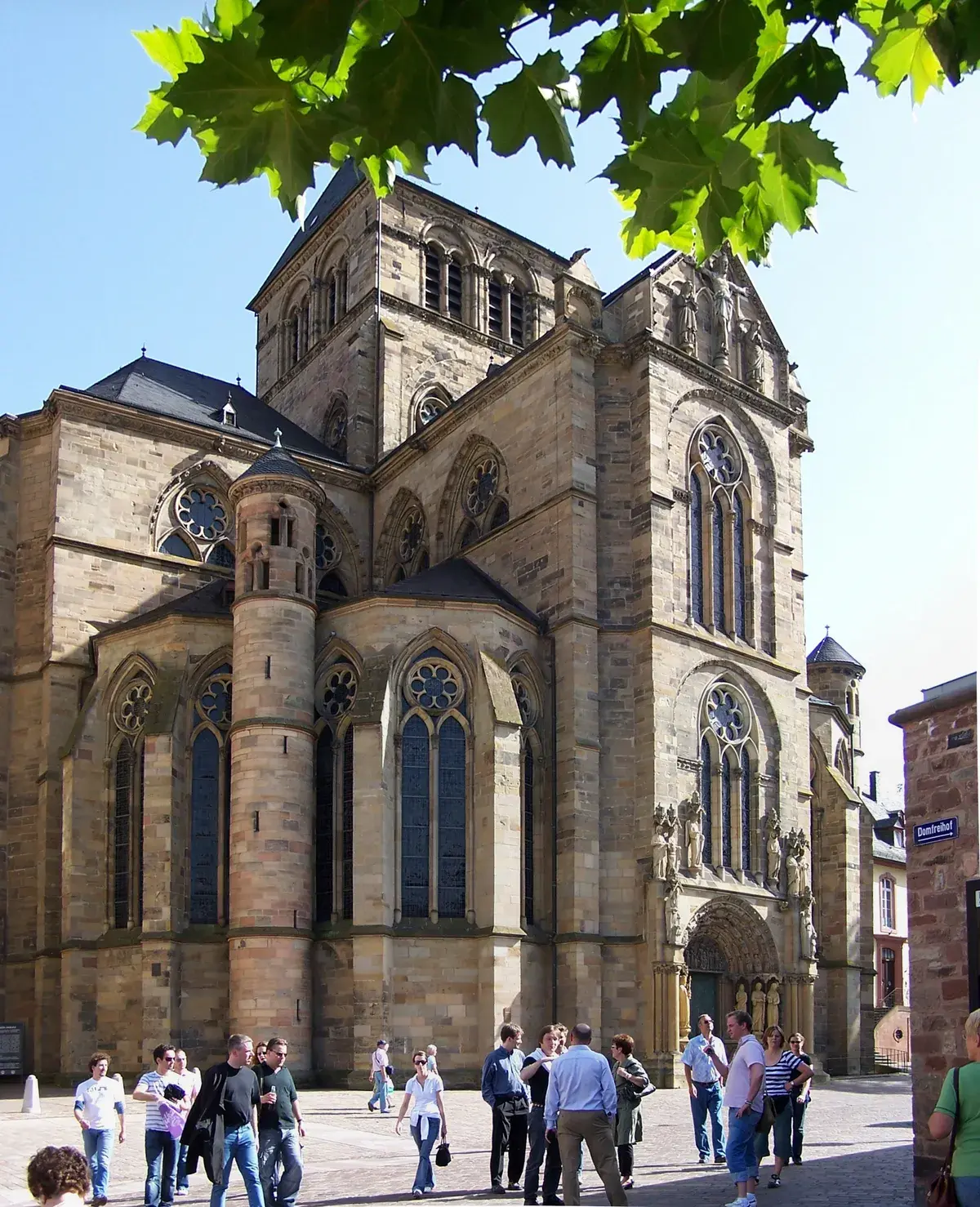
Built between 1230 and 1260, this is the earliest purely Gothic church in Germany. The floor plan is a twelve-petalled cross resting on twelve central columns, and each column carries a fifteenth-century painted fresco of one of the Apostles with his clause of the Creed.
There is a marked stone in the middle of the nave. Stand on it and you can see all twelve columns at once. That is the whole point of the building, and it takes ten seconds to find.
Open daily 10:00 to 18:00, sightseeing restricted during services. Step-free at ground level. Trier Cathedral is directly next door on the same plaza if you have the time.
Stop 3: Konstantin-Basilika
Konstantinplatz 10. Free entry, donations at the door. About 5 minutes from Liebfrauenkirche.
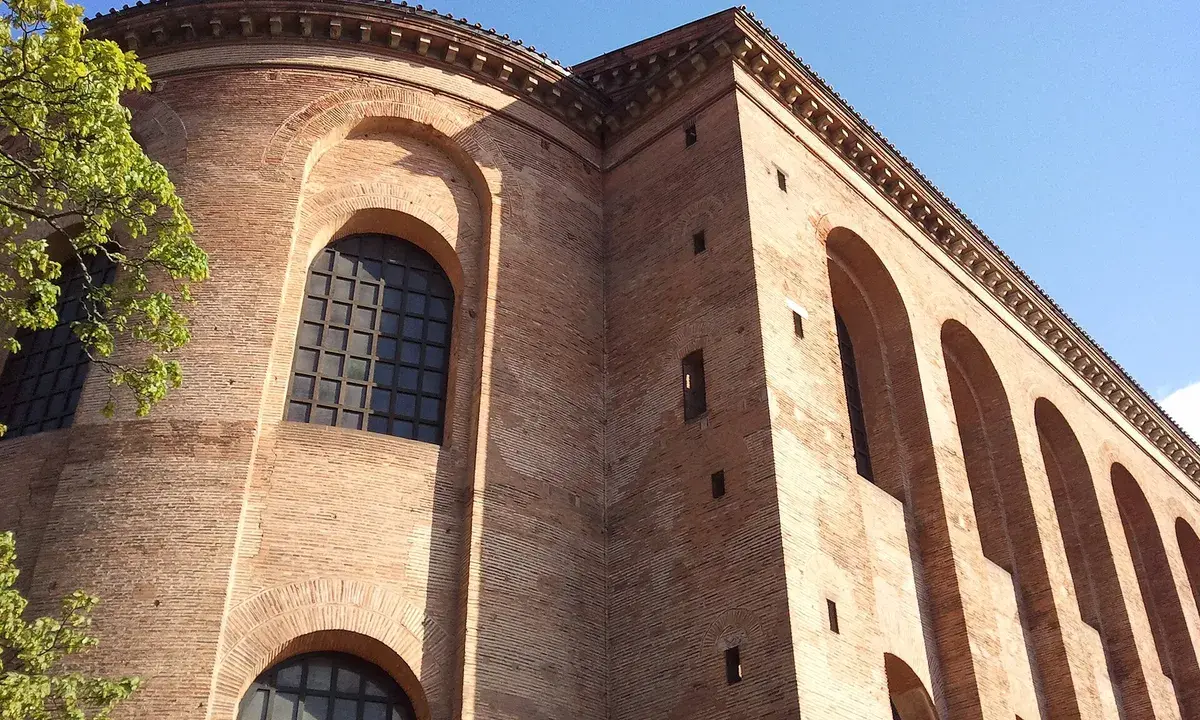
Constantine built this around 310 AD as his audience hall. It is one room, 67 metres long, 27.2 metres wide and 33 metres high, with nothing holding up the ceiling in the middle of it. From outside it reads as a wall of Roman brick with no obvious purpose.
The detail worth knowing is underfoot. Five subterranean furnaces pushed hot air below a double-layered floor and up through hollow terracotta tiles inside the walls. The system was tuned to run hottest at the apse end, so the enthroned emperor sat inside a column of rising warm air while everyone else stood in the cooler half of the room.
Hours vary sharply by season: Mon to Sat 10:00 to 18:00 and Sun 14:00 to 18:00 from April to October, much shorter split hours in winter. Entrance and main hall are fully step-free.
Stop 4: Kurfürstliches Palais and Palastgarten
Willy-Brandt-Platz 1. Park and courtyard free, palace interior closed to visitors. Two minutes from the Basilika, through the shared courtyard.
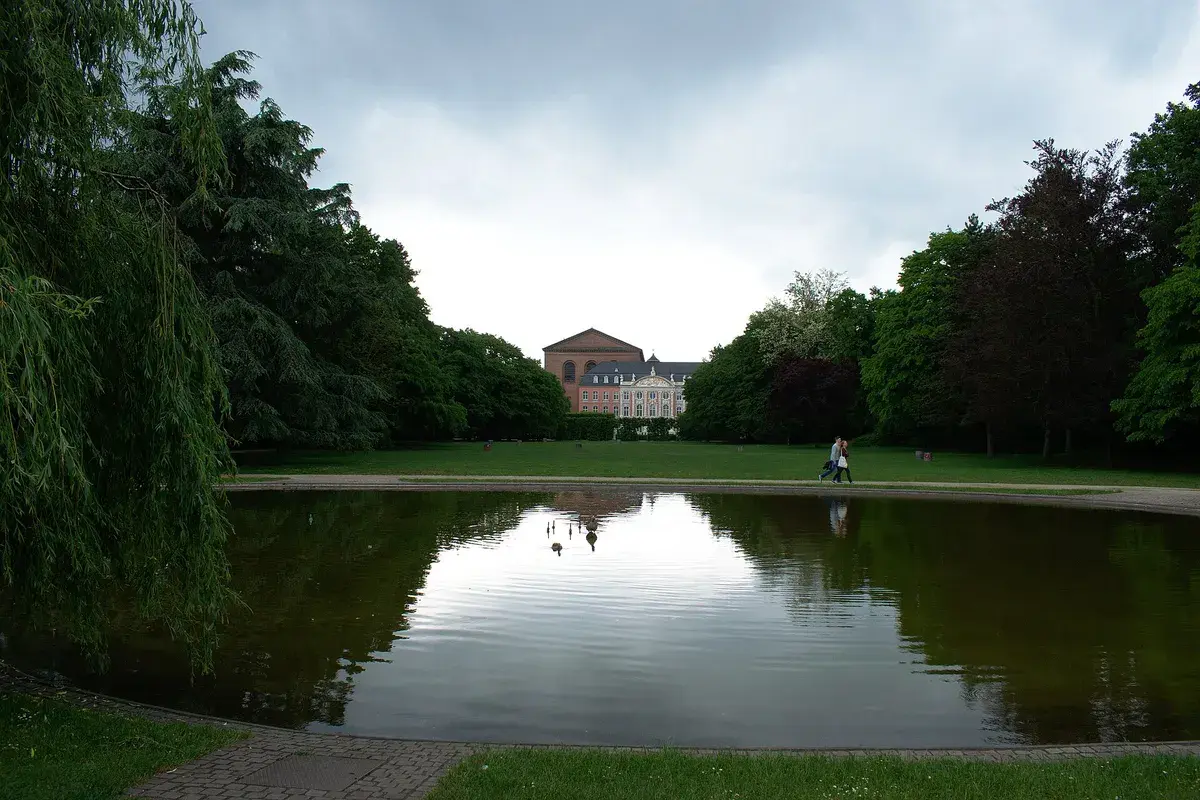
Walk to the junction where the pink Rococo wing meets the Roman brick and you are looking at an argument between two centuries.
In 1614 the Prince-Elector Lothar von Metternich knocked down the western and southern walls of Constantine's hall to build himself a palace on top of it. For over two hundred years the Roman throne room was simply part of the palace. Then between 1844 and 1856 Friedrich Wilhelm IV of Prussia had the western wings pulled off again to rebuild the Roman hall as a garrison church, while ordering the south Rococo wing left standing.
The Palastgarten below is step-free gravel and paving, with benches along the central avenues and a seasonal kiosk with an accessible toilet at the park edge. Allow 20 to 30 minutes if the weather is good.
Stop 5: Rheinisches Landesmuseum
Weimarer Allee 1. €10 adult, €8 reduced, €3 for ages 6 to 17. Five minutes south through the Palastgarten.
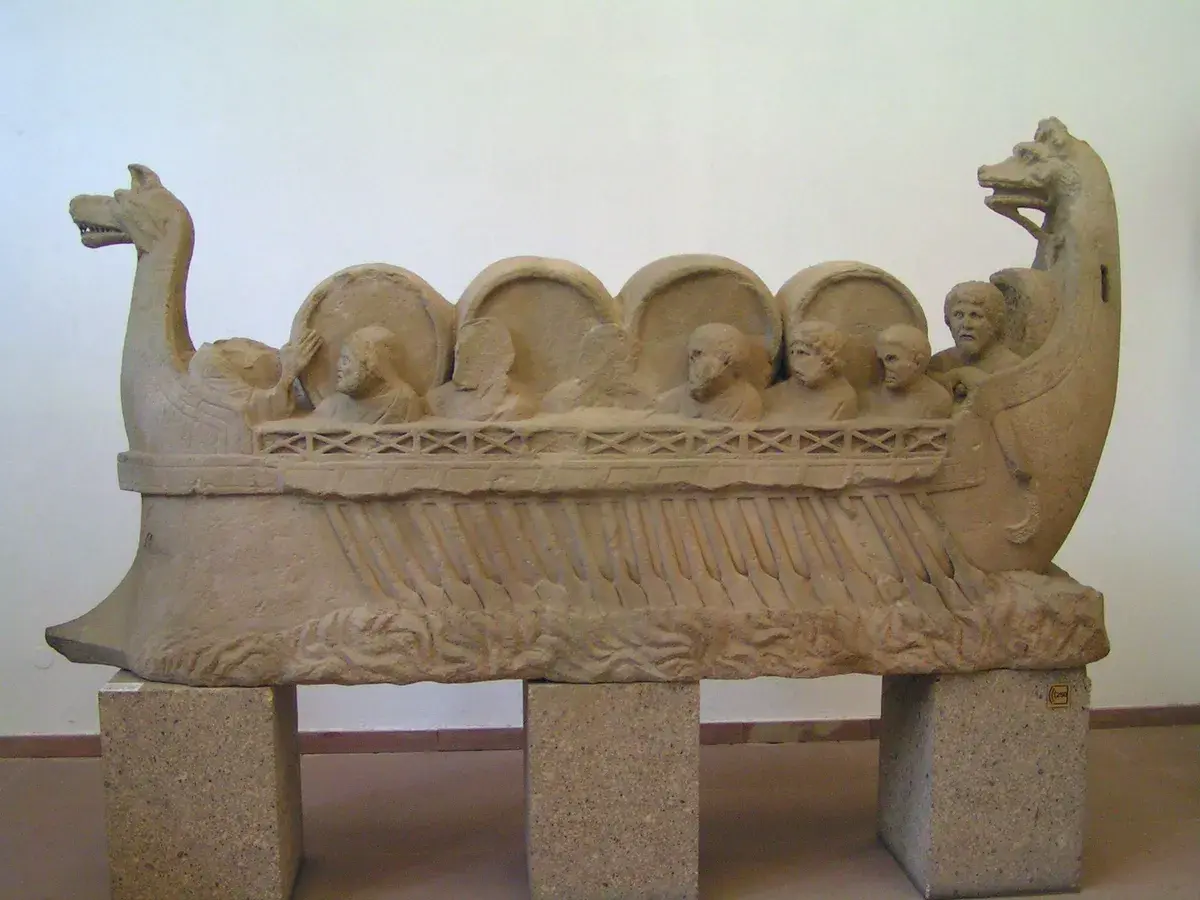
The facade is modern and gives nothing away. Everything is inside, and the single object worth the ticket is the Neumagen wine ship.
Carved around 220 AD and dug up in 1878 at Neumagen-Dhron, it is a tomb monument for a Moselle wine merchant, cut as a river boat loaded with barrels, crewed by 22 oarsmen and two helmsmen. It is the clearest surviving evidence that this valley was moving commercial wine by river in the third century, which it still does.
Tuesday to Sunday, 10:00 to 17:00, last entry 16:30. Closed Mondays. Fully step-free with lifts, lockers and accessible toilets. Budget 90 minutes minimum, up to three hours if you read everything.
Stop 6: Kaiserthermen
Weberbach 41. €6 adult, €5 reduced, €3 child. Three minutes from the museum across the Weimarer Allee junction.
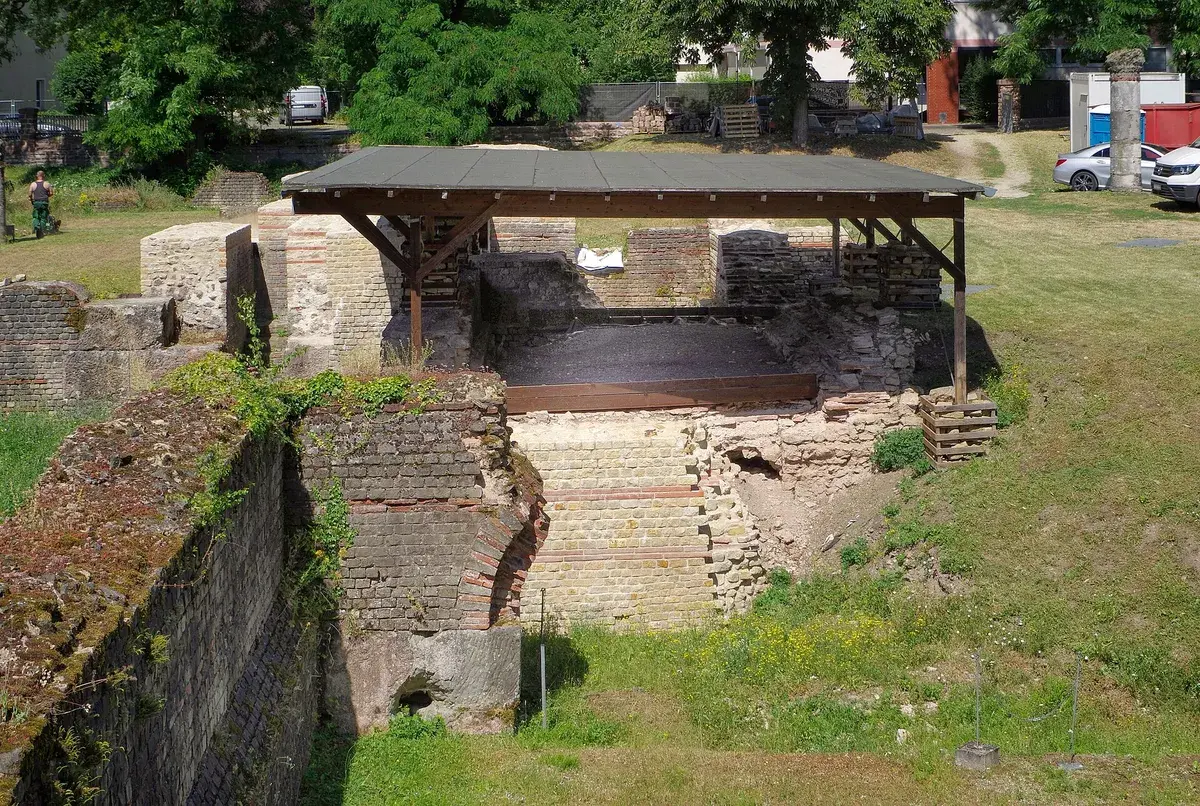
The Imperial Baths are the largest thing on this walk and the strangest. Construction started around 300 AD under Constantius Chlorus and Constantine, on a scale meant to rival anything in the empire. Then in 330 Constantine moved his court to Constantinople and work stopped.
Nobody ever bathed here. Around 360 to 380 AD the emperor Gratian repurposed the shell as cavalry barracks and a guard palace. The piping and pools were stripped out having never been filled.
Go underground. The service tunnels beneath the complex are the reason to buy the ticket. They are also narrow, dimly lit, with stone steps and unpaved floors, and are not passable with a wheelchair or a pushchair. The surface viewing platform is partially accessible.
Stop 7: Barbarathermen
Südallee 48. Free. About 10 to 12 minutes west along the Südallee boulevard.
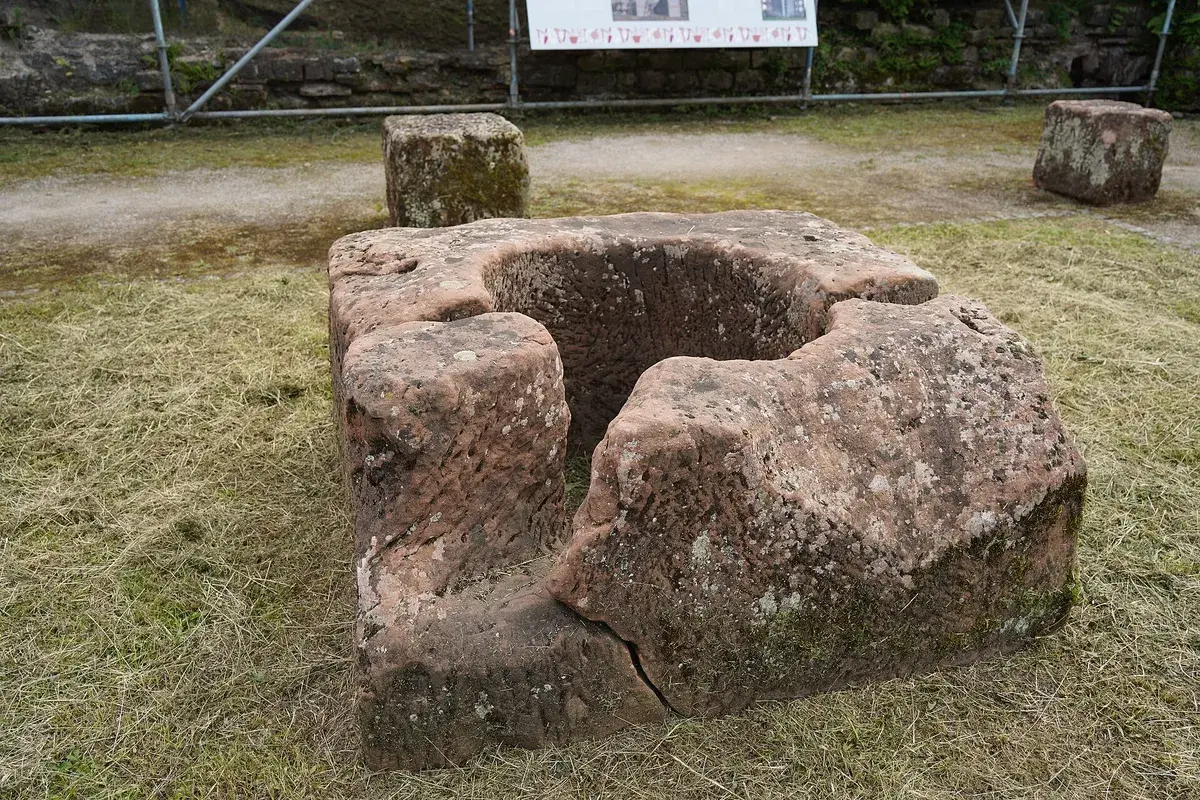
This was the second largest bath complex in the Roman Empire, built around 150 AD across 42,000 square metres. What you see now is foundation walls and the stubs of the hypocaust pillars, viewed from an elevated steel walkway that runs over the site.
It survived largely intact through the Middle Ages. In 1673, during the Franco-Dutch War, French forces under Turenne packed the arches with gunpowder and blew them up so the ruins could not be fortified against them. The fallen stone was then carted off and burned in local kilns for lime.
The walkway is step-free by ramp and is the whole visit, 15 to 20 minutes. There are no toilets on site. It can close at short notice when ice forms on the metal.
Stop 8: Römerbrücke
St.-Barbara-Ufer. Free, open permanently. Seven to eight minutes west, then northwest to the river.
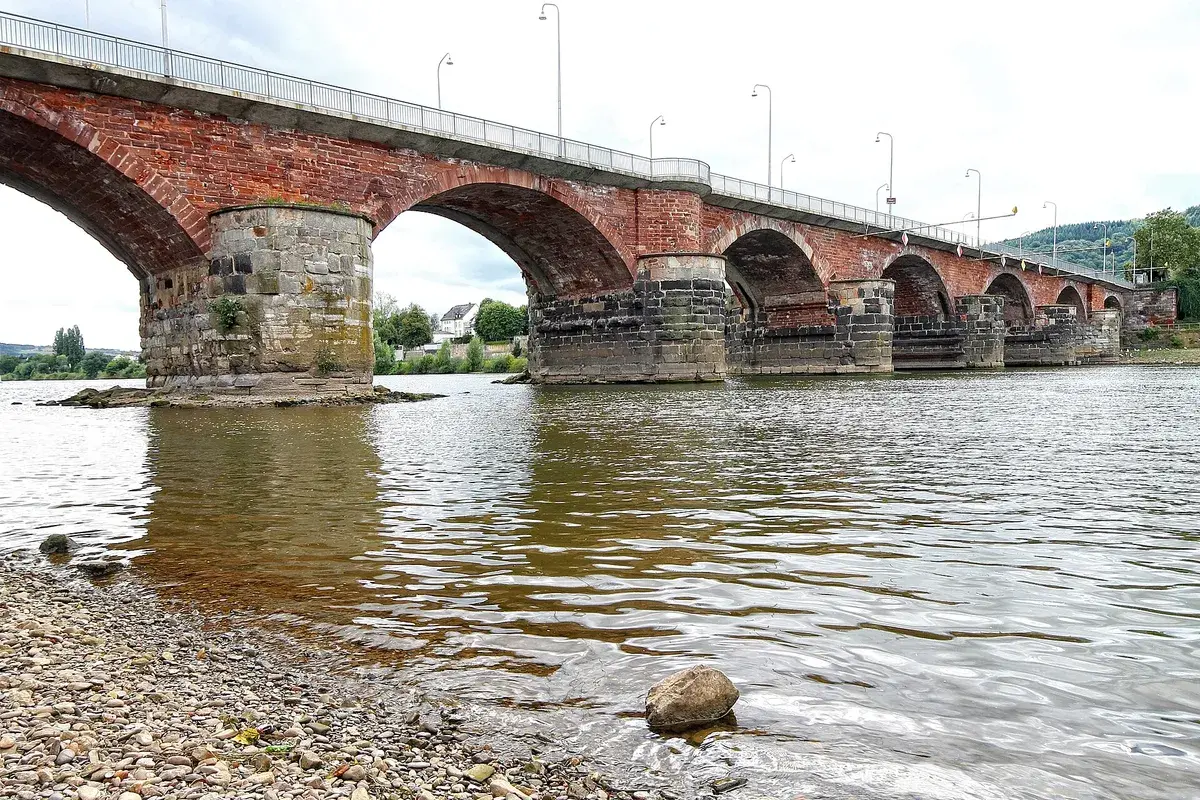
The road deck is modern. The seven dark piers underneath it are not. They were built between 144 and 152 AD from Eifel basalt, anchored on iron-tipped oak piles driven into the riverbed, and they have carried traffic across the Moselle ever since.
They nearly did not survive the twentieth century. On 2 March 1945 the US 10th Armored Division took the bridge intact. German engineers had already packed the piers with demolition charges. Confusion in the chain of command and hesitation from the bridge commander cost them the minutes they needed, and the tanks were across.
View it from the riverbank paths rather than the roadway. Cross at the signalised lights at the bridgehead, because the riverside road is fast.
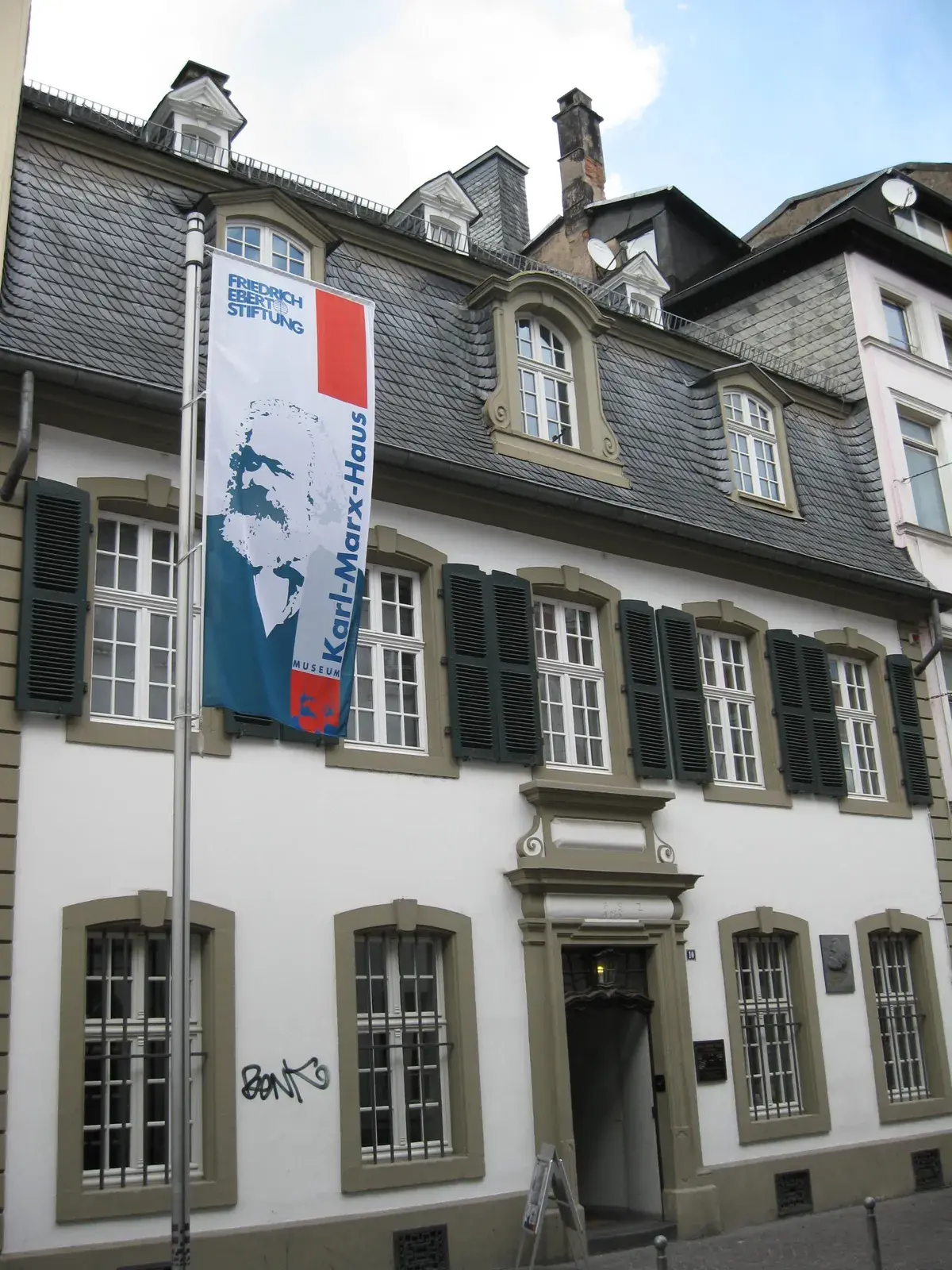
Stop 9: Karl-Marx-Haus
Brückenstraße 10. €7 adult, €5 reduced, €10 family. Ten to eleven minutes east.
Marx was born here on 5 May 1818. The family rented the house and left after fifteen months for Simeonstraße 8, which is why nobody in Trier could say with confidence where the birthplace was for the better part of a century.
An SPD archivist settled it in 1904 by working back through the city's baptismal records to this address. The party bought the building in 1928. In 1933 the SA seized it and ran it as a printing plant for the Nazi paper Nationalblatt. It came back to the SPD after the war and opened as a museum in 1947.
Daily 10:00 to 18:00, closed 13:00 to 13:30 for lunch. Closed Mondays from 15 November to 15 March. Ground floor and courtyard are accessible.
What to pay for, and what to skip
Four of the nine stops are free: Liebfrauenkirche, the Konstantin-Basilika, the Palastgarten and the Barbarathermen. The Römerbrücke is a public road. That is five of nine at no cost.
The other four add up. Porta Nigra €6, Kaiserthermen €6, Landesmuseum €10, Karl-Marx-Haus €7, so €29 to enter everything.
The Antikencard BASIC costs €18 and covers the Landesmuseum plus two Roman monuments. On this route that means the museum, the Porta Nigra and the Kaiserthermen, which is €22 bought separately. It saves a solo adult €4. It covers one adult and up to four children under 18, which is where it becomes genuinely worth it.
The PREMIUM at €28 adds the Amphitheater and the Thermen am Viehmarkt. Both are off this route. Only buy it if you are adding them.
Practical notes
Terrain: flagstones and historic cobbles through the pedestrian zone, which get slippery in rain and rattle small wheels. Compacted gravel in the Palastgarten. A steel mesh walkway at the Barbarathermen. Under 15 metres of elevation change in total.
Three crossings need attention: Weimarer Allee between the museum and the Kaiserthermen, where there is a pedestrian underpass if you prefer it; the Südallee four-lane stretch heading to the Barbarathermen; and the riverside road at the Römerbrücke bridgehead.
Toilets on or near the route: Porta-Nigra-Platz, Simeonstiftplatz 1, the Dom-Information at Liebfrauenstraße 12, the Palastgarten kiosk from April to October, and an automated accessible unit at Weberbach 56 near the Kaiserthermen.
For a stop, Weinstube Kesselstatt at Liebfrauenstraße 10 sits directly opposite the Liebfrauenkirche, has a courtyard garden and serves estate Mosel Riesling, open daily 11:00 to midnight.
Getting there, and getting back
From Trier Hauptbahnhof to the Porta Nigra is 750 metres, nine or ten minutes. Leave the station, cross Bahnhofsplatz and walk west down Theodor-Heuss-Allee. There is no simpler start point in the city.
Luggage lockers are inside the main station concourse near the platform doors, 48 small at €3.50 per 24 hours and 24 large at €5.00, coin operated, accessible during station hours.
Coming back from Karl-Marx-Haus is 1.1 km on foot, about 14 to 16 minutes east and north. Or walk 200 metres to the Karl-Marx-Haus or Neustraße stop and take SWT bus 3, 6 or 83 to the Hauptbahnhof in six to eight minutes.
Start at 09:00 if you can. The Porta Nigra fills between 10:30 and 14:00 with cruise coaches, the Hauptmarkt and Liebfrauenkirche between 11:30 and 15:00, and the Kaiserthermen and museum between 13:30 and 16:00.
When to walk it, and when not to
April to October is straightforward. Roman sites are open until 17:00 or 18:00, the Palastgarten kiosk is running and the gravel paths are dry.
November to February is harder work. Moselle fog and cold drizzle settle in the valley, the Roman monuments close at 16:00, and both the Landesmuseum and Karl-Marx-Haus close on Mondays through the winter. Freezing conditions can shut the Barbarathermen walkway and the Porta Nigra stairs at no notice.
If you are here in winter, start earlier, plan for two indoor stops rather than four, and check opening times the morning you set out.
Frequently asked questions
How long does a self-guided walk through Trier take? Between 1h30 and 2h if you stay outside, and 3h30 to 4h30 if you go into two or three sites. Net walking time is only 50 to 55 minutes. Everything else is looking.
Can you see Trier in an afternoon? Yes, comfortably, if you pick two interiors and treat the rest as exteriors. A 13:00 start still finishes before the Roman sites close in summer.
Do you need to book a guided tour? No. The tourist board's classic 90-minute walk costs €15 per adult and covers the northern half of this route. This route covers more ground and lets you set the pace.
Is the route wheelchair accessible? Mostly. The Porta Nigra plaza, the Basilika, the Palastgarten, the Landesmuseum, the Barbarathermen walkway and the Römerbrücke sidewalks are all step-free. The Kaiserthermen tunnels and the Porta Nigra upper galleries are not.
Do I need to download anything? No. The stop order and addresses above are enough to walk the whole route from any phone. The Ciceru app runs the same nine stops as a self-guided tour with the story and a quiz at each one, plus a free 500 MB global eSIM so you are online before you find WiFi.
Before you go
Nine stops, 4.15 km, roughly two thousand years between the first and the last.
The route above is free and complete. The same nine stops also run as a self-guided tour inside Ciceru, with the story and a quiz question at each one and a free 500 MB eSIM so it works from the moment you arrive.
Walk it in the order above and you will not double back once.