Gemaltes Haus: Graz's Painted House of the Gods
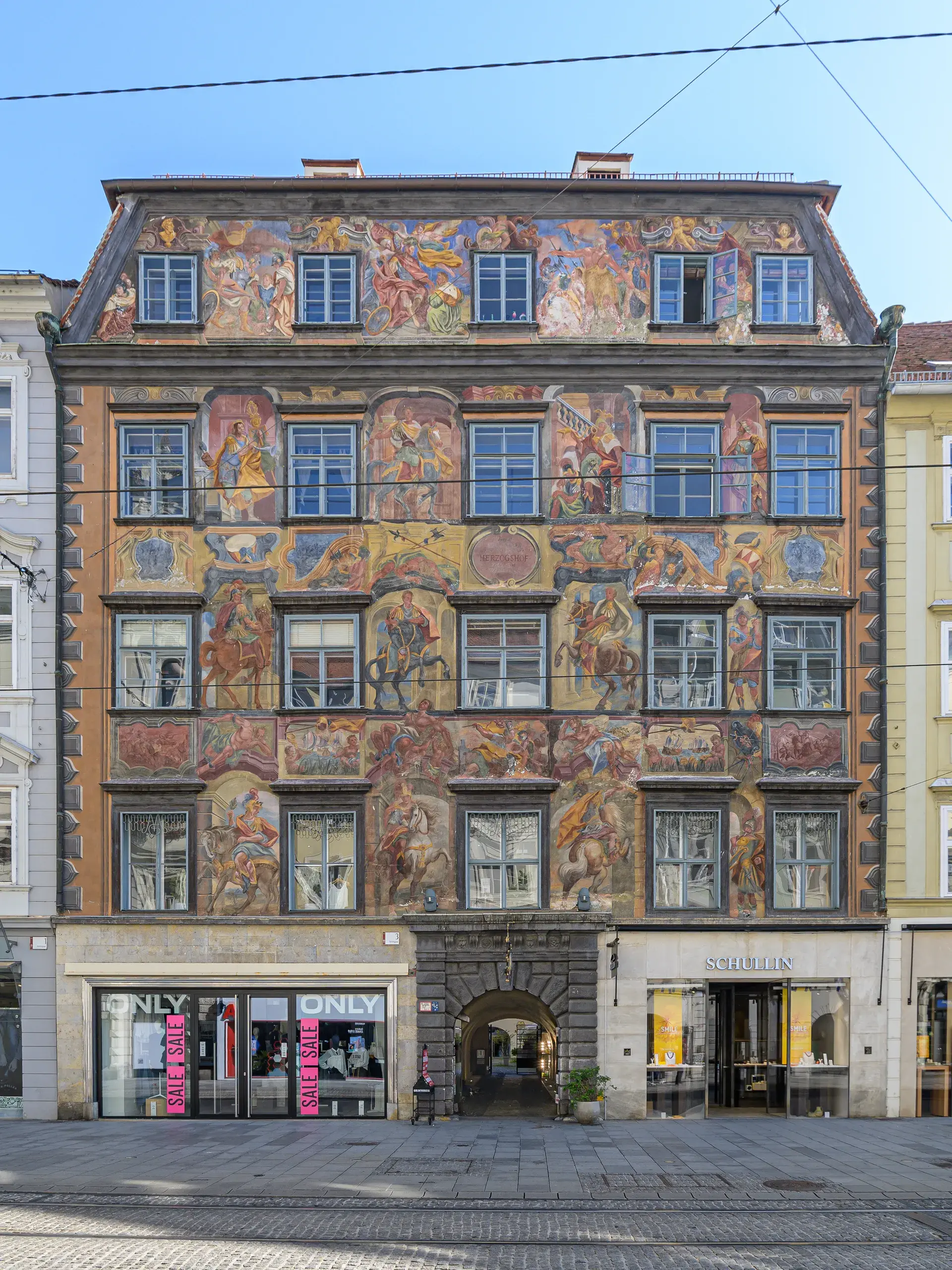
In the heart of Graz's Old Town, a UNESCO World Heritage site, stands the Gemaltes Haus, or "Painted House." Also known as the Herzogshof, this landmark is one of the city's most photographed buildings, celebrated for its entire facade being covered in vibrant frescoes.
A Ducal Administrative Center
The building's history begins in the 14th century. First documented in 1360 as the Herzogshof, it served as the administrative hub for the Dukes of Styria. Here, they conducted official business and granted land to subjects. The building manager was even exempted from taxes in exchange for providing the "Prince's chair" for these proceedings. Its role as a ducal center continued until the completion of Graz Castle around 1450.
A significant historical event took place at the Herzogshof in 1382 when a delegation from Trieste arrived to seek Habsburg protection from Venetian conquest. This appeal was successful, and Trieste remained part of the Habsburg empire until the end of World War I.
A Tale of Two Facades
The building's famous painted exterior has a layered history. The first facade painting was created around 1600 by Giovanni Pietro de Pomis, the court painter for Emperor Ferdinand II and architect of his mausoleum. However, no trace of this original work remains.
In 1742, the building's owner, moneychanger Franz von Lathurner, commissioned an entirely new set of frescoes from the Baroque painter Johann Mayer. Mayer's work completely replaced the earlier paintings by de Pomis. These are the elaborate frescoes visible today, covering over 220 square meters with depictions of Greek and Roman gods and mythological figures. The artwork also includes illusionistic architectural painting to create the impression of columns and cornices, a feature that makes it unique in Austria. For a long time, the identities of many figures in the frescoes were forgotten and have only been re-identified in recent years.
The Gemaltes Haus Today
Today, the Gemaltes Haus stands as a prominent landmark embodying Graz's rich artistic history and its evolution from a medieval center to a Baroque city. Beyond its artistic significance, the building is a lively part of the city, housing a traditional Styrian tavern that serves as a popular meeting point for both locals and tourists.
FAQ
What are the paintings on the Gemaltes Haus?
The paintings are Baroque frescoes from 1742 by artist Johann Mayer. They depict various Greek and Roman gods and mythological figures across the entire facade, which covers over 220 square meters.
How old is the Gemaltes Haus?
The building, originally known as the Herzogshof, was first documented in 1360. The current frescoes that give it its famous appearance were painted in 1742.
Who painted the Gemaltes Haus?
The current vibrant frescoes were painted in 1742 by the Baroque artist Johann Mayer. An earlier painting from 1600 by Giovanni Pietro de Pomis was completely painted over and no longer exists.
What is inside the Gemaltes Haus now?
Today, the Gemaltes Haus houses a traditional Styrian tavern, making it a meeting point for locals and tourists who can appreciate its artistic facade and traditional hospitality.