Mausoleum of Emperor Ferdinand II in Graz
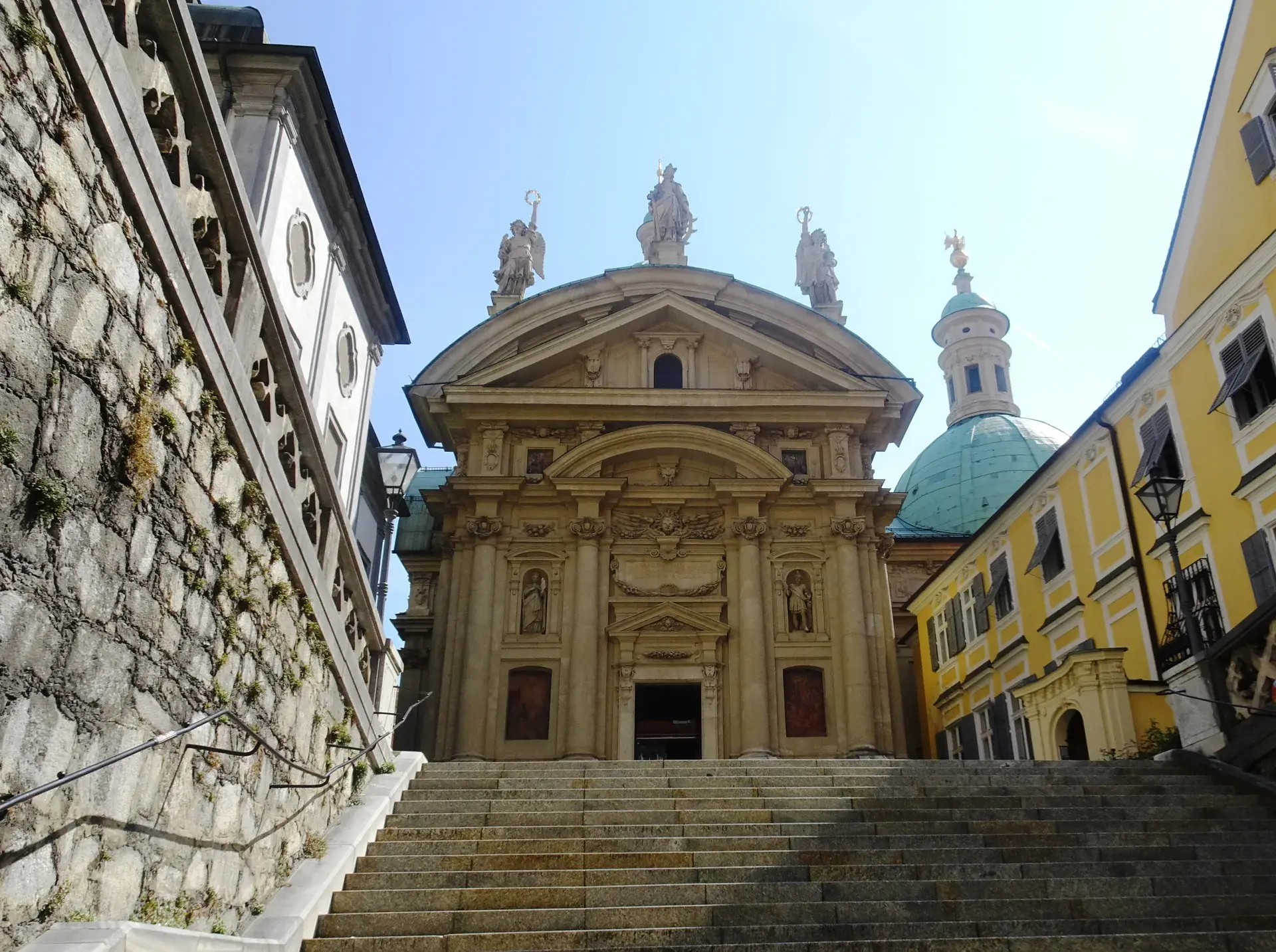
The Mausoleum of Emperor Ferdinand II is a monumental sacral building in Graz, forming a key part of the city's UNESCO World Heritage Historic Centre. Commissioned in 1614 by the future Holy Roman Emperor, its grand exterior hints at the opulent decoration and complex history contained within its walls.
A Monument to the Counter-Reformation
Construction of the mausoleum began in 1614 under Archduke Ferdinand II, a staunch defender of Catholicism. Born and educated by Jesuits in Graz, Ferdinand sought to create a dynastic burial site and a powerful symbol of the Catholic Counter-Reformation in Inner Austria. His policies, which included revoking religious freedom for Protestants, were a contributing factor to the outbreak of the Thirty Years' War.
A Century of Construction
The initial design was created by Italian court artist Giovanni Pietro de Pomis, who infused the project with Southern Mannerist style. The exterior was largely complete by the 1630s. However, construction slowed dramatically after Ferdinand was elected Holy Roman Emperor in 1619 and moved his court to Vienna. He was buried in the still-unfinished mausoleum in 1637.
Decades later, Ferdinand's grandson, Emperor Leopold I, commissioned the completion of the interior. From 1687, the celebrated Austrian Baroque architect Johann Bernhard Fischer von Erlach designed and executed the lavish interior decorations. His work, considered among his earliest documented projects, includes magnificent stucco, frescoes, and luxurious altars. The entire complex was finally consecrated in 1714.
Architectural and Funerary Curiosities
The mausoleum is an architectural masterpiece, transitioning from late Renaissance to early Baroque styles. It features an oval dome over the burial chapel, an innovation that was the first of its kind to be built outside of Italy. The adjacent St. Catherine's Church contains frescoes glorifying Emperor Leopold I and the liberation of Vienna from the Turks in 1683.
Inside the crypt, the burial arrangements are surprising. Despite commissioning the grand structure for himself, Emperor Ferdinand II's remains are marked by a simple tablet on the wall. In stark contrast, a highly ornate red marble sarcophagus holds the remains of his mother, Maria of Bavaria. This sarcophagus, featuring sculpted figures of both of Ferdinand's parents, is considered one of the crypt's most valuable elements, although his father is buried elsewhere. Furthermore, a special 'heart crypt' contains the embalmed hearts of Ferdinand II and other Habsburg family members.
The Mausoleum Today
Today, the Mausoleum of Emperor Ferdinand II is an active religious site and a significant historical monument. It is a key part of Graz's 'Stadtkrone' (Crown of the Town), an architectural ensemble that includes the Cathedral, the Burg, and the Old University. As a popular attraction, it offers a glimpse into Graz's rich imperial past and its enduring cultural legacy.
FAQ
Who is buried in the Mausoleum of Emperor Ferdinand II?
The mausoleum crypt contains the remains of Emperor Ferdinand II, his mother Maria of Bavaria, his second wife Eleonora Gonzaga, and other members of the Habsburg family. Ferdinand II is buried beneath a simple wall plaque, while his mother has a very ornate sarcophagus.
Why did the Mausoleum take 100 years to build?
Construction began in 1614 but slowed significantly after Ferdinand II became Holy Roman Emperor in 1619 and moved to Vienna. He was buried in the unfinished structure in 1637. Work on the opulent interior did not resume until 1687, with the complex finally being completed in 1714.
What is the architectural style of the Mausoleum?
The mausoleum is a pivotal example of the transition from late Renaissance to early Baroque styles. The exterior, designed by Giovanni Pietro de Pomis, shows Italian Mannerist influences, while the later interior by Johann Bernhard Fischer von Erlach is a masterpiece of Austrian Baroque.
Is Emperor Ferdinand II's heart in the mausoleum?
Yes, but separately. A special 'heart crypt' (Herzgrüftl) behind the main crypt contains the embalmed hearts of Emperor Ferdinand II, his mother Maria of Bavaria, and other Habsburgs. His body is in the main crypt, while his heart was kept separately, a practice not uncommon for the Habsburgs.