Annasäule: Innsbruck's Historic St. Anne's Column
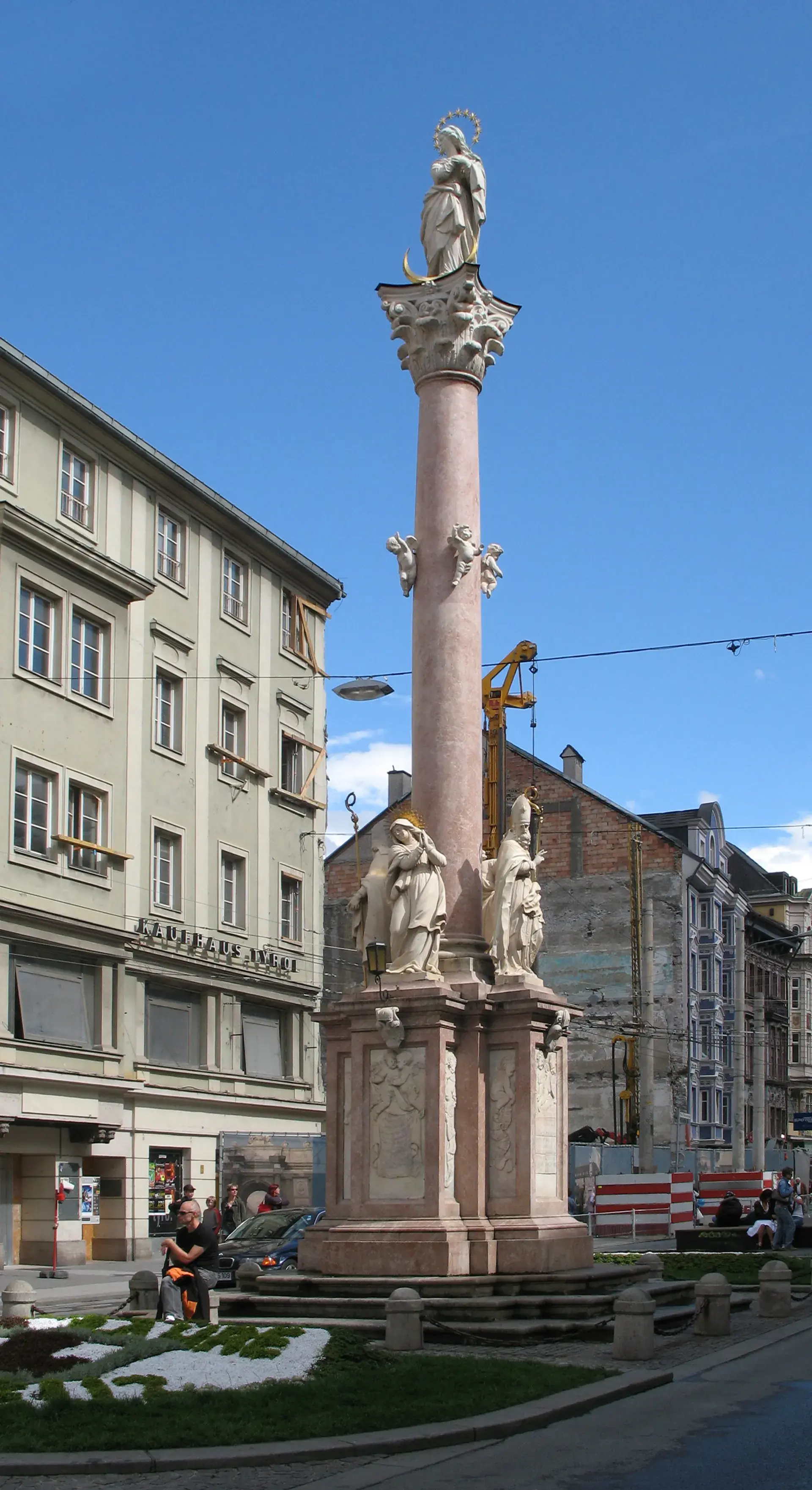
Standing proudly on Innsbruck's bustling Maria-Theresien-Straße, the Annasäule, or St. Anne's Column, is a significant historical landmark. This Baroque monument, crafted from red marble, commemorates a pivotal moment in Tyrolean history and serves as a central point in the city's public life.
A Monument to Liberation
The column's origin lies in the War of the Spanish Succession. In June 1703, Bavarian forces led by Elector Max Emanuel occupied Innsbruck. However, Tyrolean troops successfully drove out the invaders on July 26, 1703—the feast day of Saint Anne. This event is known as the “Boarischer Rummel” or Bavarian turmoil.
In gratitude for this liberation, the Tyrolean Estates vowed in 1704 to erect a monument. The Annasäule was subsequently consecrated on St. Anne's Day, July 26, 1706, by Prince-Bishop Kaspar Ignaz. It stands as a testament to the region's resilience and religious devotion.
Design and Symbolism
Designed by Trentino sculptor Cristoforo Benedetti, the column is made from red Kramsach marble and stands approximately 13 meters (42 feet) tall. Contrary to what its name might suggest, the column is crowned not by St. Anne, but by a statue of the Virgin Mary as the Woman of the Apocalypse (Maria Immaculata). This statue symbolically gazes north, towards Bavaria, the direction of the expelled invaders.
At the column's base, there are four statues of saints. Saint Anne, the monument's namesake, is one of them, positioned on the north side and also looking towards Bavaria. The other saints are St. George (patron saint of Tyrol), St. Cassian (patron of the Diocese of Brixen), and St. Vigilius (patron of the Diocese of Trent).
Preservation and Present Day
Over the centuries, the original statues have been replaced to protect them from the elements. In 1958, the original Virgin Mary statue was substituted with a replica by Franz Roilo; the original is now preserved at Fiecht Abbey. Similarly, the four saints on the base were replaced with replicas in 2009, and the originals were moved to the Altes Landhaus in Innsbruck.
Today, the Annasäule is a focal point on Maria-Theresien-Straße. It is a popular spot for photography, with the Nordkette mountains providing a stunning backdrop. The area serves as a gathering place for residents and tourists, hosting celebrations, public debates, and even protests.
FAQ
Why is it called St. Anne's Column if the Virgin Mary is on top?
The monument is named the Annasäule (St. Anne's Column) because it commemorates the liberation of Tyrol from Bavarian troops on St. Anne's Day, July 26, 1703. While the Virgin Mary crowns the column, a statue of St. Anne is prominently featured on its base.
What event does the Annasäule commemorate?
The Annasäule commemorates the withdrawal of Bavarian troops from Tyrol on July 26, 1703, during the War of the Spanish Succession.
Where are the original statues from the Annasäule?
The original statue of the Virgin Mary is preserved at Fiecht Abbey. The original statues of the four saints from the base (Anne, George, Cassian, and Vigilius) are located in the Altes Landhaus in Innsbruck.
When was St. Anne's Column in Innsbruck built?
The Tyrolean Estates vowed to build the monument in 1704. It was erected and consecrated on July 26, 1706.