Golden Roof Innsbruck: Imperial History & Gilded Tiles
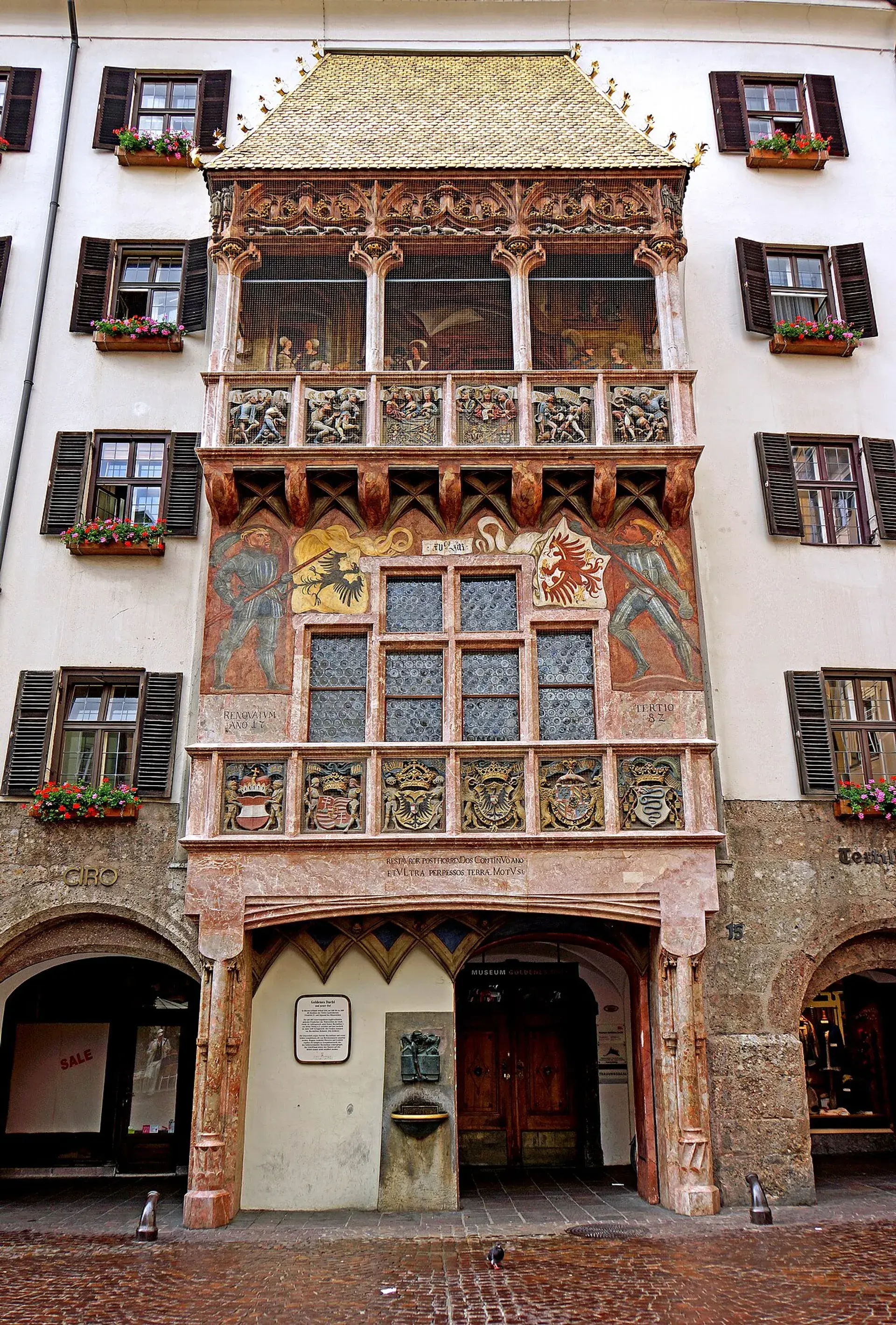
In the heart of Innsbruck's Old Town, the Golden Roof (Goldenes Dachl) stands as the city's most famous landmark, a glittering symbol of imperial power. From the street, its 2,657 fire-gilded copper tiles dazzle onlookers, reflecting the legacy of Emperor Maximilian I.
An Imperial Balcony
The building, known as the Neuhof, was first constructed around 1420 by Duke Frederick IV as a residence for Tyrolean princes. Between 1497 and 1500, Emperor Maximilian I commissioned the addition of the magnificent oriel, or bay window, and its iconic roof. This lavish extension served as a royal box, allowing the emperor and his court to observe tournaments, festivals, and other events held in the square below while showcasing his wealth and influence.
Architectural Splendor
The Golden Roof is a masterpiece transitioning between late Gothic and early Renaissance styles. The ornate oriel, 16 meters wide, was designed by master builder Nikolaus Türing the Elder. Its roof, rising 3.7 meters, is covered in thousands of gilded copper shingles. The vibrant frescoes that adorn the structure are attributed to Jörg Kölderer, Maximilian I's court painter.
Stories in Stone and Code
The reliefs on the oriel are rich with symbolism. They depict Emperor Maximilian I strategically positioned between his two wives, Mary of Burgundy and Bianca Maria Sforza, a diplomatic gesture to honor the alliances from both marriages. Other reliefs show court jesters and Morisco dancers performing acrobatic movements, though the exact origins of this dance remain a historical mystery. Hidden within the design, a banderole contains a coded Latin inscription from the Gospel of John, which translates to: “I am the light of the world. He who follows me will not walk in darkness, but he will have the light of life, says the Lord.”
From Neglect to Landmark
After Maximilian's reign, the building's significance faded. It served various functions, including as an administrative building and even a barracks, with its historical importance largely unrecognized. It was not until the rise of tourism in the late 19th century that the Golden Roof was rediscovered and celebrated as a key historical site, cementing its status as a symbol of Innsbruck.
The Golden Roof Today
Today, the Golden Roof is a central point in Innsbruck's pedestrian zone, drawing thousands of visitors. The building houses the Golden Roof Museum, which was redesigned in 2019 to focus on the life and times of Emperor Maximilian I. The museum also displays six of the original reliefs from the oriel, which were replaced with copies on the exterior in 1952 for preservation. The building is also home to the International Alpine Convention's Office, and the square below continues to host public events like the annual Christmas market.
FAQ
Why was the Golden Roof built?
Emperor Maximilian I commissioned the Golden Roof around 1500 as a lavish royal box. It allowed him and his court to watch festivals and tournaments in the square below, serving as a public display of his imperial power and wealth.
Are the tiles on the Golden Roof made of real gold?
The roof is covered with 2,657 fire-gilded copper shingles. While they are not solid gold, they are coated in gold, giving the roof its famous glittering appearance.
What is inside the Golden Roof building today?
The building houses the Golden Roof Museum, which focuses on Emperor Maximilian I. It also contains the office for the International Alpine Convention. The original reliefs from the oriel are displayed inside the museum for protection.
Who is depicted on the reliefs of the Golden Roof?
The reliefs feature Emperor Maximilian I alongside his two wives, Mary of Burgundy and Bianca Maria Sforza. They also show court jesters and Morisco dancers.