Triumphal Arch
Standing as a grand entrance to Innsbruck's bustling Maria-Theresien-Straße, the Triumphal Arch is a unique monument that tells a story of both celebration and sorrow.…

Tips and tours for explorers and travellers
Ciceru's Innsbruck route runs Maria-Theresien-Straße through the Triumphal Arch into the Altstadt, past the Golden Roof's 2,657 gilded copper tiles and the Helbling Haus stucco front, to the Hofburg and the Hofkirche, where 28 bronze figures guard Emperor Maximilian I's empty tomb.
The stops
Our one Innsbruck route stays inside the Altstadt and imperial quarter: Maria-Theresien-Straße and the Triumphal Arch, the Golden Roof and Helbling Haus, then the Hofburg, Hofkirche and Hofgarten around Rennweg. It runs about two hours on foot, all ten stops within a few streets of each other.
Standing as a grand entrance to Innsbruck's bustling Maria-Theresien-Straße, the Triumphal Arch is a unique monument that tells a story of both celebration and sorrow.…
Standing proudly on Innsbruck's bustling Maria-Theresien-Straße, the Annasäule, or St. Anne's Column, is a significant historical landmark. This Baroque monument, crafted from red…
Innsbruck’s Stadtturm, or City Tower, stands as a historic sentinel in the heart of the Old Town. Constructed in the mid-15th century, this medieval tower with its distinctive…
In the heart of Innsbruck's Old Town, the Golden Roof Goldenes Dachl stands as the city's most famous landmark, a glittering symbol of imperial power. From the street, its 2,657…
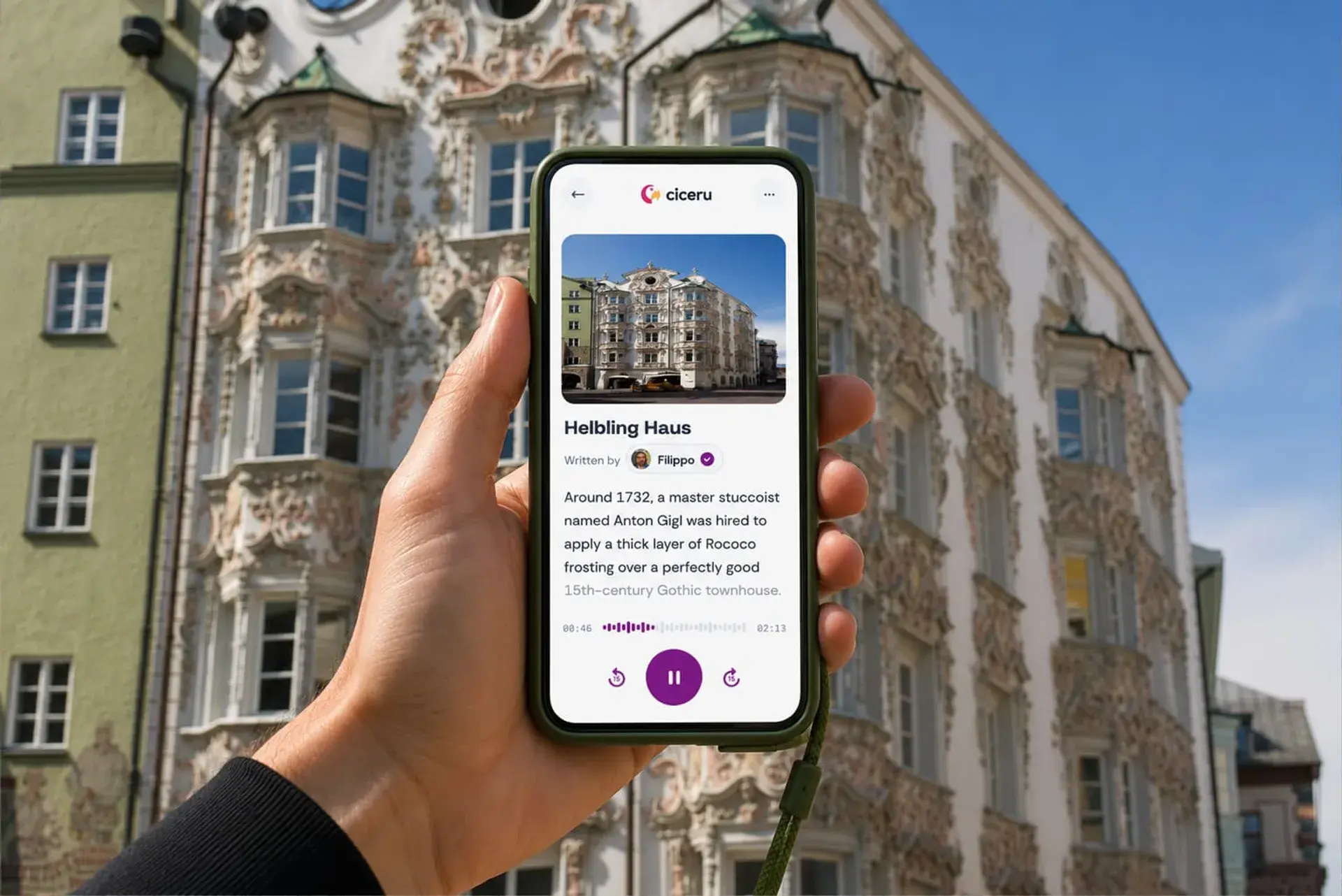
In the heart of Innsbruck's Old Town stands the Helbling Haus, a dazzling example of the artistic flair that defined the city's prosperity. Its glittering Rococo stucco facade…
In the heart of Innsbruck's Old Town, adjacent to the Goldenes Dachl, stands the stately Palais Claudiana. This historic landmark, also known as the Old Government Building,…
Dom St. Jakob, also known as the Cathedral of St. James, stands in Innsbruck as an imposing 18th-century Baroque masterpiece, its grand exterior hinting at the imperial reverence…
Your private guide, in your pocket
from
€7.00
1 self-guided tour in Innsbruck
Plan the days
Start in the historic centre, cross the Inn and use IVB for the valley routes before the weather changes on the mountain side.
€7.00 →Weather & crowds
May and June trade summer's crowds for its rain: July and August bring 121 to 135mm a month, more than double any winter figure. December to February stay cold, nights average -3.8°C, but the Altstadt empties and the Christkindlmarkt runs to 6 January. Snow can linger on the Nordkette into April.
-4–5°C/ 25–41°F
Don't miss
Christkindlmarkt (mid-November to 6 January)
Four Hills Tournament ski jumping, Bergisel (early January)
4–16°C/ 40–61°F
13–24°C/ 55–76°F
Don't miss
Innsbrucker Tanzsommer dance festival (July)
7–18°C/ 45–65°F
1–9°C/ 33–49°F
Transport
Innsbruck Airport (INN)
| Bus F to Hauptbahnhof (IVB) | 20 min | €3.30 |
|---|
Munich Hbf
| EC/Railjet train (DB/ÖBB) | 1h50-2h10 | €19.99 |
|---|
Munich Airport (MUC)
| FlixBus direct to Innsbruck | 1h25 min+ | €14.48 |
|---|
The Altstadt is car-free and every stop on our route sits within a 10-minute walk of the Golden Roof. The only climb is north towards the Hungerburgbahn valley station.
A single fare is €3.30 and a 24-hour ticket is €7.30, cheaper than three single trips. Trams 1 and 3 link Hauptbahnhof, Wilten and the Hungerburgbahn valley station.
The Hungerburgbahn funicular from the centre connects to the Seegrubenbahn and Hafelekarbahn cable cars. A Hungerburg-only return is €14.00; the full climb to Hafelekar is €56.00 return.
Innsbruck taxis charge a flat €8.25 city-zone fare for the first kilometre, then €2.15 a kilometre. Night, Sunday and holiday fares raise that zone fare to €10.50.
The Altstadt is a pedestrian zone and the city tells visitors to use public transport or Park and Ride instead of driving in. Parking charges and zones change again on 2 November 2026.
Walk the Altstadt, buy IVB's 24-hour ticket for everything else, and ride the Hungerburgbahn up the Nordkette. Leave a rental car at the Park and Ride: the old town is closed to traffic.
Budget
Coffee, beer and a Tagesteller lunch stay reasonable for an Alpine capital: from €2.90 for a small coffee and from €10.50 for a set lunch. The Aufenthaltsabgabe adds €4.00 per person per night on top of your room, raised from €3.00 on 1 May 2026, and the Nordkette cable cars are the real expense at up to €56.00 return.
| Coffee at a cafe | €2.90–€4.20 |
|---|---|
| Weekday lunch (Tagesteller) | €10.50–€18.00 |
| Draught beer, 0.3 to 0.5l | €3.90–€4.80 |
| IVB single transport ticket | €3.30 |
| IVB 24-hour ticket | €7.30 |
| Taxi across the centre | ~€8.25–~€13.00 |
| Taxi from the airport | ~€13.00–~€18.00 |
| Aufenthaltsabgabe, per person per night | €4.00 |
Cards and contactless work in cafes, restaurants and on IVB ticket machines. Carry small change for Christkindlmarkt stalls in December and for older Gasthäuser in Wilten that still prefer cash. Taxis in the official zone tariff take cards too, though it is worth confirming before the ride.
Where to stay
Every stop on our route, the Golden Roof, Hofburg and Hofkirche, sits inside this pedestrianised core. Rooms are the priciest in the city and bars on Herzog-Friedrich-Straße run loud into the night.
South of the centre around the Wilten Basilica, on tram lines 1 and 3 into the Altstadt. Cheaper than the old town, but it is a 20-minute walk or a tram ride from the sights, not a stroll.
Tree-lined streets on the edge of the Hofgarten, built up for Innsbruck's middle class a century ago. Few restaurants of its own, so evenings mean a 15-minute walk into the Altstadt.
Across the Inn river at the base of the Hungerburgbahn, with Alpine views the Altstadt cannot match. It is hilly, and every trip into the centre means the funicular or a bus down.
The tours
 Filippo Anzivino
Scratch to win
Something good might be under there. If you win, we'll show you how to use it.
One prize per traveller. Good for 2 years.
Word of mouth

Fabulous walking tour around the main areas of Dubrovnik old city.we were able to stop and listen as many times as we needed as there was also written information too
Karen Baker
A great way to discover the hidden gems in Sorrento. It provides history, cultural context and a flavour of the place. We would have missed so much had we wandered round without this valuable guide. Thank you for the research and information.
alison rye
This was a good tour. I used the Spanish tour to practice my Spanish and it was helpful because you could slow it down and listen to it multiple times. This tour is what it says it will be
Lily
Macht Spaß! Toll, im eigenen Tempo zu den verschiedenen Sehenswürdigkeiten zu schlendern.
Cécile Blumenbär
Cute and informative tour of several athenian landmarks
Ginny Glezou
Merci pour ce bel après-midi à Weimar en votre compagnie. Belle expérience, merci!
Helene Cazals
All very well written and illustrated. Perhaps some of the 'history' was a little 'contrived', i.e. the successes and achievements of the certainly key protagonists slightly embellished, and the selection of a distinctly pedestrian monument to Otto, the second last, pointless! More on the classic architectural, perhaps even planning and development of the old city, would have been very welcome. Otherwise, it was great and the quizzes interesting and fun.
Mel Cadman
I’ve made two tours of Barcelona and I liked them pretty much, quite fun!
Tugce Ucar
Ein kurzweilige und interessante Stadtrunde, die auch mit Kindern gut zum Erkunden einlädt.
Anja Köppen
Safety
Violent crime against visitors is rare in Innsbruck. The real risks are pickpocketing in crowds and the mountains themselves: sudden Foehn weather changes and off-piste terrain catch out visitors who treat the Nordkette like a city park rather than the alpine terrain it actually is.
UK Foreign Office advice flags higher petty crime, particularly pickpocketing, in busy city centres. The Christkindlmarkt stalls and the Hauptbahnhof concourse are Innsbruck's most crowded spots.
This warm downslope wind blows over Innsbruck from the south with gusts up to 150km/h, and can flip a cold morning into a mild afternoon within hours. Check the forecast before a Nordkette hike.
Avalanches are a real risk once you leave marked trails above the Nordkettenbahnen stations. UK travel advice recommends checking the Austrian Avalanche Warning Service and going with a qualified guide.
Insurance claims need a police report. Report a theft at any Polizeiinspektion in the city, or dial 133 for the police, before you leave Austria, not after you get home.
Dial 112 for a genuine emergency. For urgent but non-critical problems, the national 1450 health advice line is staffed around the clock and will direct you to a doctor or hospital.
Good to know
Austrian trading law keeps most shops closed on Sundays and public holidays, with narrow exceptions such as station kiosks. Plan grocery runs and souvenir shopping for a weekday, and expect the Altstadt to feel noticeably quieter.
You must validate every ticket, including a pre-bought one, before boarding an IVB tram or bus, using the small machines by the doors. Inspectors fine unvalidated riders €100 to €500 on the spot, cash or card, no exceptions for tourists.
The old town is pedestrianised and the city recommends Park and Ride over driving in. New parking zones, times and charges take effect from 2 November 2026, so check the current rules before you book a car.
Locals speak a Southern Bavarian dialect that differs from textbook German, though linguists note younger Innsbruckers leaning back towards standard pronunciation. Menus, signs and transport announcements use standard German throughout.
Worth reading

Story9 min read
Last updated: August 2026
Read moreQuestions
Yes. The city's water utility IKB supplies Innsbruck entirely from Nordkette spring water, chiefly the Mühlauer Quelle, which needs no chemical treatment because of its low temperature and long filtration through the rock. Cafes serve it free alongside coffee as Innsbrucker Quellwasser.
Take IVB bus line F from the airport terminal straight to Innsbruck Hauptbahnhof, about 20 minutes, on a single ticket costing €3.30. A taxi covers the same run in less time for roughly €13.00 to €18.00.
For one day of sightseeing, IVB's 24-hour ticket at €7.30 beats buying three or more single tickets at €3.30 each. If you also want the Nordkette lifts and 22 museums included, price the Innsbruck Card instead: €69.00 for 24 hours, €79.00 for 48 hours or €89.00 for 72 hours, all with public transport built in.
Yes, the Aufenthaltsabgabe. Innsbruck Tourismus raised it from €3.00 to €4.00 per person per night from 1 May 2026. Hotels and short-term rentals add it to your bill or collect it through the booking platform.
The Altstadt is flat, compact and car-free, so every stop on our route is within a 10-minute walk of the Golden Roof. The city turns hilly only once you head north towards Hungerburg, where the funicular does the climbing for you.
Violent crime against visitors is rare, per UK Foreign Office advice, which flags pickpocketing in crowded spots rather than any one district as the main risk. The Altstadt stays busy and well lit into the evening.
May and June give you long days before July and August bring the year's heaviest rain, 121 to 135mm a month. December to February are cold, nights averaging -3.8°C, but bring the Christkindlmarkt and quiet, queue-free sights.
Mostly yes. Cards and contactless work in cafes, restaurants, shops and on IVB ticket machines, and taxis in the official zone tariff take them too. But Austria's central bank found cash still covered 55% of point-of-sale transactions nationally in 2025, so carry some. Christkindlmarkt stalls in December and older Gasthäuser in Wilten often prefer cash.