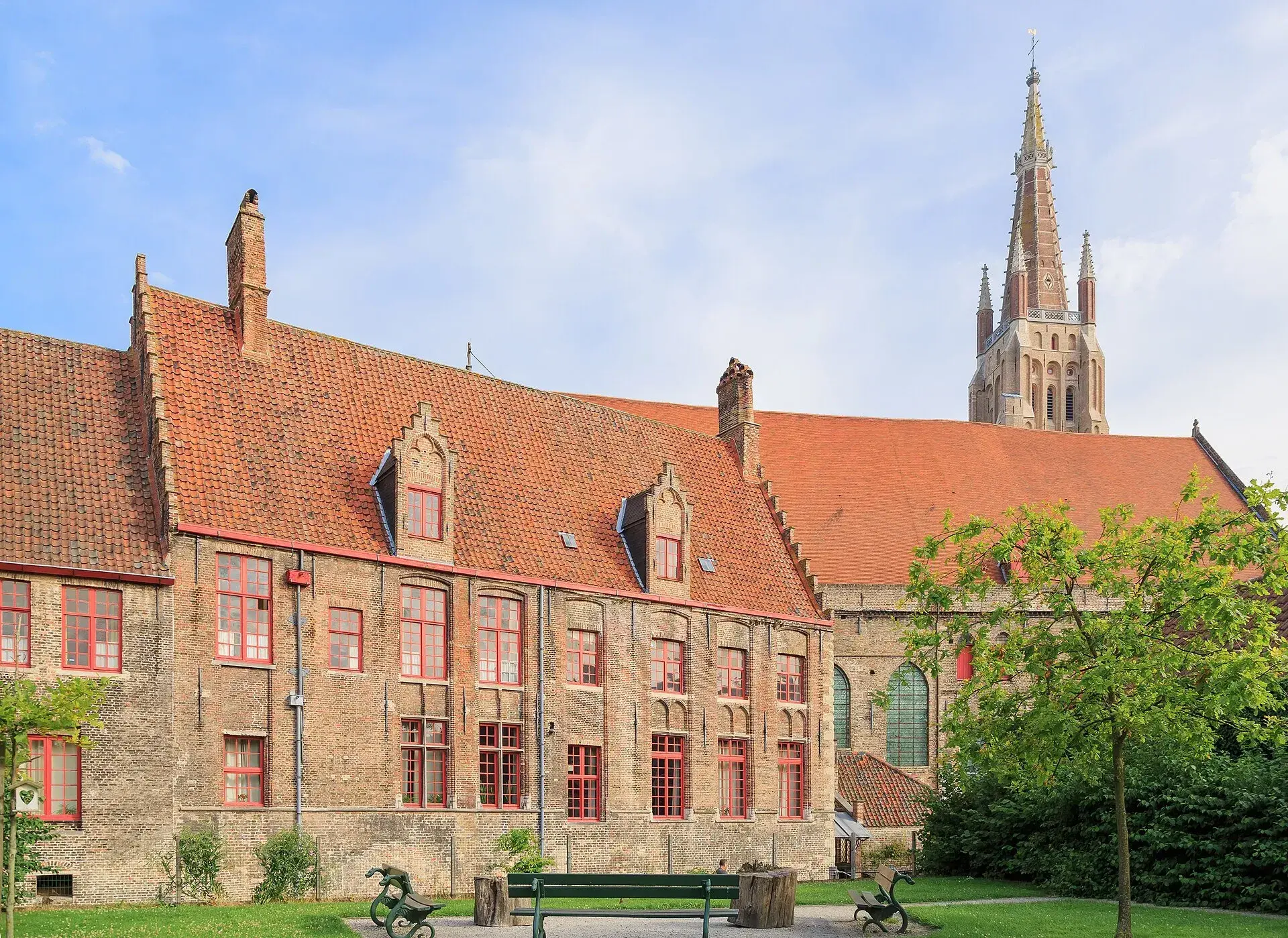
Old St. John’s Hospital & Memling Museum in Brugge
Located on Mariastraat opposite the Church of Our Lady, Old St. John’s Hospital (Museum Sint-Janshospitaal) is one of the oldest surviving medieval healthcare complexes in Europe. With origins tracing back to around 1150 and hospital statutes documented in 1188, the institution continuously offered shelter, sustenance, and care to the sick, destitute travelers, merchants, and religious pilgrims until modern clinical services relocated outside Brugge's historic center in 1977.
Spiritual Healing in the Medieval Wards
Daily care at the hospital was initially administered by Augustinian brothers and sisters, later shifting around 1600 to an all-female religious nursing order. In medieval medicine, healing of the soul was considered as vital as treatment of the body. The complex was structured so that bedridden patients lying in their curtained beds throughout the open infirmary wards maintained a direct line of sight to chapel altars to view Catholic masses.
Civic privileges played an essential role in funding these charitable efforts. In the central panel of Hans Memling's Triptych of Saint John the Baptist and Saint John the Evangelist (1479), a miniature background scene captures a city crane hoisting wine barrels from canal boats. This detail references the municipal wine tax rights awarded to the hospital, which provided the revenue necessary to sustain operations.
Bruges walking tour with audio and quizzes: Belfry, canals and beer
2 hours10 stopsAudio guideStart any day, at your own paceTicket on your phone · 30-day refundThe Masterpieces of Hans Memling
Old St. John’s Hospital holds the second-largest collection of works by Flemish Primitive master Hans Memling in the world. Several major works commissioned by the institution's friars and nuns remain preserved in their original setting, including the Triptych of Saint John the Baptist and Saint John the Evangelist (1479), the Triptych of the Adoration of the Magi (commissioned by friar Jan Floreins in 1479), and the Triptych of the Lamentation of Christ (commissioned by friar Adriaan Reins in 1480).
A popular 19th-century Romantic legend claimed that Memling created these works out of gratitude after being treated at the hospital as a wounded soldier fleeing the Battle of Nancy in 1477. Archival research has debunked this story, demonstrating that Memling was an affluent Brugge citizen who executed the paintings under professional contract.
The collection also includes Memling's Relic Shrine of Saint Ursula (1482–1489), carved and gilded from wood in the architectural form of a miniature Gothic chapel with narrative panels illustrating the saint's martyrdom. Other Memling works on site include the Diptych of Maarten van Nieuwenhove (1487), Portrait of a Young Woman, and Portrait of a Member of the De Rojas Family.
Architectural Evolution and the Medieval Attic
The architectural layout of the site reflects multiple phases of expansion, starting from a limestone hall built around 1200 into three expansive brick Gothic infirmary wards constructed between 1234 and 1310, followed by a 15th-century chapel. A 19th-century pavilion hospital featuring sixteen wards around an inner courtyard was later added to align with changing hygienic standards.
One of the most notable surviving structural spaces is the medieval roof attic. Here, visitors encounter the dry, aged scent of historic timber framed by an expansive network of 13th-century dark oak beams. Outside, the medieval brick gables rising directly out of the Reie canal form one of the city's iconic views from the Mariabrug.
The Modern Museum Experience
The museum role of the site began in 1839, when the hospital's chapter house opened as a dedicated Memling Museum amid the Romantic rediscovery of early Netherlandish art. Following a comprehensive ten-month renovation led by Musea Brugge, the institution reopened in December 2023 to present 850 years of care history through medical artifacts, apothecary jars, archival documents, and religious art.
Within the renovated space, Memling’s paintings are displayed inside a custom glass enclosure modeled after the form of the Relic Shrine of Saint Ursula. The shrine itself stands in the former hospital church, set alongside contemporary artworks by Berlinde De Bruyckere and Patricia Piccinini that explore physical vulnerability and care. The complex also provides access to a preserved 17th-century cloister pharmacy and an adjacent herb garden.
FAQ
Did Hans Memling paint his masterpieces to pay off a hospital bill?
No. Although a 19th-century Romantic legend claimed he painted them after recovering from wounds sustained at the Battle of Nancy in 1477, archival records confirm Memling was a wealthy Brugge citizen working on direct commission.
Why is a city crane unloading wine barrels depicted in Memling's altarpiece?
The miniature detail in the Triptych of Saint John the Baptist and Saint John the Evangelist commemorates the lucrative municipal wine tax rights granted to the hospital, which funded its charitable healthcare work.
When did Old St. John’s Hospital cease operating as a medical facility?
The hospital served patients continuously from the 12th century until 1977, when modern medical operations moved outside the historic center of Brugge.