Kriva Ćuprija: Mostar's Historic Crooked Bridge
Architectural Origins and Ottoman Significance
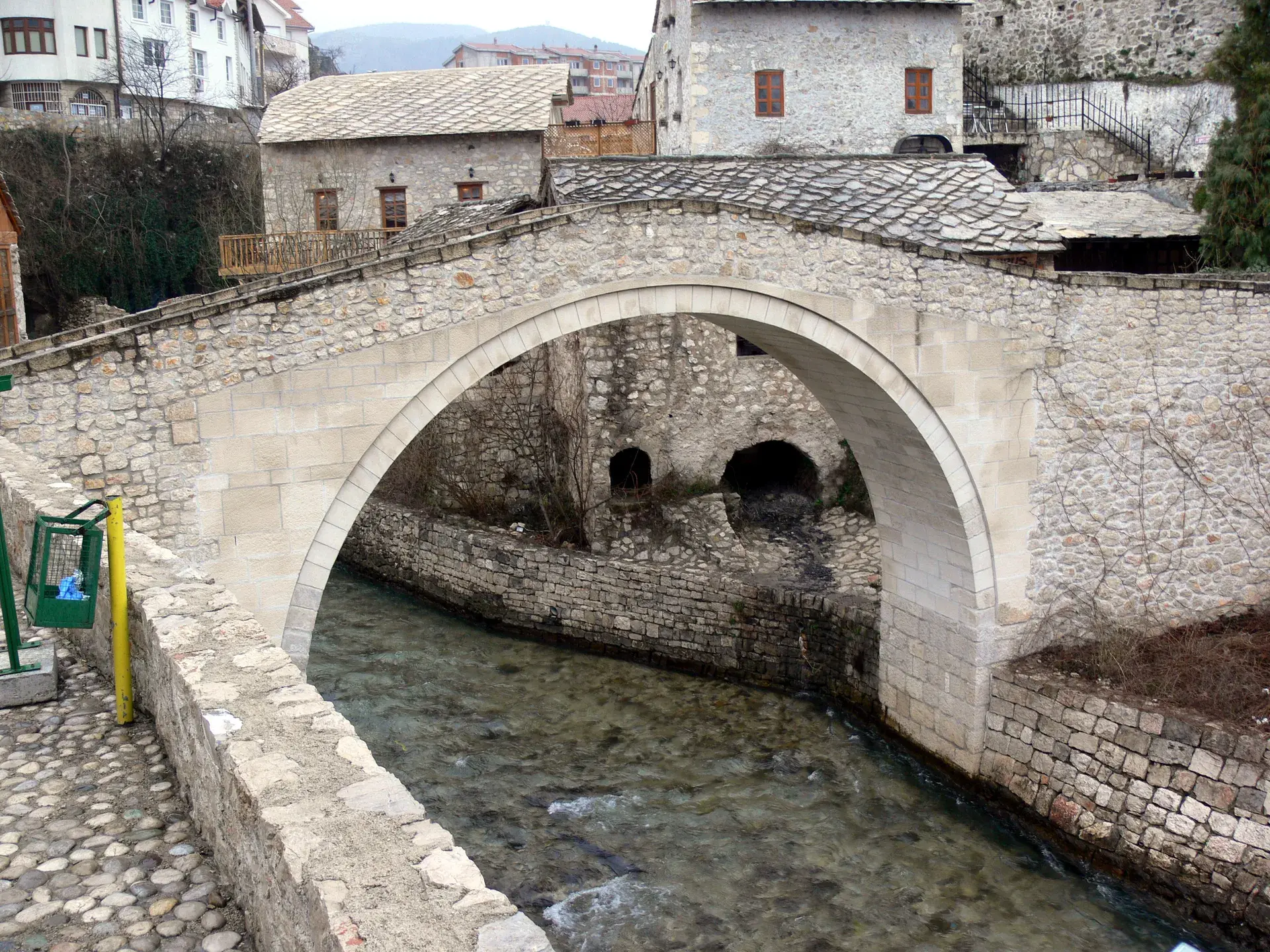
Situated in the Jusovina quarter of Mostar, Kriva Ćuprija spans the Radobolja River roughly 100 to 150 meters upstream from its confluence with the Neretva River. Archival records trace the bridge's origins to in or shortly before 1558, when it was recorded in an endowment deed (vakufnama) established by the Ottoman dignitary Ćejvan-ćehaja (Ćejvan Kethuda).
Completed eight years before the completion of the famous Stari Most in 1566, Kriva Ćuprija is Mostar's oldest surviving single-arch stone bridge. Throughout centuries of Ottoman rule, the bridge served as the only permanent crossing over the lower Radobolja River. It carried the city's primary north–south thoroughfare until modern street layouts and the arrival of the railway in 1884 superseded its transit role.
Engineering and the "Crooked" Name
Despite the name translating to "Crooked Bridge," the limestone structure does not feature an irregular or bent arch. Architectural assessments confirm that the vault forms a mathematically precise semicircle. The arch spans 8.56 meters and rises to an apex height of 4.15 meters. The designation "crooked" stems entirely from the bridge's diagonal alignment across the water, oriented to join two winding, uneven banks.
The pedestrian path across the span is stepped and surfaced with rounded river cobblestones. A persistent local tradition suggests the bridge was built as an architectural testing model for the engineering techniques later deployed on the much wider span of Stari Most. However, no surviving documentary records substantiate the claim that it was intended as a trial build.
Wartime Survival and Natural Collapse
Kriva Ćuprija possesses a distinct modern preservation history. During the 1992–1995 conflict, when heavy shelling destroyed Stari Most, Kriva Ćuprija remained standing, sustaining damage primarily to its parapets and stonework from shrapnel.
Its destruction occurred years after the war ended. In December 2000, intense flash flooding on the Radobolja River undermined the weakened arch, causing the entire span to collapse into the riverbed. In 2001, UNESCO directed an extensive restoration effort financed by the Grand Duchy of Luxembourg. Stonemasons recovered original blocks from the water and combined them with freshly quarried local tenelija limestone to reconstruct the bridge to its historical specifications.
In recognition of its cultural and architectural importance, Kriva Ćuprija was designated a National Monument of Bosnia and Herzegovina in 2004. In 2005, it was integrated into the UNESCO World Heritage listing for the Old Bridge Area of the Old City of Mostar.
The Historic District Setting
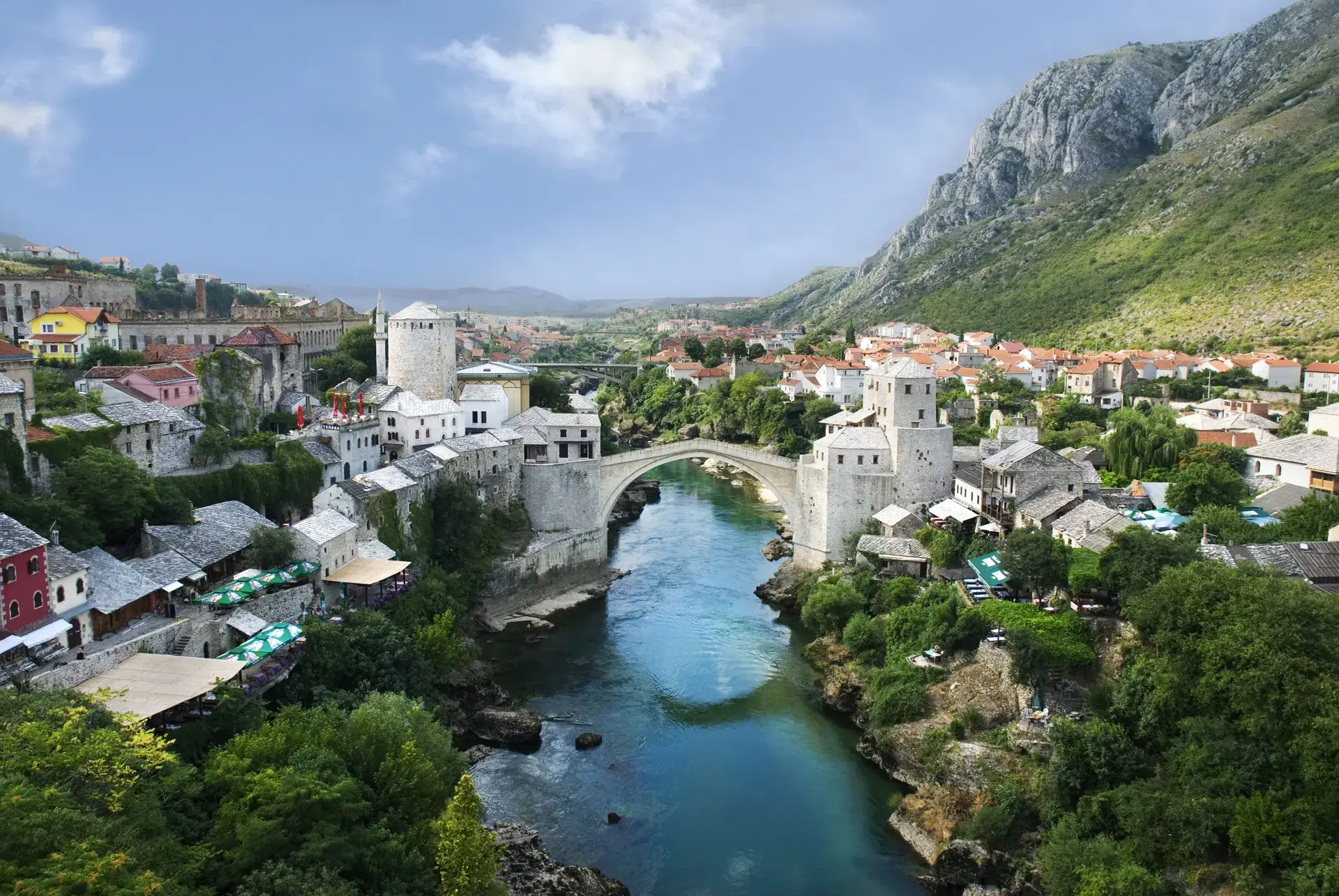
Kriva Ćuprija anchors a quiet sector of Mostar's historic core, positioned between the western bank of the Neretva, the Priječka Čaršija market, and Tabhana, the historic leather-tanning quarter. The bridge demonstrates how Ottoman stone arch construction was adapted to neighborhood waterways alongside major river crossings.
Today, the bridge functions as an open public footbridge. The embankments directly flanking the river rocks are occupied by guesthouses and outdoor dining terraces, where the primary acoustic backdrop is the rushing sound of the shallow Radobolja stream below.
FAQ
Why is Kriva Ćuprija called the Crooked Bridge?
The arch itself is a mathematically precise semicircle; the bridge is called crooked because of its skewed diagonal alignment connecting two winding, uneven riverbanks.
Is Kriva Ćuprija older than Stari Most?
Yes. Documented in a 1558 endowment deed, Kriva Ćuprija predates the 1566 completion of Stari Most by eight years, making it the oldest surviving single-arch stone bridge in Mostar.
Was Kriva Ćuprija built as a miniature model for Stari Most?
Local folklore often claims the bridge was built to test single-arch engineering before constructing Stari Most, but there is no archival documentary evidence to confirm this theory.
Do people dive from Kriva Ćuprija?
No. Diving has never developed at Kriva Ćuprija because the bridge has only about four meters of clearance and the Radobolja River is too shallow.