Spanish Square Mostar: History & Architecture
The Crossroads of Mostar's History
Situated along Mostar's central Bulevar, Spanish Square (Španski trg or Španjolski trg) serves as an urban and historical transition point. The plaza marks the boundary where Austro-Hungarian civic planning meets the historic Ottoman core of the city. Located opposite Zrinjevac City Park and the concrete shell of the former Ljubljanska Banka building—known locally as the "Sniper Tower"—the square anchors the modern civic center of Mostar.
The Old Gymnasium and Pseudo-Moorish Design
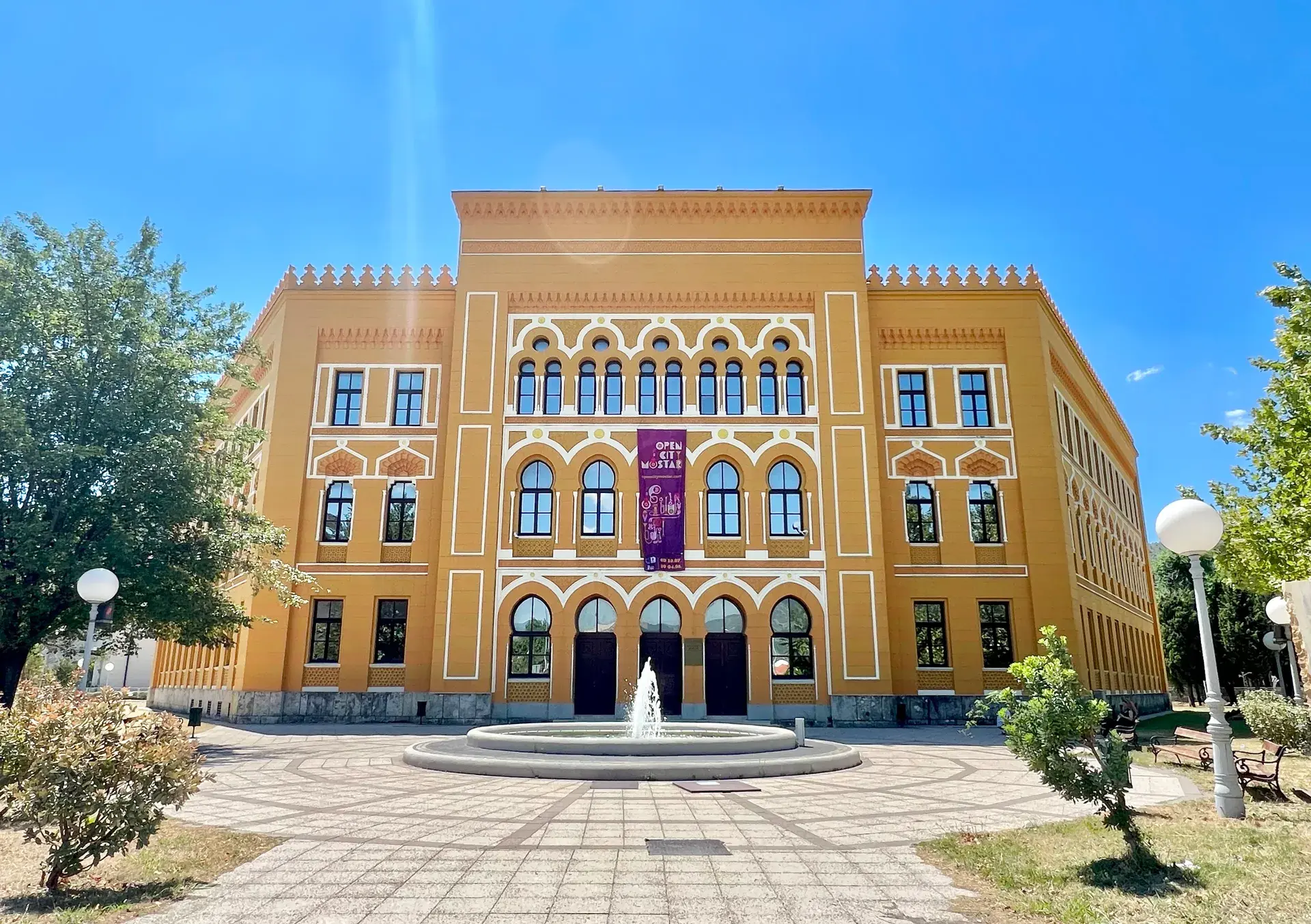
The most recognizable landmark facing the square is the Old Gymnasium (Gimnazija Mostar). Established in 1893 under Austro-Hungarian rule to modernize secondary education and project imperial civic authority, the building was designed by Czech architect František Blažek. The structure was constructed in two phases, with its initial wing opening in 1898 and the full complex reaching completion in 1902.
Rather than adopting local Ottoman forms, Habsburg administrators favored the Pseudo-Moorish (Neo-Moorish) style to establish a distinct regional visual identity. The building's decorative scheme draws heavy inspiration from the Alhambra Palace in Granada, Spain. The facade displays rich ochre and terracotta horizontal bands accented by white stucco borders and carved stone reliefs. Distinctive horseshoe and lobed arches frame the exterior windows and portals, rising to decorative crenellations along the roofline.
Wartime Legacy and the Spanish Connection
Spanish Square holds two distinct and unrelated connections to Spain: its 19th-century Alhambra-inspired facade and its name honoring late-20th-century international peacekeepers.
During the 1992–1995 conflict in Bosnia and Herzegovina, Spanish Square and the Bulevar formed an active front line between warring factions. The fighting reduced the Old Gymnasium to a burned-out shell and left the open space heavily damaged. In the post-war period, members of the Spanish UNPROFOR peacekeeping contingent stationed in Mostar cleared and leveled the site. In the late 1990s, Spanish military engineers arranged for authentic 17th-century-style streetlamps to be shipped directly from Spain to illuminate the recovering plaza.
The plaza was officially dedicated to the Spanish peacekeepers who served during the conflict. At its center stands a stone monument commemorating the 21 Spanish soldiers and one Spanish interpreter who lost their lives during the United Nations mission. In March 2012, King Juan Carlos I of Spain visited Mostar to inaugurate the modernized square and its renovated memorial.
Dual Education and Modern Civic Life
Following extensive reconstruction in the 2000s, the Old Gymnasium reopened to students as a shared educational facility. Today, it houses two separate learning institutions under one roof. Gimnazija Mostar operates across all three floors, administering separate educational curricula for Croat and Bosniak students.
The building is also home to the United World College in Mostar (UWC Mostar), which was formally opened inside the gymnasium in 2006 by Queen Noor of Jordan as part of a post-conflict reconciliation initiative. Occupying the first, second, and attic levels, UWC Mostar teaches an integrated International Baccalaureate curriculum to students from Bosnia and Herzegovina as well as countries around the world.
Today, Spanish Square functions as a central pedestrian hub, transit junction, and civic gathering space. The ambient sound of vehicle traffic moving across the sun-drenched square contrasts with the steady bustle of local and international students passing through the building's Moorish-style arched entryways.
FAQ
Why is it called Spanish Square?
The square is named in honor of the Spanish UNPROFOR peacekeeping contingent deployed to Mostar during the 1992–1995 war. A central stone monument on the plaza commemorates 21 Spanish soldiers and one Spanish interpreter who died during the United Nations mission.
What is the architectural style of the Old Gymnasium on the square?
Designed by Czech architect František Blažek and completed in 1902, the Old Gymnasium was built in the Pseudo-Moorish (Neo-Moorish) style, featuring decorative motifs and arches modeled on the Alhambra in Granada, Spain.
What schools operate inside the Old Gymnasium building today?
The building houses Gimnazija Mostar, which provides separate curricula for Croat and Bosniak students across all three floors, and the United World College in Mostar (UWC Mostar), which teaches an integrated International Baccalaureate program on the first, second, and attic levels.