Šišman Ibrahim Pasha Hamam: Počitelj Bathhouse
Imperial Origins in Počitelj
During the sixteenth and seventeenth centuries, the Ottoman administration transformed Počitelj from a medieval fortress above the Neretva River into an urban settlement, or kasaba. As part of this expansion, military commander and Ottoman official Šišman Ibrahim Pasha established a philanthropic complex (külliye) that included a mosque, madrasa, caravanserai, soup kitchen, and a public bathhouse (hamam).
Built before 1664, when it was recorded by the Ottoman traveler Evliya Çelebi, the bathhouse was deemed an important public work for the frontier garrison settlement. Archival and narrative records show that master stonemasons and artisans were dispatched directly from the imperial capital of Istanbul to ensure the bathhouse reflected metropolitan standards of masonry and engineering.
Architectural Design and Heating
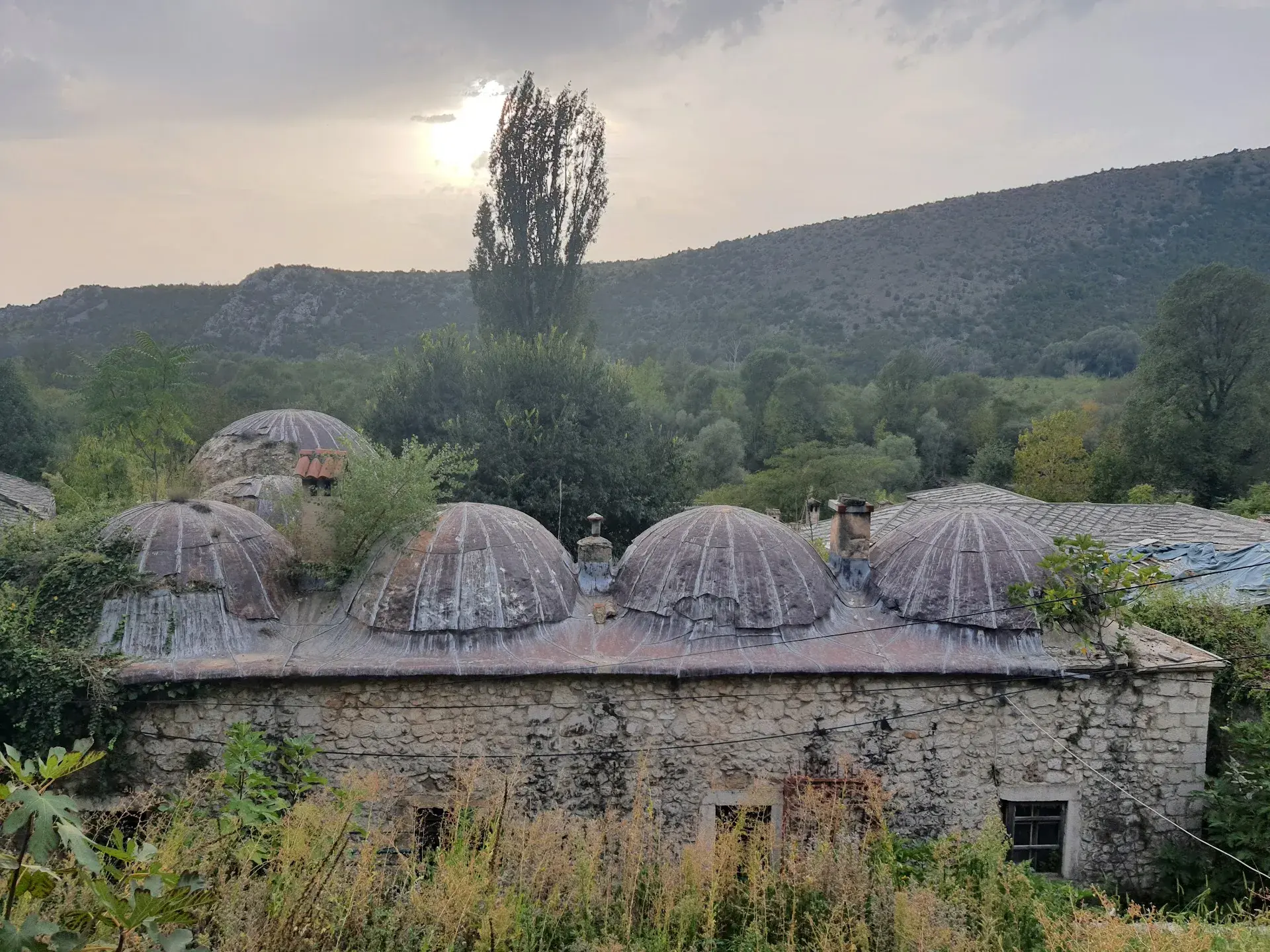
The structure is a classical single public bathhouse (tek-hamam) constructed from local honey-colored limestone blocks. Its low roofline is crowned by five vaults and cupolas clad in dull gray lead, which contrast with the surrounding stone masonry. Embedded within these lead domes are small, circular glass openings known as filgözü ("elephant eyes"). These oculi were specifically designed to channel downward shafts of natural daylight through thick bath steam while shielding bathers from exterior view.
Internally, the building followed the traditional spatial sequence of an Ottoman bath. It featured an entrance and dressing hall (šadrvan), an intermediate warm room (kapaluk), private hot bathing chambers (halvat), and a central water reservoir (hazna). The building relied on a hypocaust heating system powered by a wood-fueled furnace pit (ćulhan). Hot air, gases, and smoke circulated under the raised floors through subterranean channels before venting upward through flues embedded within the thick stone walls.
Civic Role and Community Life
Positioned beside the lower caravanserai near the town gate, the hamam was a vital civic amenity. It served merchant caravans traversing the commercial trade corridor between the Adriatic port of Dubrovnik and the Bosnian interior, as well as garrison troops stationed in the stronghold.
Beyond accommodating regional travelers, the bathhouse played a critical role in local social life. In provincial Ottoman society, public baths maintained strict gender divisions through designated hours or days. For the women of Počitelj, the hamam served as one of the few sanctioned public spaces outside the domestic sphere to convene, share news, and take part in communal traditions, including ritual pre-wedding baths, away from male oversight.
Decline, Restoration, and Current Status
The bathhouse ceased operations in the nineteenth century during the late Ottoman period. Following its abandonment, the damaged building deteriorated significantly, and local villagers began referring to the roofless shell as the hamamina (ruin). The structure suffered further neglect and damage during the 1992–1995 conflict in Bosnia and Herzegovina.
After 2000, heritage initiatives stabilized, cleared, and structurally conserved the surviving limestone walls and lead domes. In 2003, the bathhouse was protected as an integral component of the Historic Urban Area of Počitelj, designated a National Monument of Bosnia and Herzegovina, and was later included on the UNESCO Tentative World Heritage List in 2007. Today, the hamam is preserved as a locked architectural monument, with its interior closed to regular tourist entry while remaining a prominent landmark along the lower paths of the village.
FAQ
Can visitors enter the interior of the hamam?
The hamam is preserved as a locked architectural monument, and its interior is closed to regular individual tourist entry. Visitors can view the limestone walls, entrance portal, and lead-domed roof from the surrounding paths.
Who designed and built the bathhouse?
The bathhouse was commissioned as an endowment by Šišman Ibrahim Pasha. To ensure it met imperial standards, master stonemasons and craftsmen were sent directly from Istanbul to construct the facility.
How was the bathhouse heated and illuminated?
The interior was illuminated from above via small circular glass oculi (filgözü) set into the lead cupolas. It was heated by an underground furnace (ćulhan) that sent hot air through channels beneath the floor and through flues built into the masonry walls.
Discover Pocitelj like never before
Dive into Pocitelj hidden stories and secret spots with Ciceru interactive tours.
Explore tour
Audioguide
Quizzes
Maps
Solo
Couples
Groups & families

© Photo by Emir Karaduman via Google Maps · Google Places