Latin Bridge: Sarajevo's Bridge to World War I
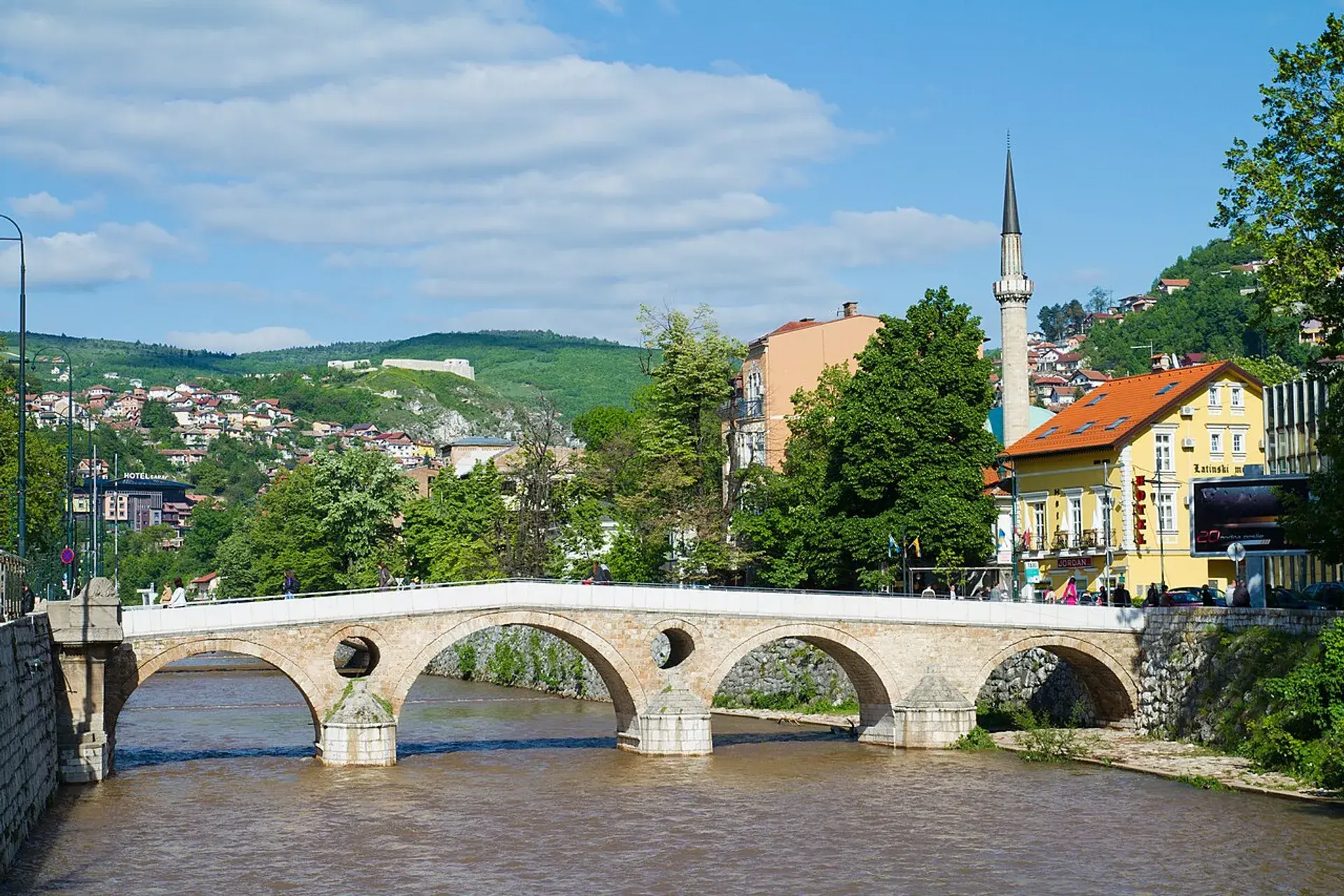
The Latin Bridge is an elegant Ottoman-era stone bridge spanning the Miljacka River in Sarajevo, Bosnia and Herzegovina. While a beautiful structure in its own right, it is world-famous as the location of a single event that changed the course of the 20th century: the assassination of Archduke Franz Ferdinand, which triggered the start of World War I.
Ottoman Origins and Construction
The history of the crossing dates back to at least 1541, when a census recorded a wooden bridge built by a leatherworker named Hussein. A more permanent stone bridge was commissioned around 1565 by Ali Ajni-Beg, a prominent citizen of Sarajevo. The bridge gets its name from 'Latinluk,' the name for the Catholic quarter that was situated on its northern bank during the Ottoman period.
A severe flood on November 15, 1791, heavily damaged the structure. A wealthy merchant, Abdulah-aga Briga, financed its reconstruction, which was completed between 1798 and 1799. The current four-arched bridge with three strong pillars largely reflects this late 18th-century rebuild. Its distinctive circular openings above the pillars, known as 'eyes,' are featured in the official seal of Sarajevo.
The Assassination that Sparked a War
The bridge's most pivotal moment occurred on June 28, 1914. On this day, Gavrilo Princip, a 19-year-old Bosnian Serb nationalist and member of the Young Bosnia society, assassinated the heir to the Austro-Hungarian throne, Archduke Franz Ferdinand, and his wife, Sophie. The act took place at the bridge's northern end and is widely considered the catalyst for the clash of empires known as World War I. Because of his age, Princip avoided the death penalty under Habsburg law and was sentenced to 20 years in prison, where he died of tuberculosis in 1918.
A Bridge of Shifting Names
The bridge's name has been a reflection of the region's shifting political tides. During the socialist Yugoslav era, from 1918 to 1993, Gavrilo Princip was celebrated as a national hero who fought to liberate the people from Habsburg oppression. In his honor, the bridge was officially renamed 'Principov Most' (Princip's Bridge). Following the Bosnian War, the name was reverted to the more neutral and historical 'Latin Bridge' to depoliticize its interpretation.
The Latin Bridge Today
Currently, the Latin Bridge is closed to motor traffic and serves as a crossing for pedestrians and cyclists. It remains a significant landmark for locals and tourists, connecting the old town (Baščaršija) with other parts of the city. At the northern foot of the bridge, the Museum of Sarajevo 1878–1918 occupies the building at the site of the assassination, offering visitors further context on this world-changing event.
FAQ
Why is the Latin Bridge in Sarajevo famous?
The Latin Bridge is famous as the site of the assassination of Archduke Franz Ferdinand of Austria-Hungary on June 28, 1914. This event is widely recognized as the trigger for World War I.
What was the Latin Bridge formerly called?
During the Yugoslav era (1918-1993), the Latin Bridge was officially renamed 'Principov Most' (Princip's Bridge) in honor of Gavrilo Princip, the assassin of Archduke Franz Ferdinand.
Who was Gavrilo Princip?
Gavrilo Princip was a 19-year-old Bosnian Serb nationalist who assassinated Archduke Franz Ferdinand and his wife, Sophie, at the Latin Bridge in 1914. He was a member of the Young Bosnia society.
Can you drive across the Latin Bridge?
No, the Latin Bridge is now closed to road traffic and functions exclusively as a pedestrian and cyclist crossing over the Miljacka River.