Sebilj: Sarajevo's Iconic Ottoman-Style Fountain
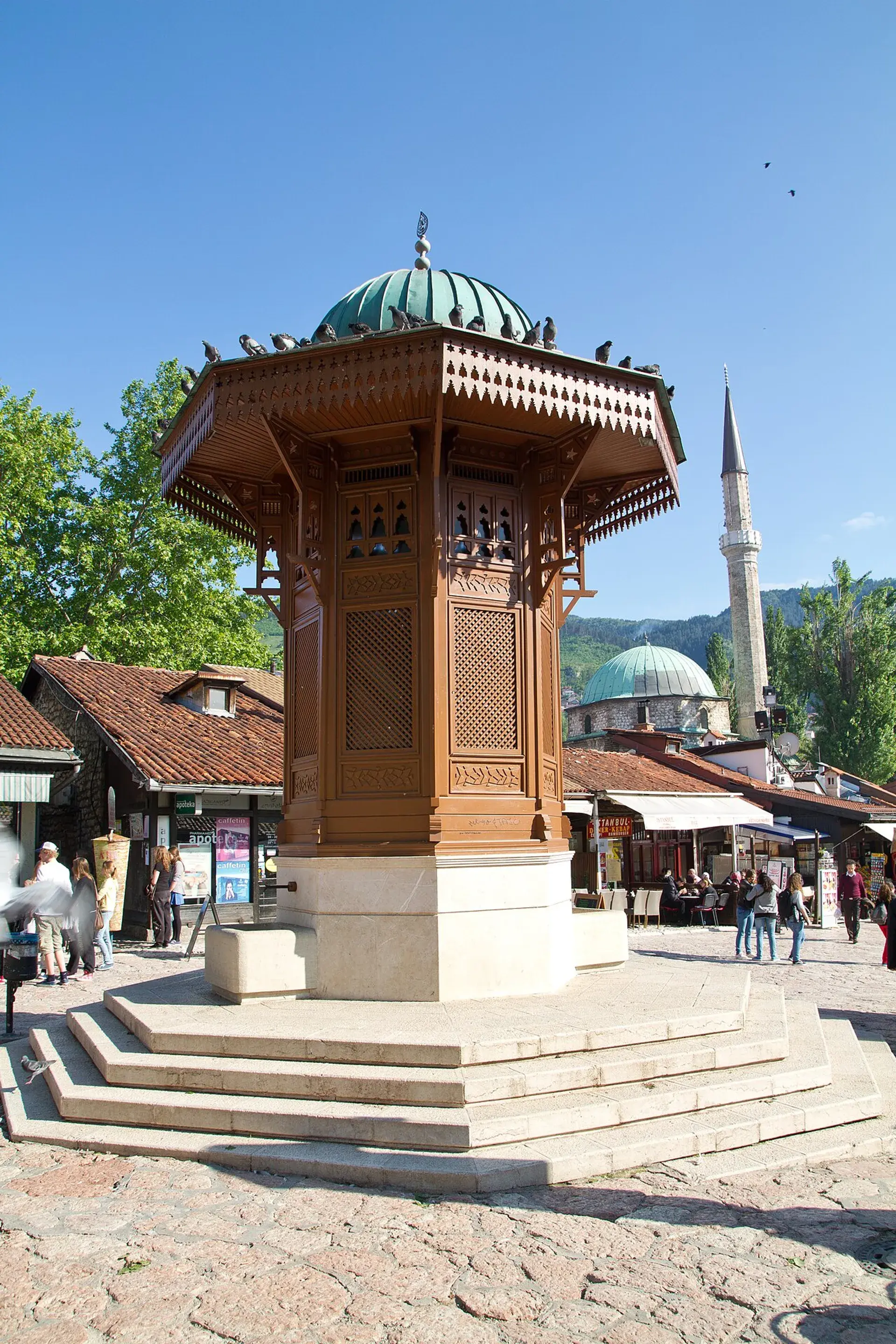
The Sebilj is an Ottoman-style wooden public drinking fountain and one of Sarajevo's most recognizable symbols. Located in the center of Baščaršija Square, this kiosk-shaped structure serves as a historic landmark and a vibrant social hub.
History of Two Empires
The original Sebilj was commissioned in 1753 by Mehmed-paša Kukavica, the Ottoman governor of Bosnia. The term 'Sebilj' originates from an Arabic word for a public fountain, reflecting its purpose as a charitable endowment (vakıf) providing free water to the public. This first structure was destroyed in a fire in 1852.
Decades later, under the Austro-Hungarian administration, the current Sebilj was reconstructed in 1891. It was designed by the Austrian architect Alexander Wittek in a Pseudo-Moorish style, which blended Orientalist motifs with European historicism. The fountain was later moved to its present central position in the square in 1913.
Architectural Significance
The Sebilj is a prime example of Sarajevo's layered history, where Ottoman and Austro-Hungarian influences converge. While its form is Ottoman-inspired, its reconstruction by an Austrian architect illustrates how the succeeding empire integrated and reinterpreted existing cultural markers.
A surprising detail is the inscription on the fountain. The Ottoman Turkish text detailing its history and Islamic phrases was incorporated during the 1891 reconstruction by Wittek; historical records indicate the original 1753 fountain did not have such an inscription.
The Sebilj Today
Today, the Sebilj is a central meeting point for locals and visitors in the heart of Baščaršija. The area is often called 'Pigeon Square' due to the flocks of birds that gather there. The fountain continues to fulfill its original purpose, dispensing fresh, cool, and potable water sourced from the springs of Mount Trebevic via a 16th-century aqueduct system. The surrounding square is a bustling area with cafes, souvenir shops, and street performers.
While the current Sebilj is unique, historical sources suggest Sarajevo once had as many as 300 such fountains during the Ottoman period, though most were destroyed in a 1697 fire. As a testament to its symbolic importance, replicas of the Sarajevo Sebilj have been gifted to cities around the world, including Belgrade, St. Louis, and Novi Pazar.
FAQ
Who built the Sebilj in Sarajevo?
The original Sebilj was commissioned in 1753 by Ottoman governor Mehmed-paša Kukavica. The current structure is a reconstruction from 1891, designed by Austrian architect Alexander Wittek.
Is the water from the Sebilj fountain safe to drink?
Yes, the water from the Sebilj is potable. It is fresh, cool water sourced from the springs of Mount Trebevic and delivered through a 16th-century underground aqueduct.
What does the word 'Sebilj' mean?
The word 'Sebilj' originates from Arabic and means 'a public fountain' or 'a place where water is given,' reflecting its traditional purpose as a charitable water dispenser for the public.