Inat Ćuprija: Stolac's Asymmetric Stone Bridge
The Oldest Stone Crossing in Stolac
Spanning the Bregava River in the historic center of Stolac, Inat ćuprija is regarded as the oldest preserved stone bridge in the town. Historically referred to simply as Ćuprija or Gornja ćuprija (Upper Bridge), the crossing was built under Ottoman administration to link the upper urban quarters situated along the riverbanks. The structure is generally dated to the 17th century, though some historical accounts point to the late 16th century, and official records note the possibility of pre-Ottoman origins.
Today, the bridge is legally protected as a core feature of the National Monument of Bosnia and Herzegovina, designated in 2003 under the natural and architectural ensemble comprising the Bregava riverbed, traditional mills, stamping mills, and bridges.
Unconventional and Asymmetric Architecture
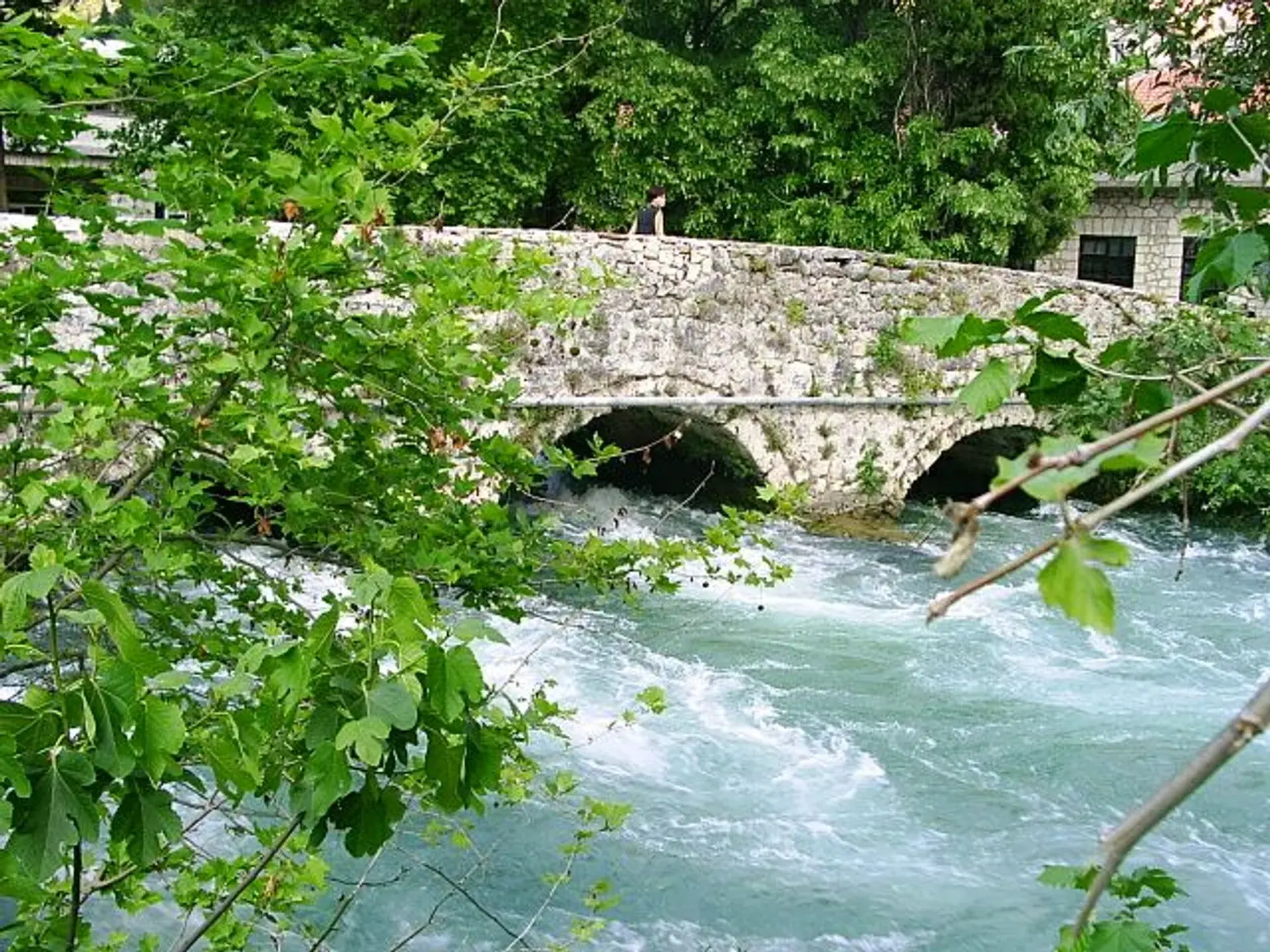
Unlike the strict mathematical balance and symmetry characteristic of classical Ottoman bridge engineering, Inat ćuprija exhibits an irregular, crooked design. Constructed from roughly cut local stone, the bridge measures approximately 35.5 meters in length and 2.65 meters in width. Its path spans the river across five semicircular and segmental arches, each varying in span and height. At one end, an arch lands directly into the steep riverbed, while at the other, it terminates on the riverbank.
The bridge is supported by piers fitted with pointed cutwaters upstream to channel the rushing rapids, while blunt counterforts extend past the downstream facade. Instead of raised, decorative stone parapets (korkaluk), the bridge's spandrel walls continue directly upward to form low protective side railings along the path.
The Legend of Defiance
While the crossing existed for centuries as Gornja ćuprija, the popular name Inat ćuprija (Bridge of Spite) was popularized in the 1970s. The moniker stems from a local legend personifying the Balkan cultural concept of inat—an act of stubborn, willful defiance.
According to oral folklore, while Stolac's Ottoman governor was away on a military campaign, an upstart local ruler named Trtak seized control of the settlement. Demanding a crossing grander than the governor's bridge, Trtak ordered master builders named Isah and Risto to erect a structure with more arches. In quiet rebellion against the usurper's hubris, the builders followed his decree regarding the number of spans but intentionally built every single arch unequal, misaligned, and visibly crooked, quietly ridiculing his pride.
Survival, Repair, and Present Use
Inat ćuprija has endured significant historical upheaval. Two of its stone arches were destroyed during World War II and subsequently rebuilt using concrete. Decades later, the bridge survived the 1992–1995 Bosnian War intact, even as surrounding Ottoman landmarks—such as the adjacent Ćuprijska Mosque—suffered complete destruction before their later reconstruction.
In May 2024, a vehicle struck the side wall of the bridge, causing a section of the stone masonry to fall into the Bregava River. By October 2024, conservation masons completed repairs, reassembling the dislodged stone course and top slabs. Today, Inat ćuprija remains an active crossing for pedestrians and light local traffic, serving as a prominent landmark between downstream bazaars and upstream residential complexes.
FAQ
Why is the bridge called Inat ćuprija?
The name comes from local folklore regarding builders who were forced by an upstart ruler named Trtak to build a grand bridge. Out of defiance (inat), the builders constructed the arches deliberately unequal and misaligned to quietly mock his pride.
How many arches does Inat ćuprija have?
Inat ćuprija features five semicircular and segmental stone arches of varying heights and spans.
What is the historical significance of Inat ćuprija?
It is considered the oldest stone bridge in Stolac, dating generally to the 17th century, and is protected as part of a 2003 National Monument ensemble covering the Bregava riverbed, mills, and bridges.