St. James Cathedral: Toronto's Historic Anglican Heart
The Cathedral Church of St. James stands as a testament to Toronto's history, a symbol of the Anglican establishment and the final resting place of Bishop John Strachan, leader of the powerful 'Family Compact'. Yet, it also holds the gravestone of John Ridout, a man killed in a duel by a member of that same elite circle, illustrating the complex social history contained within its walls. Home to Toronto's oldest congregation, established in 1797, the current cathedral is the fourth church to occupy this historic site.
A History of Fire and Rebirth
The Anglican parish's journey on this site has been marked by destruction and resilience. The first wooden church, built in 1807, was used as a hospital during the War of 1812 and was subsequently damaged by American troops. Dedicated to St. James the Apostle in 1828, it was replaced by a stone Neoclassical church in 1833. This second structure burned down in 1839. A rebuilt third church met a similar fate, completely destroyed in the Great Fire of Toronto in April 1849. From these ashes, the present cathedral would rise.
The Gothic Revival Masterpiece
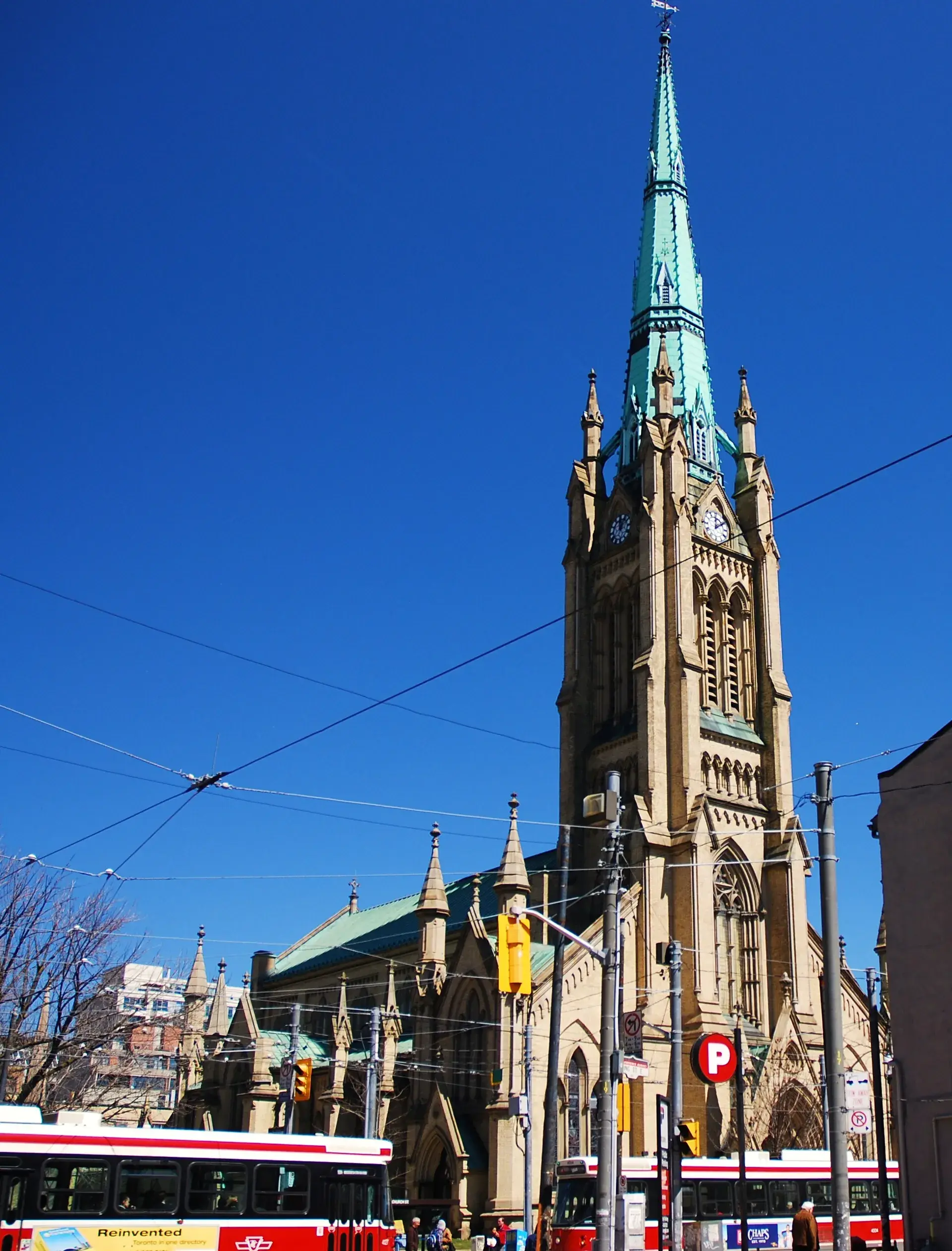
Following the 1849 fire, an international competition was held to design a new church. The winning Gothic Revival design was by Frederick William Cumberland and Thomas Ridout. Construction began in 1850, and the new church opened for services on June 19, 1853. The iconic tower and spire, designed by Henry Langley, were completed between 1873 and 1874. At 92.9 metres (305 ft), the spire was the tallest structure in Canada upon its completion, a title it held for 25 years, serving as a landmark for ships on Lake Ontario.
The Family Compact and Bishop Strachan
In the 19th century, St. James was the center of Toronto's social and political life, largely due to the influence of John Strachan. Arriving in York in 1812, he became the first Anglican Bishop of Toronto in 1839 and was the undisputed leader of the 'Family Compact,' a small group of men who controlled the colony. Upon his death in 1867, Strachan was buried beneath the high altar. The cathedral also bears witness to the era's conflicts; the gravestone of John Ridout, killed in an 1817 duel by the prominent Samuel Jarvis, was later moved to the wall of the south porch.
Architectural and Musical Highlights
Within the cathedral are numerous historical treasures. The marble baptismal font is the only artifact to have survived the Great Fire of 1849. The cathedral houses an impressive 5,001-pipe organ, originally built in 1888. A stained-glass window by Tiffany & Co. of New York is dedicated to William Jarvis, a Revolutionary War Loyalist. The clock tower, whose clock was a gift from Toronto citizens in 1875, also contains the 'Bells of Old York.' This set of 12 change ringing bells, installed in 1997, is the largest peal in North America.
The Cathedral Today
Officially designated a cathedral in 1936, the Cathedral Church of St. James remains an active spiritual and community center. It serves as the episcopal seat of the Bishop of Toronto and holds multiple weekly services, including Choral Eucharist and Choral Evensong. Beyond worship, the cathedral is a community hub, hosting events like trivia nights, offering tours, and running outreach programs such as a drop-in and a foot care clinic for those in need. The peal of its historic bells continues to ring out over the St. Lawrence neighbourhood.
FAQ
When was the current St. James Cathedral built?
Construction on the current Gothic Revival building began in 1850, and it opened for services on June 19, 1853. The distinctive tower and spire were completed later, between 1873 and 1874.
What is the significance of the 'Family Compact' to the cathedral?
The Family Compact was an elite group that dominated early 19th-century Toronto. The leader of this group was Bishop John Strachan, who was the first Anglican Bishop of Toronto and a key figure at St. James, making the church a center of political and social power. He is buried beneath the high altar.
How tall is the spire of St. James Cathedral?
The spire measures 92.9 metres (305 feet). When it was completed in 1874, it was the tallest structure in Canada, a distinction it held for 25 years.
Did anything from the previous church survive the Great Fire of 1849?
Yes, a single item survived the fire that destroyed the third church on the site: the marble baptismal font. It is still located in the porch of the current cathedral.