Dragon Monumental Gate: Toronto's Chinatown Landmark
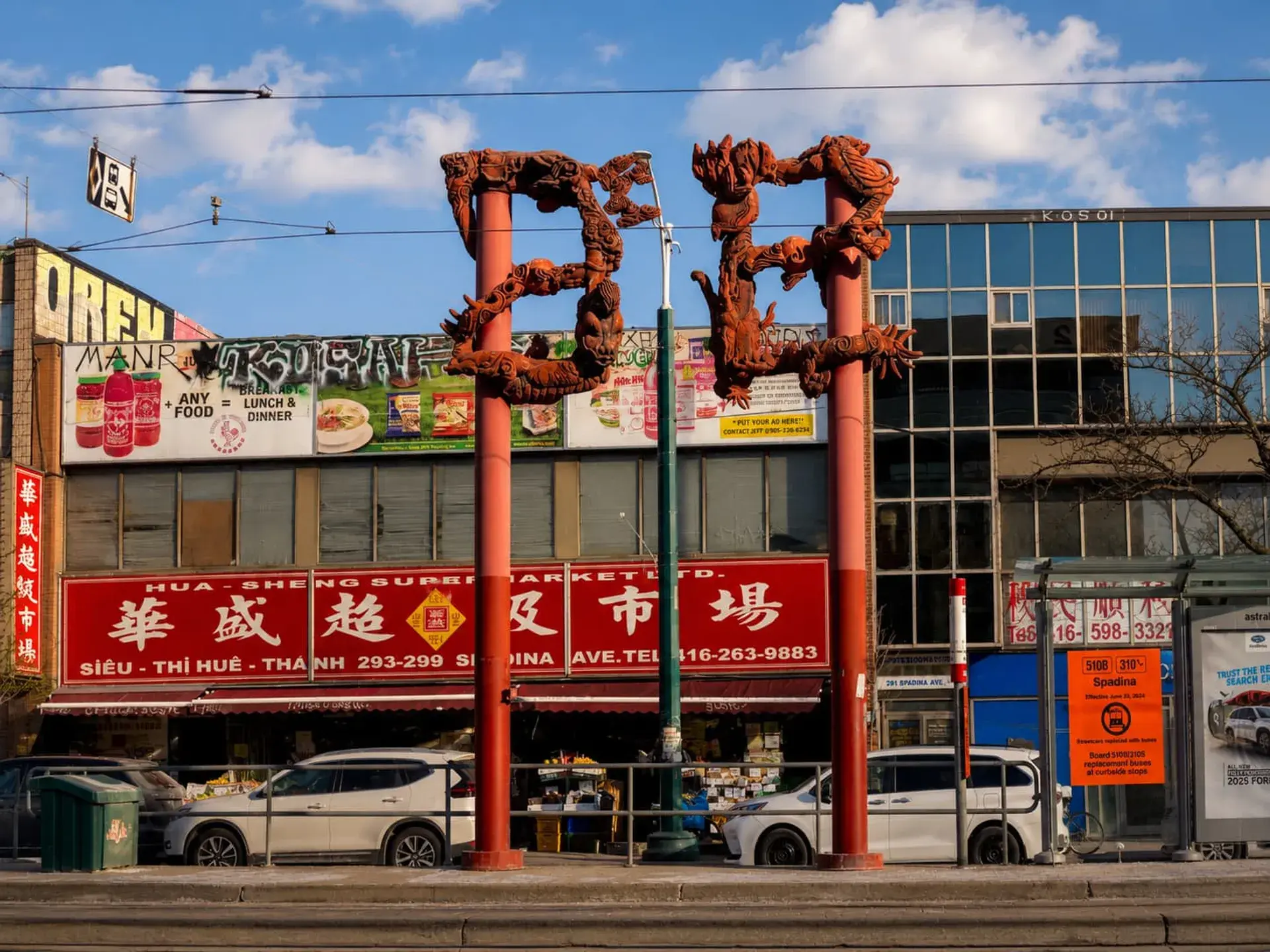
At the bustling intersection of Spadina Avenue and Dundas Street West stands the Dragon Monumental Gate, a significant landmark marking the entrance to Toronto's West Chinatown. Also known as "Gateway," these allegorical structures were created through a collaboration between artists Millie Chen and Warren Quigley. The project, dating from 1997, was commissioned by the City of Toronto, the Toronto Transit Commission, and the Toronto Chinatown Development Association to define and identify the vibrant community.
A History of Relocation and Resilience
The gate stands as a testament to the history of Toronto's Chinese community. The current West Chinatown emerged in the 1960s after the city's original Chinatown near Bay and Dundas streets was expropriated and demolished to build the new City Hall and Nathan Phillips Square. Chinese immigrants and businesses moved westward to Spadina Avenue, establishing a new cultural hub. The gate was designed to reflect the neighborhood's social heritage and signify the continuous transition of cultures as new immigrants arrive in the city.
Intricate Design and Deep Symbolism
The architectural style of the gate is deeply symbolic. The two separate structures are intentionally designed to form the ancient script form of the Mandarin character for “gate” when viewed together. The support poles themselves are integrated into this calligraphic design, symbolizing both a physical and metaphorical entry into the community. This linguistic representation for "gateway" also carries the same meaning in Korean, Japanese, and pre-colonial Vietnamese, highlighting cross-cultural connections.
The upper portion of the gate is adorned with four venerable mythological figures: the Long (Dragon), Feng Huang (Phoenix), Sun Hou Zi (Monkey King), and Qilin (Unicorn). These figures are not static; they are depicted as hybridized, containing elements of other creatures to represent perpetual metamorphosis and transformation rather than fixed identities.
A Modern Cultural Hub
Today, the Dragon Monumental Gate is a prominent identifier for one of Toronto's most dynamic districts. West Chinatown is a vibrant cultural and commercial area filled with Asian markets, specialty shops, and authentic restaurants. Major shopping centers like Dragon City Mall and Chinatown Centre offer everything from fresh produce and herbs to home goods. The gate marks the entry to a neighborhood where colorful signs in English and Chinese line the streets and the aromas of barbecued duck and fresh noodles fill the air, serving as a powerful symbol of identity for the Chinese diaspora in Toronto.
FAQ
Where is the Dragon Monumental Gate located?
The Dragon Monumental Gate is located at the intersection of Spadina Avenue and Dundas Street West in Toronto, marking the entrance to the city's West Chinatown.
What is unique about the design of the Dragon Monumental Gate?
The gate's two structures are designed to form the Mandarin character for “gate.” Its upper portion features hybridized mythological figures, including a dragon and phoenix, which symbolize transformation and cultural metamorphosis.
Who created the Dragon Monumental Gate?
The gate was created by artists Millie Chen and Warren Quigley. The project was a collaboration commissioned by the City of Toronto, the Toronto Transit Commission, and the Toronto Chinatown Development Association.
Why is Toronto's main Chinatown located on Spadina Avenue?
Toronto's original Chinatown was located near Bay Street and Dundas Street but was demolished in the 1950s and 60s to make way for the new City Hall. The community subsequently relocated westward, establishing the current West Chinatown on Spadina Avenue.