Golden Gate Split: Diocletian's Palace North Portal
Imperial Entry and Roman Origins
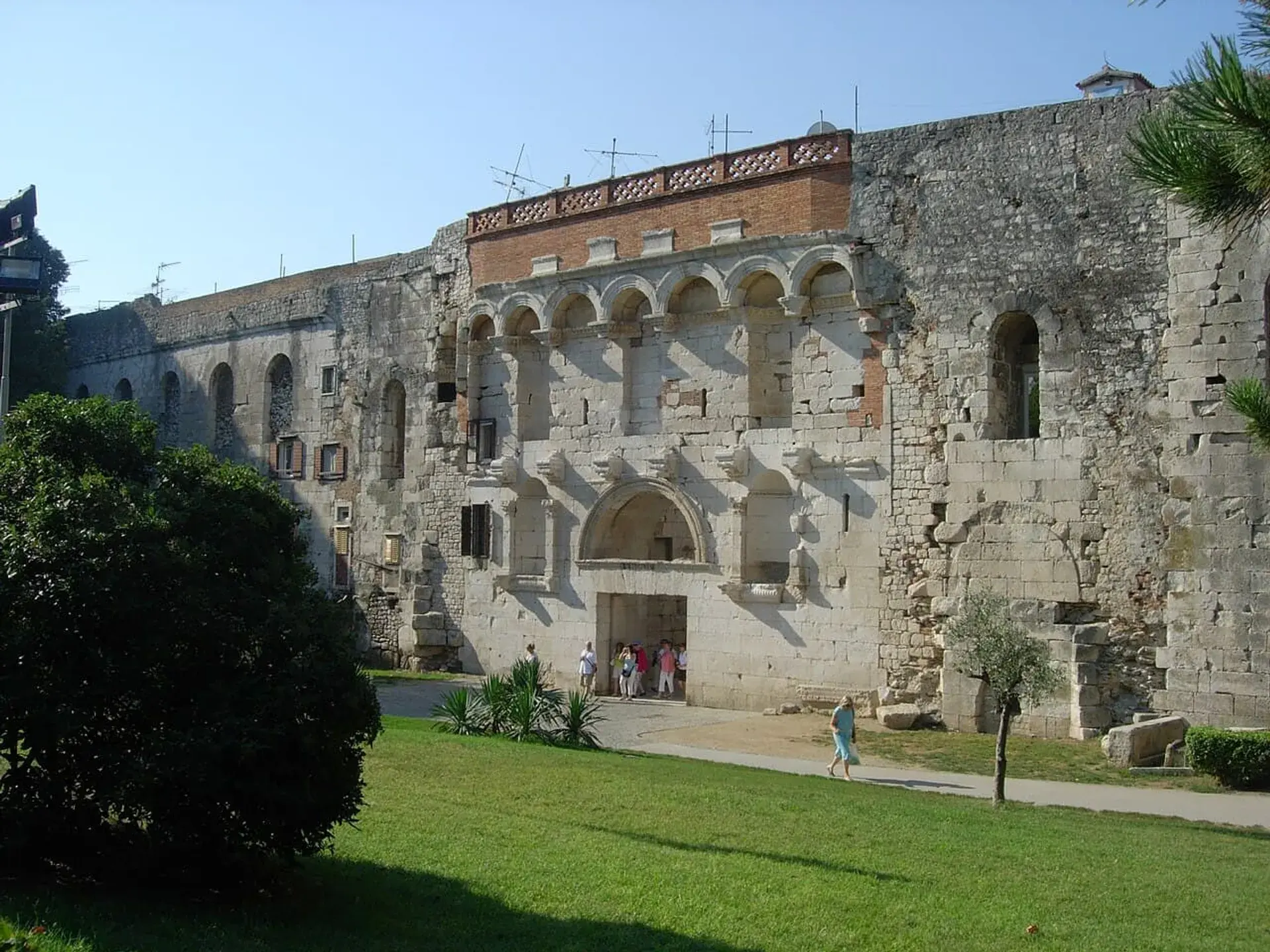
Constructed between 295 and 305 CE, the Golden Gate (Porta Aurea) was built as the primary landward entrance to Emperor Diocletian’s fortified retirement palace. Originally designated Porta Septemtrionalis in Late Antiquity and later known as Porta Romae in the Middle Ages, the portal secured the direct military and trade route connecting the palace to Salona, the provincial Roman capital of Dalmatia. Historical tradition holds that Diocletian entered his coastal palace through this gateway after stepping down from imperial rule in 305 CE.
The portal forms the northern terminus of the Cardo Maximus, the principal north–south arterial street of the Roman complex. From the gate, this axis continues directly into the historical core, leading past Dioklecijanova street toward the Peristyle and the southern quarters.
Split walking tour with audio and quizzes: Diocletian’s Palace
2 hours10 stopsAudio guideStart any day, at your own paceTicket on your phone · 30-day refundDefensive Architecture of the Propugnaculum
Beyond ceremonial pageantry, the gateway was engineered as a fortified defense system. The exterior portal measures 4.17 by 4.36 meters and is topped by a 3.02-meter-high arch formed from 19 massive stone blocks. In antiquity, the entrance was protected by a heavy portcullis and flanked by two protruding octagonal towers.
The architecture formed an intentional tactical trap. Intruders who breached the exterior portcullis were funneled into a rectangular inner courtyard, or propugnaculum, measuring roughly 9 by 9 meters. Palace guards stationed on the elevated walkways above could target enclosed forces before they could penetrate the inner gate leading onto the palace streets. Today, moving through the gate provides a stark spatial shift, transitioning from the open, sunlit expanse of Strossmayer's Park into the shadowed, echo-prone stone enclosure of the Roman courtyard.
Facade Statues and Structural Evolution
The exterior northern facade features weathered limestone ashlar masonry decorated with blind arcading resting on carved consoles. Four niches in the upper wall originally displayed statues of the Roman Tetrarchy: Augusti Diocletian and Maximian, alongside Caesars Galerius and Constantius Chlorus. Over time, the surrounding architecture altered substantially. The defensive octagonal towers were demolished during the early modern period, and decorative marble and limestone columns adorning the exterior niches were dismantled across the 18th and early 19th centuries.
The name "Porta Aurea" was first recorded in Venetian itineraries in 1553. The title was chosen to denote its primary status in the hierarchical naming system applied to the palace portals alongside the Silver, Iron, and Bronze gates. The structure contains no actual gold, and popular claims that the Roman arch was decorated in gold leaf lack archaeological evidence.
The Church of St. Martin
In the 7th century, refugees fleeing the fall of Salona settled inside the palace, prompting the repurposing of its military infrastructure. During the 9th-century rule of Croatian Duke Trpimir, the narrow sentry corridor directly above the northern portal was converted into a pre-Romanesque chapel dedicated to St. Martin.
Measuring just 1.64 meters wide and 10 meters long, the Church of St. Martin is the narrowest and one of the smallest churches in Split. Inside, it preserves a rare, intact 11th-century pre-Romanesque carved stone chancel screen. The chapel is overseen by an adjacent Dominican convent and can be visited via a narrow interior flight of steps.
Modern Setting and Surrounding Landmarks
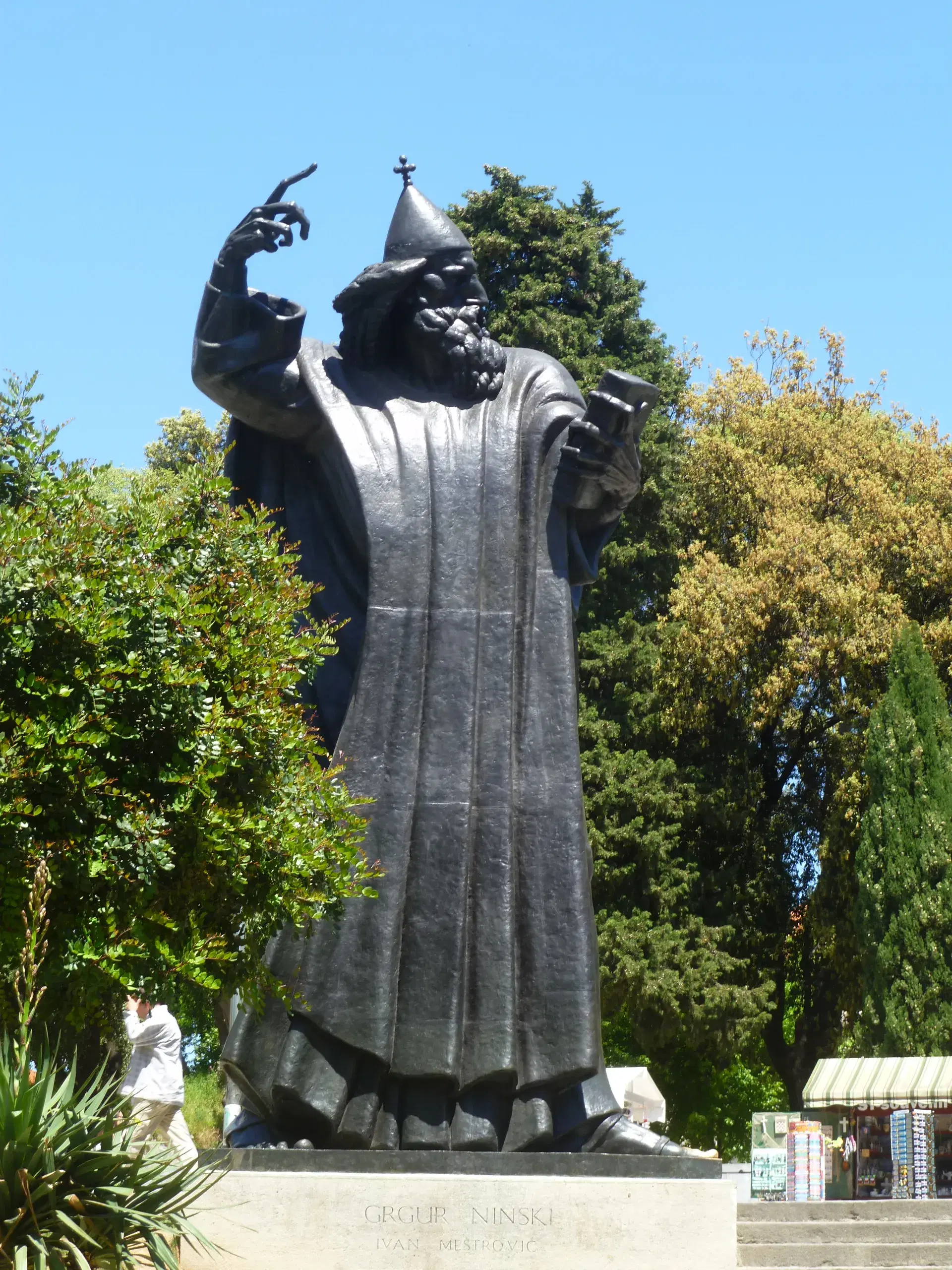
The Golden Gate functions today as a primary, free-access pedestrian portal into Split's UNESCO-listed historical center. The open esplanade immediately facing the gate borders Strossmayer’s Park (Đardin) and serves as a major gathering point for walking tours. Positioned in the park directly opposite the portal is Ivan Meštrović's colossal bronze monument to the 10th-century bishop Gregory of Nin (Grgur Ninski), where local custom encourages passersby to rub the statue's polished big toe for good luck.
FAQ
Did the Golden Gate of Split ever contain gold?
No, the gate is made of local stone and contains no gold. The name Porta Aurea was recorded by Venetians in 1553 to reflect its status as the palace's grandest entrance relative to the Silver, Iron, and Bronze gates.
What is the small church located inside the Golden Gate?
The Church of St. Martin is a 9th-century pre-Romanesque chapel installed directly inside the former Roman sentry walkway above the gate. Measuring 1.64 meters wide and 10 meters long, it contains a preserved 11th-century stone chancel screen.
How did the defensive propugnaculum work?
The propugnaculum was a roughly 9-by-9-meter inner courtyard between the outer portcullis and inner gate. If attackers breached the exterior barrier, they were trapped inside the stone chamber under fire from guards on the ramparts above.