Gregory of Nin Statue in Split: History & Tradition
Ivan Meštrović’s Monumental Bishop
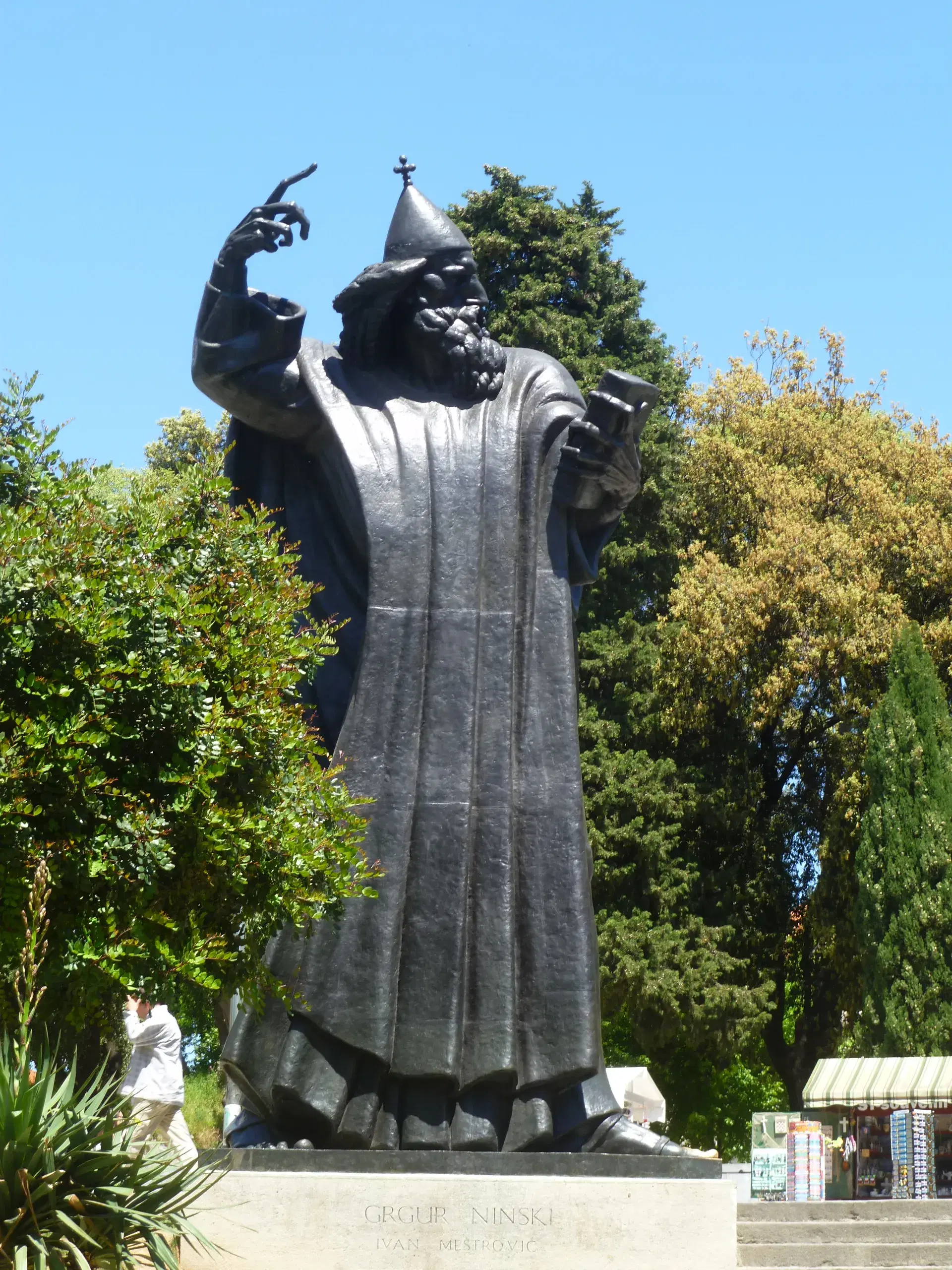
The bronze monument of Bishop Gregory of Nin (Grgur Ninski), sculpted by Ivan Meštrović, was unveiled on September 29, 1929. Created to commemorate the millennium of church synods held in Split between 925 and 928 AD, the monument honors the 10th-century medieval prelate known for advocating liturgy in the vernacular Old Church Slavonic using Glagolitic script rather than Latin.
Standing between 7.58 and 8.5 meters tall, the statue ranks among the largest bronze monuments in Croatia. Sculpted with dramatic, exaggerated drapery folds, the prelate holds a book in one arm while gesturing forcefully with his other hand, looming over passersby.
Split walking tour with audio and quizzes: Diocletian’s Palace
2 hours10 stopsAudio guideStart any day, at your own paceTicket on your phone · 30-day refundRelocation and Controversy
The statue was not originally positioned in its current location. When first unveiled, it stood inside Diocletian's Palace within the ancient Roman Peristyle. Its colossal scale inside the antique courtyard triggered intense debate regarding the placement of modern national symbols in classical Roman spaces. For more than a decade, the dark bronze figure visually competed directly with Diocletian's colonnades and the bell tower of the Cathedral of Saint Domnius.
During World War II in 1941, occupying Italian forces dismantled and removed the monument. In 1954, it was re-erected outside the palace's northern entrance, the Golden Gate (Zlatna vrata), adjacent to Josip Juraj Strossmayer Park (Đardin). Decades later, between 2013 and 2015, the monument underwent comprehensive structural conservation and restoration.
The Polished Bronze Toe
One of the statue's most prominent visual characteristics is the sharp contrast across its surface. While the body remains coated in a dark, oxidized bronze patina, the left big toe gleams with a mirror-like golden shine. This finish is the result of decades of continuous touching by visitors.
According to local tradition, rubbing the bishop's big toe brings good luck, ensures a future return to Split, or helps make a wish come true.
Practical Details and Related Works
Located in an open pedestrian plaza outside the Golden Gate, the monument anchors the northern threshold of Split's historic center. It functions as an orientation landmark and public meeting point along the route into the palace. The site is an open-air public monument accessible 24/7 with no admission fees.
In addition to the Split monument, Meštrović sculpted two other versions of Gregory of Nin with varied poses, which stand in the Croatian towns of Nin and Varaždin.
FAQ
Why was the Gregory of Nin statue moved from the Roman Peristyle?
Its massive size sparked aesthetic controversy inside the Peristyle courtyard, as it visually competed with Roman colonnades and the Cathedral of Saint Domnius. Occupying Italian troops dismantled it in 1941 during World War II, and it was reassembled outside the Golden Gate in 1954.
Why is the statue's toe polished golden?
A local custom claims that rubbing the bishop's left big toe brings good luck, makes a wish come true, or guarantees a return to Split. Decades of visitor contact have worn away the dark oxidized patina, polishing the bronze to a mirror shine.
Are there other Gregory of Nin statues created by Ivan Meštrović?
Yes. Meštrović sculpted two additional versions of Gregory of Nin featuring different poses, which are located in the Croatian towns of Nin and Varaždin.