Temple of Jupiter in Split: History and Architecture
Imperial Origins and Roman Architecture
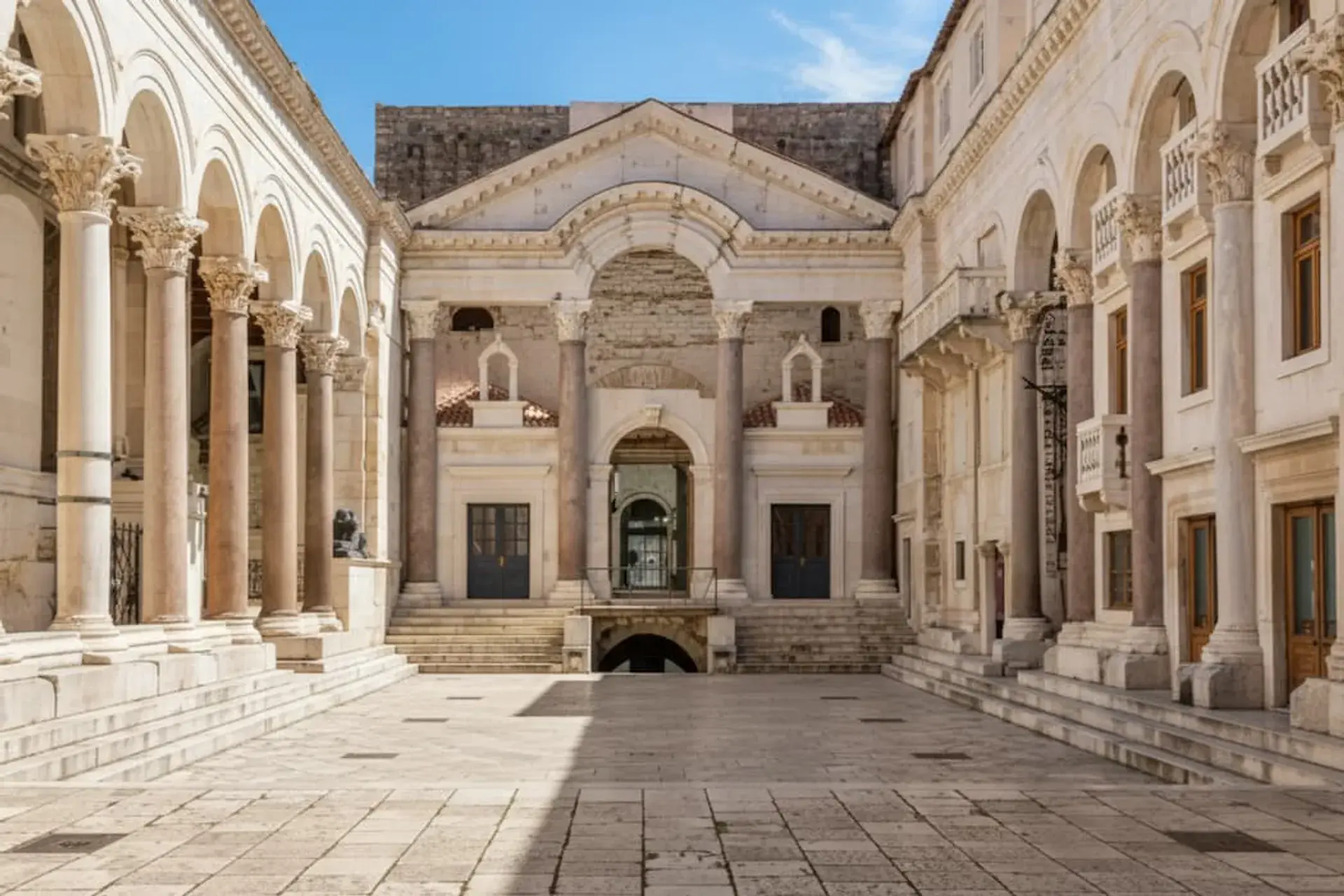
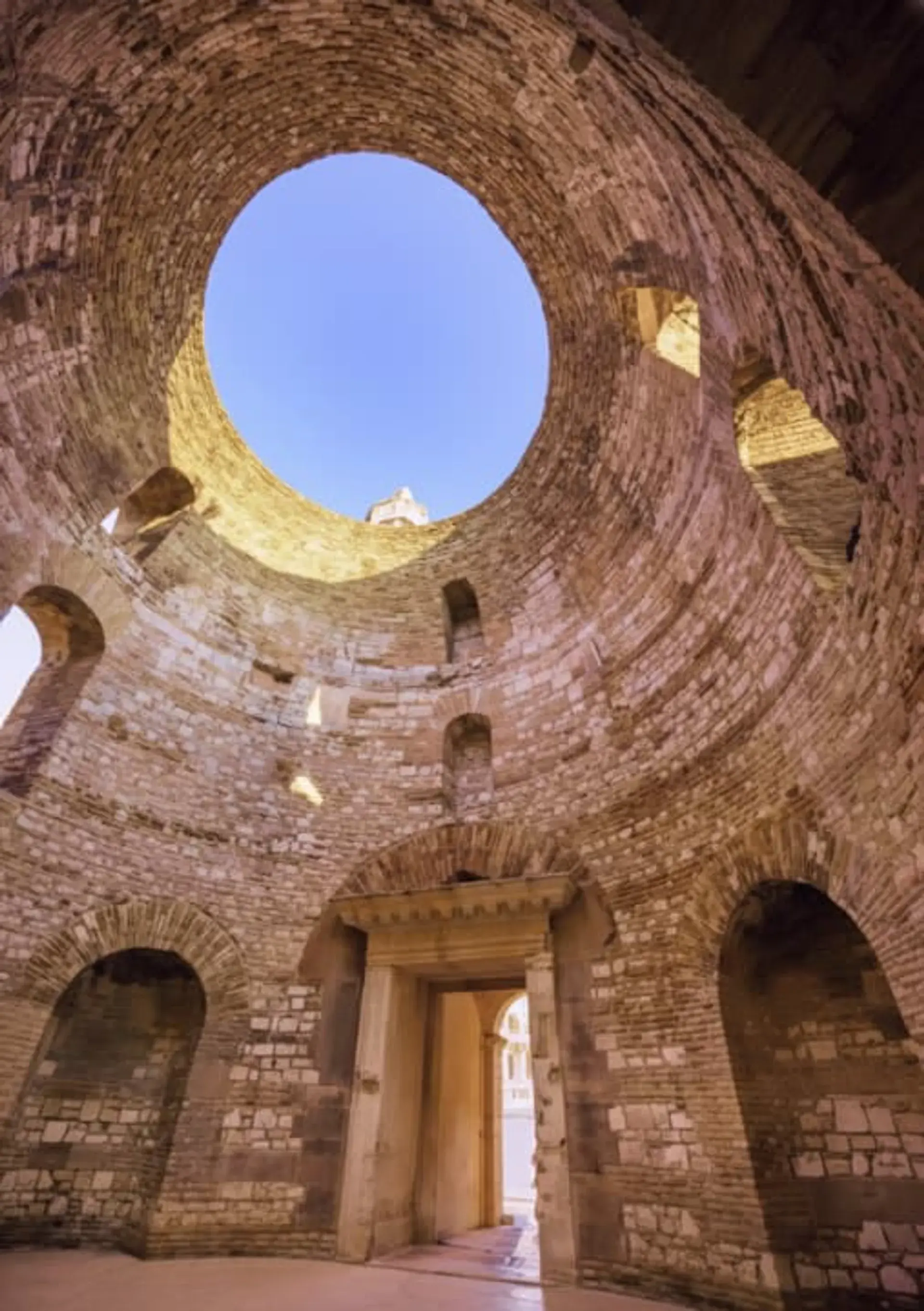
The Temple of Jupiter (Jupiterov hram) was commissioned by Roman Emperor Diocletian between 295 and 305 AD in the western religious quarter of his palace in Split. Diocletian revered Jupiter as his divine protector and the spiritual father of his imperial dynasty. Built in classical Roman style upon an elevated stone podium, the sanctuary was originally fronted by a hexastyle portico leading into a compact rectangular cella roofed by a white limestone barrel vault.
The vault itself remains one of the building's most notable classical features, decorated with deeply carved square coffers depicting floral rosettes, human faces, masks, and classical motifs. Construction halted abruptly in 305 AD when Diocletian abdicated the imperial throne, leaving several decorative and structural elements unfinished. In 1757, Scottish architect Robert Adam surveyed and sketched the monument, praising its refinement; its vaulted ceiling later served as an architectural model for Dalmatian Renaissance masters Andrija Alessi and Niccolò di Giovanni Fiorentino in nearby Trogir.
Split walking tour with audio and quizzes: Diocletian’s Palace
2 hours10 stopsAudio guideStart any day, at your own paceTicket on your phone · 30-day refundConversion into the Baptistery of St. John
Following the 7th-century destruction of the nearby Roman city of Salona, refugees settled within the fortified palace walls. Over the ensuing centuries, pagan imperial structures were systematically converted to Christian worship. The Temple of Jupiter was consecrated as the Baptistery of St. John the Baptist, while its subterranean crypt was dedicated to St. Thomas.
During the Middle Ages, several modifications altered the ancient profile of the site. Sarcophagi containing the remains of 11th-century Archbishops of Split, Ivan of Ravenna and Lovre, were installed inside the chamber. An 11th-century Romanesque bell tower was also built directly above the stone vault, though it was dismantled around 1840 to expose the temple's classical Roman roofline. Later, in 1907, medieval residential buildings clustering along the south and west walls were cleared to isolate the monument. The cella received another major addition in 1954 with the placement of a bronze statue of St. John the Baptist created by Croatian sculptor Ivan Meštrović.
The Historic Baptismal Font and Early Royal Relief
At the center of the cella stands a cruciform baptismal font assembled in the early 13th century. It was constructed using 11th-century carved marble altar screens (plutei) originally brought from the cathedral.
One of the font's carved stone panels depicts a crowned monarch seated upon a throne, holding a cross and an orb. Historians traditionally identify the figure as either King Petar Krešimir IV or King Dmitar Zvonimir. This carving is widely recognized as the earliest surviving stone sculptural representation of a native medieval king in European art.
Exterior Elements and the "Let Me Pass" Alley
Outside the temple steps rests a headless black granite sphinx dating back more than 3,000 years to the reign of Pharaoh Thutmose III. It was one of several Egyptian sphinxes imported by Diocletian to adorn the palace complex. The statue's head was destroyed by early Christians seeking to deface pagan symbols, leaving a dark, polished stone body smoothed by centuries of weathering.
Directly bordering the western exterior wall of the temple is Pusti me proć ("Let Me Pass"). Measuring approximately 57 centimeters wide, it is recognized as Split's narrowest passageway, requiring pedestrians meeting in the alley to maneuver carefully around one another.
Location and Access
The Temple of Jupiter stands at the western terminus of Kraj Svetog Ivana, a narrow lane leading directly west from the Peristyle square. Because standard GPS navigation frequently directs visitors to incorrect nearby coordinates, navigating straight west down Kraj Svetog Ivana from the Peristyle provides the most direct and accurate route.
The site is managed under the Split Cathedral complex (Episcopal Ordinariate of Split) and operates daily as a ticketed monument. Entry to the interior cella and baptismal font is available via an individual admission ticket or as part of a combined cathedral pass, though the exterior facade and the Egyptian sphinx can be viewed freely from the street without paid admission.
FAQ
How can visitors find the Temple of Jupiter within Diocletian's Palace?
Because GPS navigation often directs visitors to the wrong location, the easiest route is to start at the central Peristyle and take the narrow lane heading west, Kraj Svetog Ivana. The temple stands directly at the end of this street.
Is admission required to visit the Temple of Jupiter?
Paid admission is required to enter the interior cella, see the medieval font, and view the Meštrović bronze statue. Tickets can be bought individually or as part of a cathedral complex pass. The exterior architecture and the headless Egyptian sphinx can be viewed from the street without a ticket.
What is the historical significance of the baptismal font relief?
The early 13th-century font features an 11th-century carved relief showing a crowned king holding an orb and cross, traditionally identified as King Petar Krešimir IV or King Dmitar Zvonimir. It is regarded as the earliest surviving stone sculptural representation of a native medieval monarch in European art.
Why is the Egyptian sphinx outside the entrance headless?
The 3,000-year-old black granite sphinx was brought from Egypt by Emperor Diocletian. After the fall of the empire, early Christians systematically defaced pagan imagery within the palace, decapitating the statue.