Church of Saint Michael in Olomouc: History & Guide
A Southern Italian Marvel in Moravia
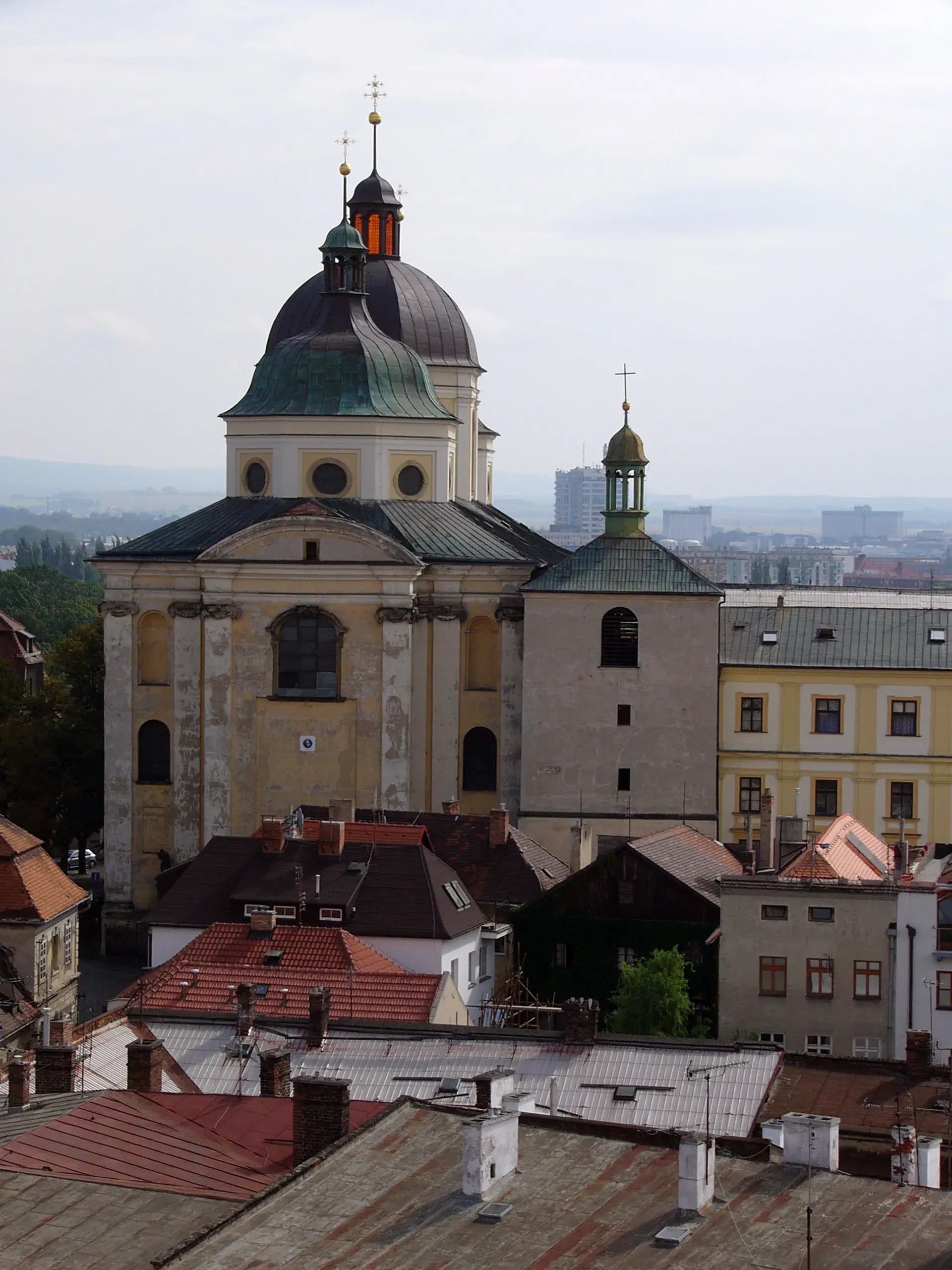
Rising above the ancient streets of Olomouc, the Church of Saint Michael the Archangel on St. Michael's Hill stands as a defining landmark of the city's skyline. The Baroque single-nave structure is recognized as the earliest North Italian-style domed ecclesiastical building in Moravia. Period chronicles noted that this specific architectural design was exceptionally rare north of the Alps, drawing structural parallels only to churches in Southern Italy. The current building was designed by Giovanni Pietro Tencalla beginning around 1673 to 1676, completed by Domenico Martinelli, and officially consecrated in 1707.
Symbolism and Artistry
The church's exterior is instantly recognizable by its three distinct octagonal copper domes, which join the Wenceslas Cathedral and the Town Hall tower as key anchors of the Olomouc skyline. These three domes were designed to symbolize the Holy Trinity: God the Father, the Holy Spirit, and God the Son. The church's intricate artistic details include elaborate interior stucco crafted by Baldassarre Fontana and exterior facade sandstone statues sculpted by Ondřej Zahner.
From Gothic Roots to War and Revival
Local tradition and archaeological lore suggest that St. Michael's Hill was an ancient pre-Christian cultic and judicial assembly site before any church was built. In the 1230s and 1240s, Dominican friars settled on the hill, consecrating an early Gothic church around 1251. Centuries later, the complex suffered immense devastation during the Thirty Years' War. Between 1642 and 1650, occupying Swedish troops plundered the monastery, using its spaces as horse stables and storehouses.
When the Baroque rebuilding effort began in the late 17th century, Tencalla preserved sound portions of the surviving medieval outer masonry to reduce construction costs. The monastic chapter came to a close in 1784 when Emperor Joseph II dissolved the monastery. The complex transitioned into a parish church and seminary, later receiving Neo-Baroque decorative updates in the 1890s.
The Hidden Subterranean Spring
Beneath the church floor lies an unexpected natural feature. Accessible via the historical Gothic cloister, visitors can find a rock-hewn meditative grotto. Within this cool, damp rock chamber, a continuously fed underground spring drips into a small, still pool, creating a striking contrast with the gilded Baroque architecture above.
Visiting the Church Today
Today, the Church of Saint Michael operates as an active Roman Catholic parish, holding regular daily and Sunday masses. During specific weekly visiting windows, tourists are granted access to explore the nave, the historical cloister, the subterranean grotto, and the bell tower, which offers panoramic views of the city.
FAQ
Why does the Church of Saint Michael have three domes?
The church features three distinct octagonal copper domes designed to symbolize the Holy Trinity, representing God the Father, the Holy Spirit, and God the Son.
What is hidden in the basement of the Church of Saint Michael?
Beneath the church, accessible through the Gothic cloister, is a rock-hewn meditative grotto containing a small pool fed continuously by a natural underground spring.
When was the Church of Saint Michael built?
The original Gothic church on the site was consecrated around 1251. After being plundered during the Thirty Years' War, the current Baroque structure was built between 1673 and 1707 using parts of the surviving medieval masonry.