Saint Wenceslas Cathedral: Olomouc's Tallest Spire
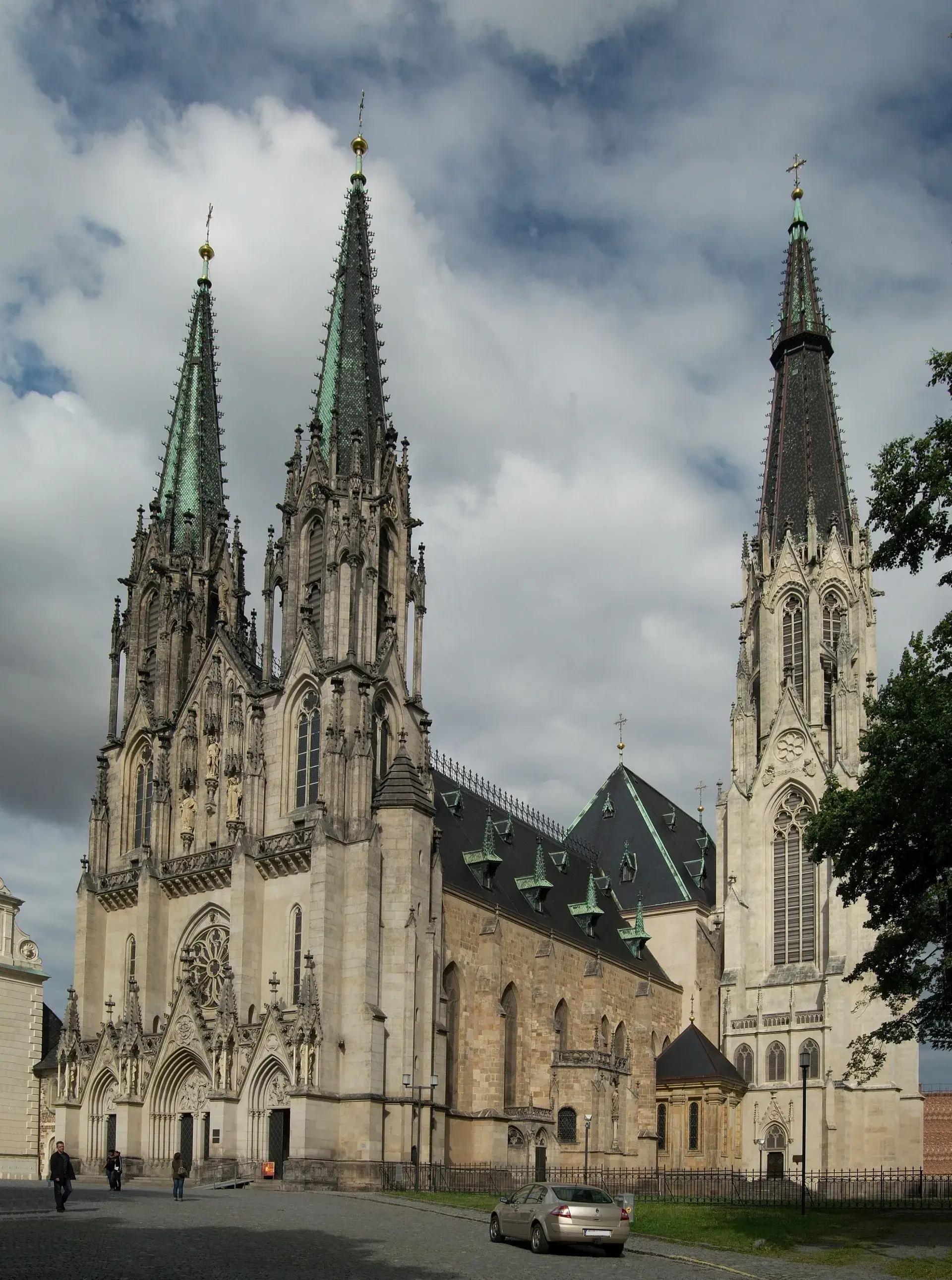
Stand before the tallest spire in Moravia, a towering Neo-Gothic landmark that marks both a spiritual center and a site of profound historical consequence. Saint Wenceslas Cathedral anchors Wenceslas Hill within the former Olomouc Castle complex. Functioning as the seat of the Roman Catholic Archdiocese of Olomouc, it remains the principal cathedral of Moravia and a vital spiritual counterpart to the secular Town Hall in the historic center.
A Legacy of Kings and Rebuilding
The cathedral's origins stretch back to between 1104 and 1107, initiated by Přemyslid Prince Svatopluk and consecrated in 1131 by Bishop Jindřich Zdík. Over the centuries, the structure evolved through multiple disasters and renovations. Following devastating fires in 1204 and 1265, the church underwent extensive Gothic reconstruction. Thirteen-century Gothic pillars still support the interior today.
In 1306, the cathedral grounds became the site of a royal tragedy. Sixteen-year-old King Wenceslaus III was assassinated in the adjacent capitular deanery. This shocking event abruptly terminated the centuries-old male line of the Přemyslid royal dynasty, altering the course of Bohemian history.
Architectural Evolution and Interior Design
The building is a three-aisled hall structure that blends its Romanesque foundations with later architectural styles. In the 17th century, Cardinal František of Dietrichstein oversaw the addition of a massive early Baroque presbytery. Natural light filters into this elevated presbytery through 1880s biblical stained glass. The cathedral is also known for its echoing acoustics, produced by an organ that is regarded as one of the finest Romantic-era instruments in the Czech Republic.
Between 1883 and 1892, Archbishop Friedrich of Fürstenberg commissioned a sweeping Neo-Gothic redesign. Architects Gustav Meretta and Richard Völkel transformed the exterior, adding three carved portals, a large rose window, and two 68-meter front towers.
The Spire, Bell, and Crypt
The most prominent feature of the late-19th-century renovation is the soaring 100.65-meter southern spire, which stands as the second-tallest church tower in the Czech Republic. The cathedral's belfry houses the eight-ton Saint Wenceslas Bell, the heaviest bell in all of Moravia.
Beneath the presbytery lies a two-level crypt supported by columns. This space serves as an exhibition area for liturgical vestments and as a burial ground for Olomouc bishops. Among the crypt's curiosities is a sealed wall compartment containing the heart of Austrian Archduke and Olomouc Archbishop Rudolf Jan, who requested his heart rest here rather than with his body in Vienna's Imperial Crypt. Above ground, visitors can also view a reliquary shrine preserving the remains of the martyred priest Jan Sarkander, canonized at the cathedral by Pope John Paul II in 1995.
FAQ
How tall is the spire of Saint Wenceslas Cathedral?
The southern spire of Saint Wenceslas Cathedral is 100.65 meters tall, making it the tallest church tower in Moravia and the second-tallest in the Czech Republic.
Who is buried in the crypt of Saint Wenceslas Cathedral?
The two-level crypt is a burial ground for Olomouc bishops. It also contains the heart of Austrian Archduke and Olomouc Archbishop Rudolf Jan, who requested it be sealed in the crypt wall while his body was buried in Vienna.
What happened to King Wenceslaus III at the cathedral?
In 1306, 16-year-old King Wenceslaus III was assassinated in the capitular deanery adjacent to the cathedral. His death ended the male line of the centuries-old Přemyslid royal dynasty.