Christiansborg Slotsplads: Copenhagen Palace Square
Denmark's Political and Royal Heart
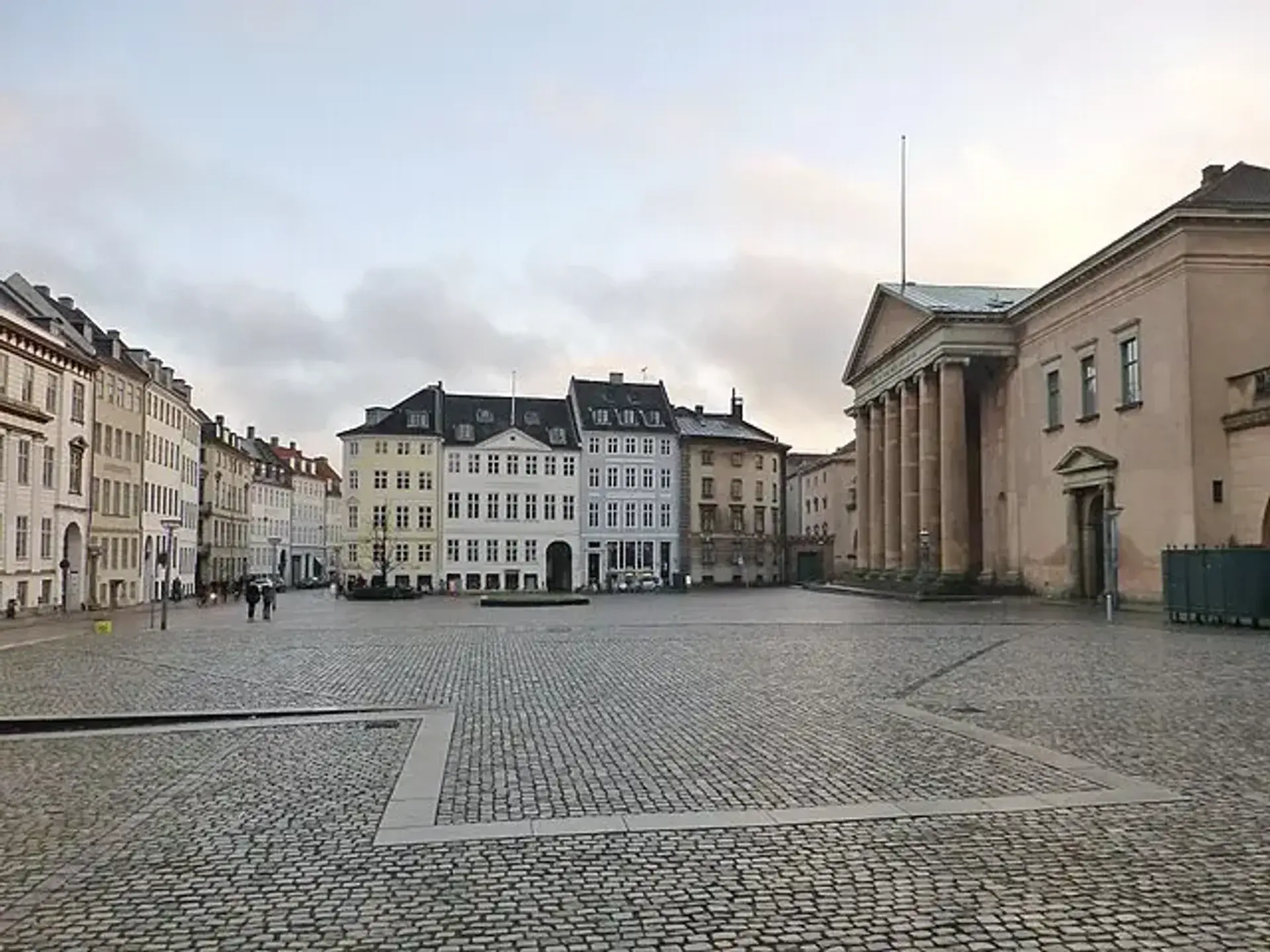
Christiansborg Slotsplads is the ceremonial urban square fronting Christiansborg Palace on the islet of Slotsholmen in central Copenhagen. The palace is unique as the seat of all three branches of the Danish government—the Folketing (Parliament), the Prime Minister's Office, and the Supreme Court—alongside the Royal Reception Rooms. Positioned at an urban crossroads, the square links the walking spine from Højbro Plads and Strøget with historic landmarks including Thorvaldsens Museum and the historic Stock Exchange.
The location has served as the core of Danish political and royal governance since 1167, when Bishop Absalon constructed Copenhagen's earliest fortress on the islet. That fortification was succeeded by Copenhagen Castle and three successive iterations of Christiansborg Palace. The present neo-baroque complex, designed by architect Thorvald Jørgensen, was built between 1907 and 1928 after a fire destroyed the previous palace in October 1884. During this reconstruction, granite stones were gathered from more than 700 parishes across Denmark to form the building's base, symbolizing the unity of the democratic nation.
Discover Copenhagen’s soul on a self-guided adventure
2.5 hours10 stopsAudio guideStart any day, at your own paceTicket on your phone · 30-day refundThe Birthplace of Danish Democracy
Christiansborg Slotsplads played a pivotal role in the transition of Denmark from an absolute monarchy to a constitutional democracy. On March 21, 1848, an estimated 10,000 citizens gathered on the plaza to demand constitutional reform. This peaceful mass demonstration led King Frederik VII to renounce absolute rule, culminating in the signing of Denmark's first democratic constitution on June 5, 1849.
At the center of the square stands a monumental bronze equestrian statue of Frederik VII, commissioned to commemorate this historic achievement through both public and state funding. Designed by sculptor Herman Wilhelm Bissen and completed by his son Vilhelm Bissen, the monument was unveiled in 1873. The pedestal is inscribed with the monarch’s motto, "Folkets Kiærlighed, min Styrke" ("The people's love, my strength"), and commemorates him as "Grundlovens Giver" ("Granter of the Constitution"). When fire engulfed Christiansborg Palace in 1884, the statue stood completely unharmed amid the surrounding ruins.
Architectural Harmony and Subtle Security
The visual character of Christiansborg Slotsplads combines classic Nordic stonework with modern public landscape architecture. The open ground is paved with nearly 200,000 recycled and dressed cobblestones, set beneath the 106-meter palace tower.
Defining the perimeter is an arc of 85 spherical granite bollards, installed during a comprehensive security and landscape redesign completed between 2018 and 2019. Crafted from Bornholm Moseløkke granite, each sphere weighs 1.7 metric tons. The bollards conceal anchored interior steel posts designed to serve as high-impact vehicle barriers. Rather than using conventional fencing or concrete walls, the smooth, waist-high globes were selected to blend seamlessly into the civic space, functioning as seating and play elements for the public.
Public Assembly and Proclamation Traditions
Today, the plaza remains Denmark's primary forum for civic expression, hosting political rallies, public demonstrations, and national democratic gatherings. It also provides pedestrian entry to the Christiansborg Palace Tower (Tårnet), the Palace Chapel, and state reception areas.
The square is also the traditional gathering point for royal accessions. Danish monarchs proclaimed from the palace balcony are traditionally hailed by the Prime Minister in three directions rather than four, as the fourth direction faces inward toward the palace Throne Room. Christiansborg Slotsplads filled with thousands of spectators on January 14, 2024, when Prime Minister Mette Frederiksen proclaimed King Frederik X from the balcony.
FAQ
What is the purpose of the granite balls around Christiansborg Slotsplads?
The 85 spherical Bornholm Moseløkke granite bollards serve as an anti-ram vehicle security barrier. Installed between 2018 and 2019, each 1.7-ton globe conceals an anchored steel core while doubling as public seating.
Who is the statue on Christiansborg Slotsplads?
The bronze equestrian statue depicts King Frederik VII. Designed by Herman Wilhelm Bissen and completed by Vilhelm Bissen, it was unveiled in 1873 to honor the king for signing Denmark's first democratic constitution in 1849.
Why are royal accessions proclaimed in only three directions from the balcony?
When a Danish monarch is proclaimed from the palace balcony, the Prime Minister calls out to three directions because the fourth direction faces inward toward the Christiansborg Palace Throne Room.