Gammeltorv: Guide to Copenhagen's Oldest Square
Gammeltorv, meaning "Old Market," is the oldest public square in Copenhagen. Situated in the Indre By district along the Strøget pedestrian route, this civic space has served as a primary gathering point and trading center since the early 12th century, predating Bishop Absalon's fortifications on Slotsholmen. Today, it forms a continuous open plaza alongside the adjoining Nytorv, serving as both a bustling commercial junction and a historic zero point for the city.
The Evolution of the Civic Center
Originating as an open-air trading venue and assembly ground for judicial proceedings, Gammeltorv became Copenhagen's administrative heart in 1479 when the city's town hall was erected on its southern perimeter. Between 1608 and 1610, King Christian IV rebuilt the town hall in the Renaissance style and cleared adjacent grounds behind it to create Nytorv ("New Square"). Public duties were subsequently divided between the two plazas: Gammeltorv accommodated general market commerce, while Nytorv hosted meat markets and public executions. Despite the name pairing, historical records indicate that Gammeltorv was officially distinguished as the "old square" in the 15th century to contrast with the newer Amagertorv.
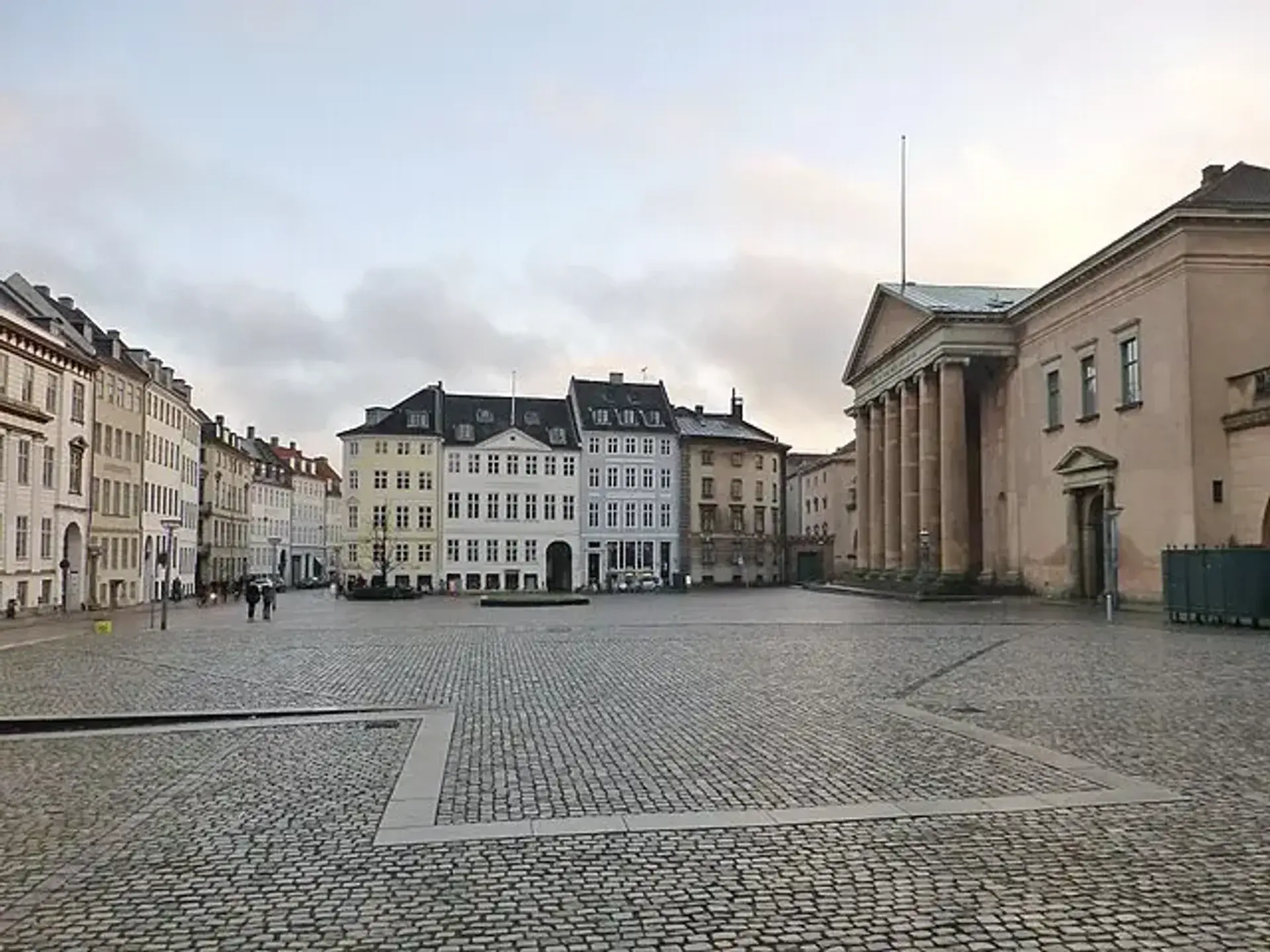
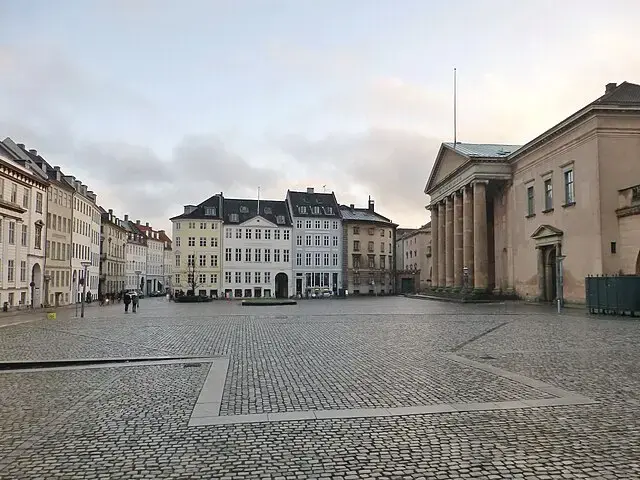
The town hall burned down during the Great Fire of 1728, was reconstructed in the Baroque style, and was destroyed once again by the Great Fire of 1795. Following the 1795 disaster, municipal authorities chose not to rebuild on the historic plot, opting instead to relocate city administration to a new Court House on Nytorv. This decision physically merged Gammeltorv and Nytorv into one interconnected civic area. During a 1993 renovation by city architect Otto Käszner, pale paving stones were embedded into the plaza surface to visually trace the subterranean footprint of the lost town hall.
Discover Copenhagen’s soul on a self-guided adventure
2.5 hours10 stopsAudio guideStart any day, at your own paceTicket on your phone · 30-day refundThe Caritas Fountain
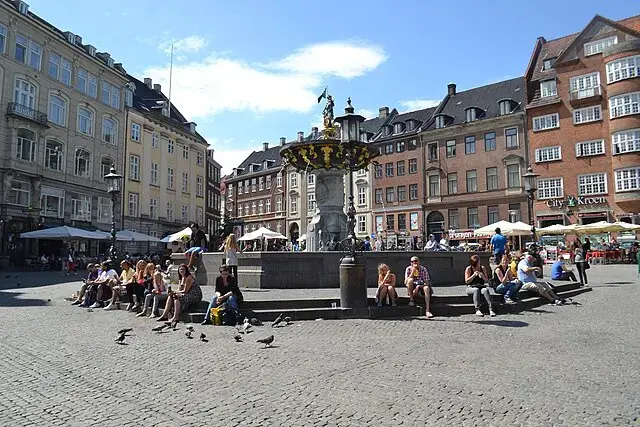
At the center of Gammeltorv stands Caritasbrønden (The Caritas Fountain), commissioned in 1608 by King Christian IV. Recognized as Copenhagen's oldest surviving fountain, the monument features tiered bronze and copper basins whose cascading waters provide an acoustic backdrop amidst pedestrian traffic along Strøget. An open sightline from the fountain aligns directly with the neoclassical façade and tower of Copenhagen Cathedral (Church of Our Lady).
Beyond its Renaissance artistry, the fountain originally operated as an essential municipal water source. It was fed from Lake Emdrup through a six-kilometer pipeline constructed of hollowed tree trunks, utilizing a natural nine-meter drop in elevation to generate water pressure. The fountain's bronze figures sparked controversy in the 19th century due to spouts that released water from the mother's breasts and the accompanying boy figure; authorities sealed these spouts from 1857 until 1940. A long-standing tradition dating back to the 18th century sees 24-carat gold-plated copper spheres, known as golden apples, placed atop the fountain's water jets on the monarch's birthday, balancing upon the streams.
Architecture and Contemporary Urban Life
Gammeltorv stands midway along Strøget, the central pedestrian thoroughfare connecting City Hall Square (Rådhuspladsen) with Kongens Nytorv. Much of the square's perimeter is lined with Neoclassical buildings erected in the wake of the 1795 fire. An exception to this historicist style is the Stelling House, located at the corner of Skindergade, which was designed by architect Arne Jacobsen as an early Functionalist landmark.
The plaza serves as an active civic space accessible day and night, hosting outdoor dining terraces, seasonal markets, street performers, and events such as Copenhagen Jazz Festival concerts. Reflecting its longstanding standing in the capital's geography, house numbers throughout Copenhagen traditionally measure outward from Gammeltorv, beginning with the lowest numbers at the end of each street situated closest to the square.
FAQ
What do the pale paving stones in Gammeltorv represent?
Installed during a 1993 renovation led by city architect Otto Käszner, the pale paving stones outline the underground foundation lines of Copenhagen's former town hall, which stood on the site until it was destroyed in the Great Fire of 1795.
What is the golden apples tradition at the Caritas Fountain?
Dating to the 18th century, 24-carat gold-plated copper spheres are placed atop the Caritas Fountain's water jets on the monarch's birthday, balancing and bobbing on the water streams.
How does street numbering in Copenhagen relate to Gammeltorv?
Gammeltorv serves as Copenhagen's traditional geographic reference point for street numbering, with address numbers starting at the end of each street positioned closest to the square.