Nytorv: Copenhagen's Historic Square & Court House
Origins as a Market and Execution Site
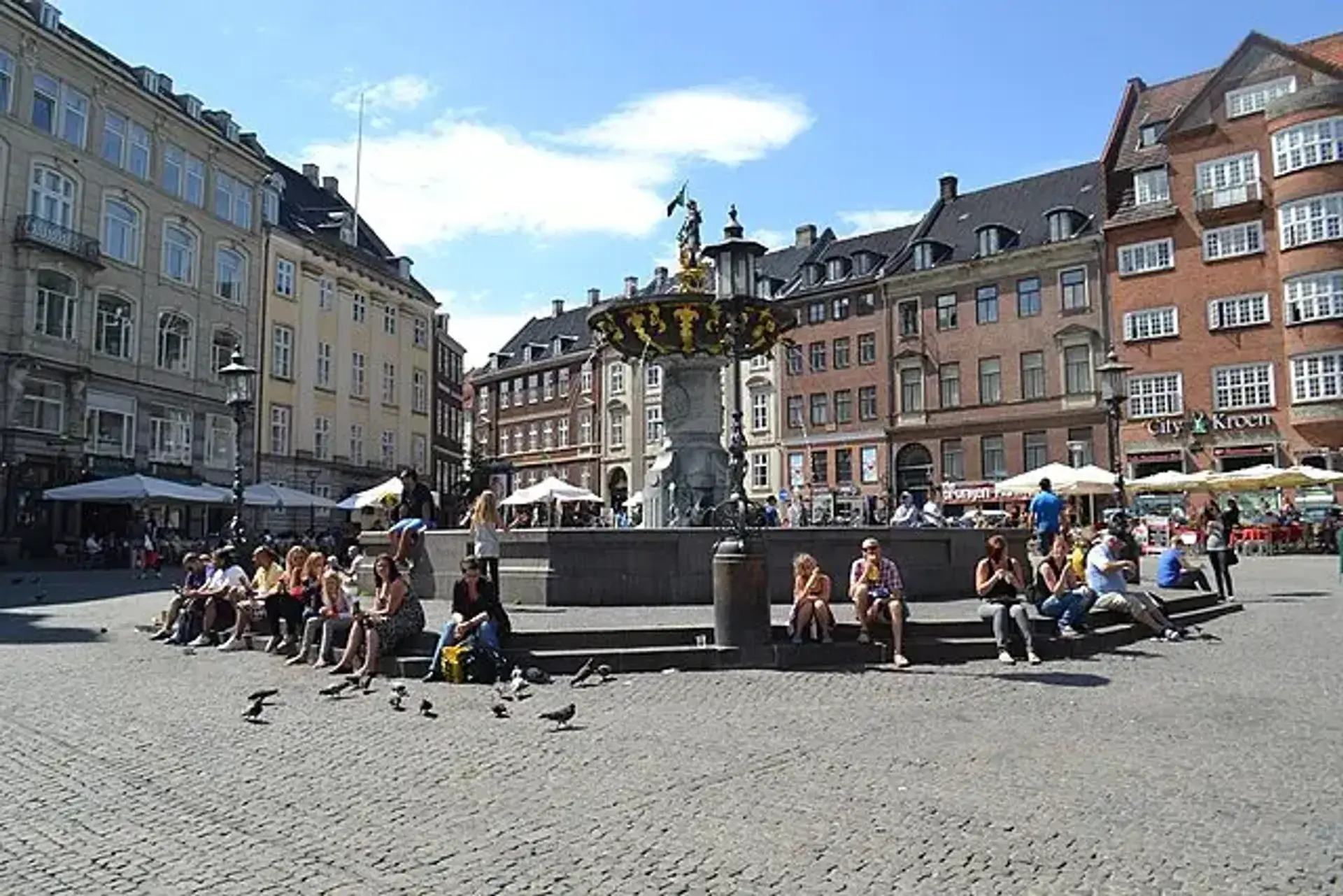
Nytorv, meaning "New Market," is a historic public square in Copenhagen's Indre By. Established between 1606 and 1610 under King Christian IV, the square was carved out behind the existing medieval city hall to provide meat butchers with a dedicated commercial space distinct from the produce stalls on neighboring Gammeltorv. Together, Nytorv and Gammeltorv form a central civic hinge along the east–west axis connecting Rådhuspladsen to Kongens Nytorv.
Throughout the 17th and 18th centuries, Nytorv served as the principal location for judicial enforcement and public punishment in Copenhagen. A permanent execution scaffold was erected in the square in 1627, accompanied by a whipping pillory. The site remained the focal point of the city's punitive system until major urban upheaval reshaped the district at the close of the 18th century.
Discover Copenhagen’s soul on a self-guided adventure
2.5 hours10 stopsAudio guideStart any day, at your own paceTicket on your phone · 30-day refundThe Great Fire and C.F. Hansen’s Courthouse
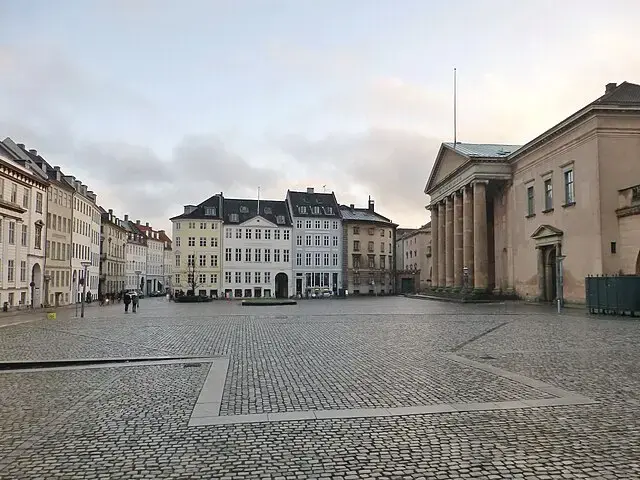
In 1795, the Great Fire of Copenhagen leveled the medieval city hall that had physically separated Nytorv from Gammeltorv. Rather than rebuilding on the historic dividing boundary, municipal authorities merged the two public spaces into a single open expanse and commissioned royal architect Christian Frederik Hansen to design a new combined civic complex on the western edge of Nytorv.
Completed and inaugurated in 1815, Hansen's Neoclassical building originally functioned as both City Hall and the municipal courthouse. It maintained this dual administrative role until 1905, when the current Copenhagen City Hall opened at Rådhuspladsen. Following the relocation of municipal government, the Hansen building became exclusively the headquarters of the Copenhagen District Court (Københavns Byret), a judicial role it continues to fulfill today.
Architectural Features and Historic Markers
The western facade of the Copenhagen Court House is defined by a massive Neoclassical portico supported by Ionic columns. Across the pediment is inscribed the Danish legal maxim, "Med lov skal man land bygge" ("With law shall the land be built"). Spanning Slutterigade to the rear is an enclosed, elevated archway linking the courthouse to the former jailhouse. Inscribed with "For almeen sikkerheden" ("For the public safety"), this structure was built as Copenhagen's counterpart to Venice's Bridge of Sighs, designed to transport accused prisoners directly into the court shielded from public view.
Physical traces of the square's earlier incarnations remain visible in its ground plane. Lighter-colored granite paving stones trace the exact rectangular footprint of the medieval city hall destroyed in 1795. Additionally, during a 1993 repaving project, a slightly raised octagonal stone podium was placed at the precise location of the 1627 scaffold, where it now serves as a public seating bench. The square also retains a preserved green octagonal telephone kiosk dating from the early 20th century.
Kierkegaard and Contemporary Public Life
Nytorv holds a strong connection to Danish philosophical history. Søren Kierkegaard was born facing the square on May 5, 1813, and resided there until 1848. While the Kierkegaard family residence was demolished in 1908—marked today by a commemorative plaque on the replacement bank building—the square was integral to his work. Kierkegaard spent hours pacing the plaza to observe local pedestrians, a routine he referred to as his "daily people bath" (menneskebad).
Today, Nytorv is fully pedestrianized and bisected by Strøget. The plaza accommodates outdoor café seating throughout the year and serves as an open-air venue for civic events and concerts, including public performances during the annual Copenhagen Jazz Festival.
FAQ
Why was Nytorv originally created?
King Christian IV established Nytorv between 1606 and 1610 to create a dedicated trading venue for meat butchers separate from the produce trade on adjoining Gammeltorv.
What is the purpose of the archway over Slutterigade?
Inscribed 'For almeen sikkerheden,' the enclosed bridge was built as Copenhagen's version of the Bridge of Sighs to transfer prisoners between the jailhouse and the courthouse away from public view.
How is the medieval city hall commemorated on the square?
The footprint of the medieval city hall destroyed in the 1795 fire is outlined in the square's ground using lighter-colored granite paving stones.
What was Søren Kierkegaard's connection to Nytorv?
Philosopher Søren Kierkegaard was born in a house facing Nytorv in 1813, lived there until 1848, and regularly strolled through the crowds to take what he termed a 'daily people bath.'