Rådhuspladsen: Copenhagen's Historic City Hall Square
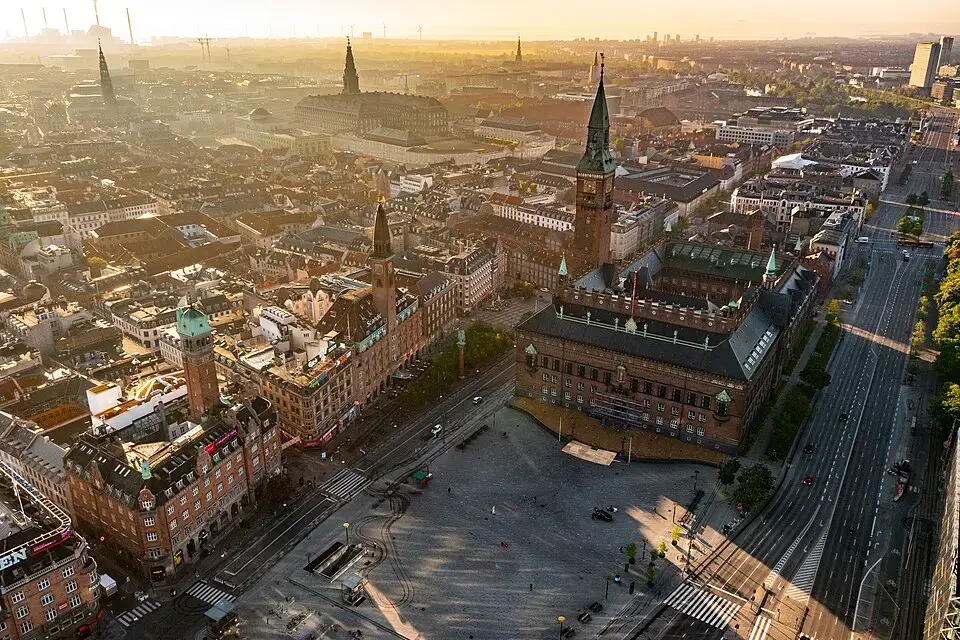
Rådhuspladsen, or City Hall Square, serves as the primary civic forum of Copenhagen. Located at the threshold between the medieval core of Indre By and the late-19th-century expansion of Vesterbro, the plaza marks the southwestern terminus of the pedestrianized shopping corridor Strøget. It also functions as Copenhagen’s historic zero-kilometer datum, the national benchmark traditionally used to calculate highway distances across Denmark.
Today, the expansive square forms an acoustic transition zone. Along its perimeter, the vehicular roar of H. C. Andersens Boulevard subsides into the pedestrian chatter and clicking bicycle gears of foot traffic entering the car-free stretches of the historic city.
From Hay Market to Civic Forum
Until the mid-19th century, the land occupied by Rådhuspladsen lay just beyond Copenhagen's fortified ramparts near the Western Gate (Vesterport). The open ground served as Halmtorvet, the municipal hay market. After the defensive walls were decommissioned and dismantled in the 1850s, the vacated grounds transformed into exhibition spaces, hosting both the Nordic Exhibition of 1872 and the Nordic Exhibition of 1888.
Architect Martin Nyrop designed a sprawling temporary wooden exhibition hall for the 1888 fair, an achievement that directly secured his commission to design the permanent City Hall complex. The foundation stones were laid in 1894, and the complete square opened in September 1905 as a grand public piazza inspired by Siena's Piazza del Campo.
Beneath the surface lies an even deeper historical chronology. Between 2011 and 2012, excavations for the Copenhagen Metro uncovered human burials and settlement layers dating back to approximately 1050 A.D. These archaeological findings proved that urban settlement at the site preceded Bishop Absalon’s celebrated 1167 fortifications by more than a century.
Discover Copenhagen’s soul on a self-guided adventure
2.5 hours10 stopsAudio guideStart any day, at your own paceTicket on your phone · 30-day refundKøbenhavns Rådhus and Architectural Landmarks
Dominating the southwestern boundary of the square is Copenhagen City Hall (Københavns Rådhus). Built between 1892 and 1905, the building exemplifies the National Romantic style, drawing architectural cues from the Palazzo Pubblico in Siena. Its clock tower reaches a height of 105.6 meters, while a gilded relief of Bishop Absalon presides above the main portal.
Overlooking the square stands the 1936 Art Deco Richshuset building, notable for its rooftop automated weather sculpture, Vejrpigen (The Weather Girl), created by Einar Utzon-Frank. The rotating mechanism displays a gilded woman riding a bicycle during clear weather, which switches to a figure holding an umbrella accompanied by a dog when rain is anticipated.
Along H. C. Andersens Boulevard, a bronze statue of author Hans Christian Andersen sits gazing toward Tivoli Gardens.
Notable Monuments and Legends
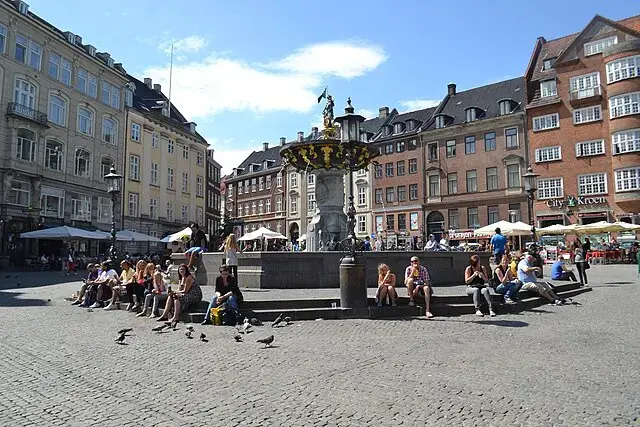
Several prominent monuments punctuate the plaza, led by the Dragon Fountain (Dragespringvandet). Conceived by Joakim Skovgaard and Thorvald Bindesbøll, the monument depicts a bull locked in combat with a dragon. Originally submitted for an 1880s design contest for Amagertorv, the fountain was erected at Rådhuspladsen in 1904. It was shifted 25 meters in the 1950s to accommodate street widening, during which its outer granite basin was removed to a suburban site. In 2023, the fountain was completely reassembled in its original configuration at the center of the square.
Nearby stands the Lur Blowers (Lurblæserne), a 20-meter-tall brick column inaugurated in 1914. Designed by architect Anton Rosen and topped with bronze figures sculpted by Siegfried Wagner, the column depicts horn players holding Bronze Age lurs. The monument was originally designed for a single horn player; however, Wagner adapted the design to place two figures onto the pedestal after archaeologists noted that authentic Scandinavian lurs were always cast and discovered in musically tuned pairs. According to local folklore, the silent horns will sound if a true virgin walks past the monument.
Contemporary Gathering Ground and Transit Hub
Rådhuspladsen remains the civic epicenter of Danish public life. It routinely accommodates political demonstrations, civic commemorations, national sports victory celebrations, and the gathering of crowds on New Year's Eve.
Below ground, an underground station serving the M3 Cityringen and M4 metro lines operates 24/7. Street-level skylights channel natural light down into the station, and an adjacent bike corridor bordered by trees organizes pedestrian and cycle traffic. Inside the metro concourse, high-gloss dark reflective glass panels echo the dynamic neon signage, streetlamps, and urban movement of the plaza above.
FAQ
Why are there two figures on the Lur Blowers column?
Although originally planned to depict only one horn player, sculptor Siegfried Wagner altered the composition after archaeologists pointed out that authentic Bronze Age lurs were always cast and excavated in musically tuned pairs.
What is the automated sculpture on the Richshuset building?
Known as Vejrpigen (The Weather Girl), this 1936 mechanical sculpture by Einar Utzon-Frank forecasts conditions: a gilded woman on a bicycle rotates outward for sunshine, while a woman with an umbrella and dog appears when rain is expected.
What archaeological remains were found beneath Rådhuspladsen?
Metro excavations between 2011 and 2012 uncovered human burials and settlement layers dating to around 1050 A.D., demonstrating urban activity on the site more than a century before Bishop Absalon built his 1167 fortifications.
What is the history of the Dragon Fountain?
Designed by Joakim Skovgaard and Thorvald Bindesbøll, the fountain depicts a bull battling a dragon. Installed in 1904, it was relocated in the 1950s and had its outer basin removed for decades before being fully restored and reassembled in the center of the square in 2023.