Pika Jala Väravatorn: Tallinn's Historic Gate Tower
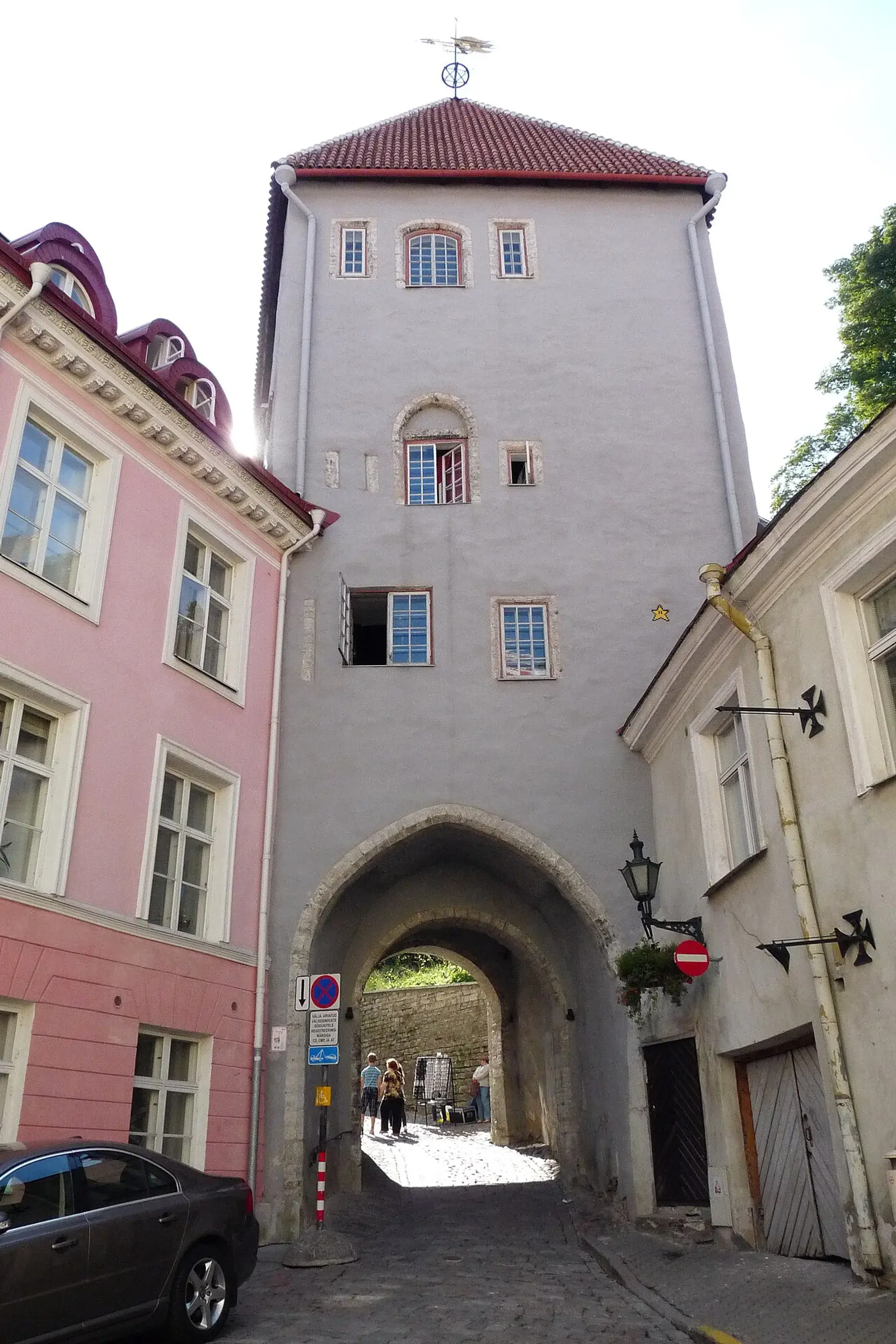
Pika Jala Väravatorn, or the Long Leg Gate Tower, is one of only two surviving gate towers in Tallinn and a pivotal landmark in the city's historical fabric. For centuries, it has stood as a guardian, controlling the passage between the lower town and the aristocratic Toompea Hill. Its history reflects the complex social and political dynamics of medieval Tallinn, evolving from a defensive fortress into a modern symbol of resilience.
A History of Division and Defense
The tower's origins lie in the tensions between the mercantile residents of the lower town (All-linn) and the powerful knights and nobles on Toompea Hill. Construction began in 1380 with a wooden tower, and in the same year, Ordumeister Wilhelm von Friemersheim granted permission for a stone gate building. The primary purpose was to safeguard the lower town from the perceived arbitrary actions of the ruling class. The city wall along Pikk Jalg street was even known as the "wall of mistrust," underscoring the deep-seated social divide.
For centuries, the gate was a controlled checkpoint, often requiring a tax for passage. It was closed nightly—at 9 PM during the Livonian Order's rule and 10 PM under Swedish administration. This practice continued until the late Tsarist era. The gate was briefly closed again in 1924 during a communist coup attempt.
Architectural Evolution
Pika Jala Väravatorn has undergone several transformations. Around 1450, the tower was reconstructed and expanded with the addition of two protective floors. A key architectural feature is its trapezoidal foundation, measuring 6.2 by 6.8 meters, which distinguishes it from the more common horseshoe-shaped battle fortresses of the era. In 1454, blacksmith Sepp Rosenberg funded the installation of its gates, and the following year, fellow blacksmith Sepp Klaus Denenil crafted two metal weathervanes for the structure.
The upper part of the tower was rebuilt in 1608. Much later, after a fire in 1995, a new roof was installed along with a new weathervane forged by metal artist Heino Müller, continuing the tower's legacy of craftsmanship.
From Fortress to Modern Symbol
Beyond its medieval function, the tower served various roles. During the 19th century, it housed a military garrison. In 1926, its purpose shifted dramatically when artist Ludvig Oskar renovated the tower into his personal living quarters and studio, illustrating its adaptability.
One of the tower's most significant modern moments occurred during the August Putsch in 1991. As Estonia sought to restore its independence, the gate's opening was intentionally blocked with a large granite cube. This decisive action was taken to physically prevent Soviet Pskov tanks from advancing on Toompea Hill, the seat of power, transforming the ancient defensive structure into a barricade for modern freedom.
The Tower Today
Today, the Pika Jala Väravatorn accommodates residential apartments and artists' studios (ateliers). It stands on Pikk Jalg street, which is recognized locally as an "art Mecca" where artists have sold their works for decades. Historically, the wider Pikk Jalg (Long Leg) street was the main route for horse-drawn vehicles, while pedestrians typically used the steeper Lühike Jalg (Short Leg) street to move between the upper and lower towns.
FAQ
Why was the Pika Jala Väravatorn built?
It was originally constructed as a defensive measure to protect the residents of the lower town (All-linn) from the knights and nobles residing on Toompea Hill and to control passage between the two distinct sectors of the city.
What is unique about the tower's architecture?
Unlike the typical horseshoe design of medieval fortresses, the Pika Jala Väravatorn features an unusual trapezoidal foundation.
What role did the tower play in 1991?
During the August Putsch in 1991, the gate's opening was blocked with a large granite cube to physically impede the potential advance of Soviet tanks towards Toompea Hill during Estonia's fight for independence.
What is the Pika Jala Väravatorn used for today?
The tower currently houses residential apartments and artists' studios. The street it is on, Pikk Jalg, is known as a hub for local artists selling their work.