Viru Gate: Historic Gateway to Tallinn's Old Town
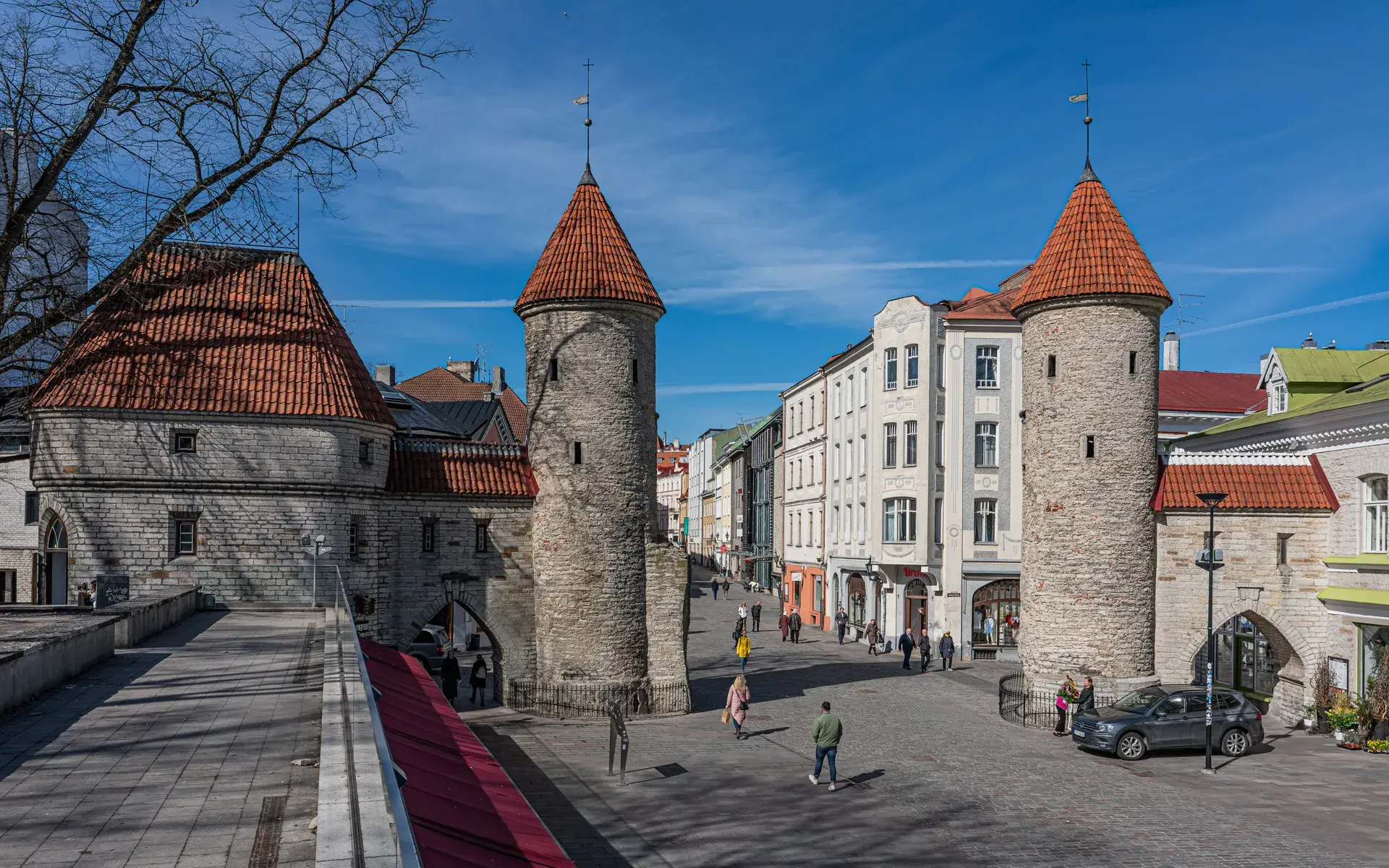
The Viru Gate, with its two distinctive ivy-covered towers, serves as the iconic entrance to the medieval Old Town of Tallinn, a UNESCO World Heritage site. These robust round towers with conical tiled roofs are a tangible link to the city's past, marking the transition from the modern city into a world of cobblestone streets and historic architecture.
A Medieval Stronghold
The Viru Gate was originally part of a complex and formidable defensive system built in the 14th century to protect the city, then known as Reval. The groundwork for Tallinn's fortifications was laid in 1265 by order of Margaret Sambiria, Queen of Denmark. The first mentions of the Viru Gate complex itself date to 1359. The structure was significantly enhanced over time; a stone gatehouse replaced old wooden structures in 1446, and the two surviving outer towers were added in 1454.
The original gate system was far more extensive than what remains today. It included powerful, square-based towers, a deep moat with a drawbridge, and a 'gersa'—a heavy lifting grate of iron-bound oak timber that could be dropped to trap invaders. The gate's German name, 'Lehmpforte' (Clay Gate), referred to the nearby clay pits.
From Defense to Urban Development
A significant turning point in the gate's history occurred in the late 19th century. As Tallinn expanded, the medieval fortifications were seen as an obstacle to modern development. In a surprising move, the main gate tower was dismantled in 1888. The primary reason for this demolition was to accommodate a new horse tram route. The two foregate towers survived simply because they did not impede the new flow of traffic.
The Viru Gate Today
Today, the Viru Gate is a symbolic and highly photographed landmark. It functions as a popular meeting point and a starting place for exploring the historic center. The gate opens onto Viru Street, one of the city's main commercial thoroughfares, bustling with boutiques, souvenir shops, restaurants, and nightclubs.
The area around the gate is a lively hub, featuring cafes, traditional market stalls, and distinctive flower vendors who have been a fixture in the location for decades, adding a vibrant and fragrant atmosphere to this historic portal.
FAQ
Why are there only two towers left at Viru Gate?
The original Viru Gate was a much larger complex. The main gate tower was demolished in 1888 to make way for a horse-drawn tram. The two towers that remain today were the foregate towers, which survived because they did not block the new traffic route.
When was the Viru Gate built?
The Viru Gate was part of Tallinn's 14th-century city wall system. The first historical mentions of the gate complex date to 1359, and the two surviving outer towers were constructed in 1454.
What was the original purpose of the Viru Gate?
The Viru Gate was a crucial part of Tallinn's medieval defenses. It served to protect the city from invaders and to control trade and movement into the city, which was then called Reval.