Tallinn Town Hall: A Gothic Baltic Landmark
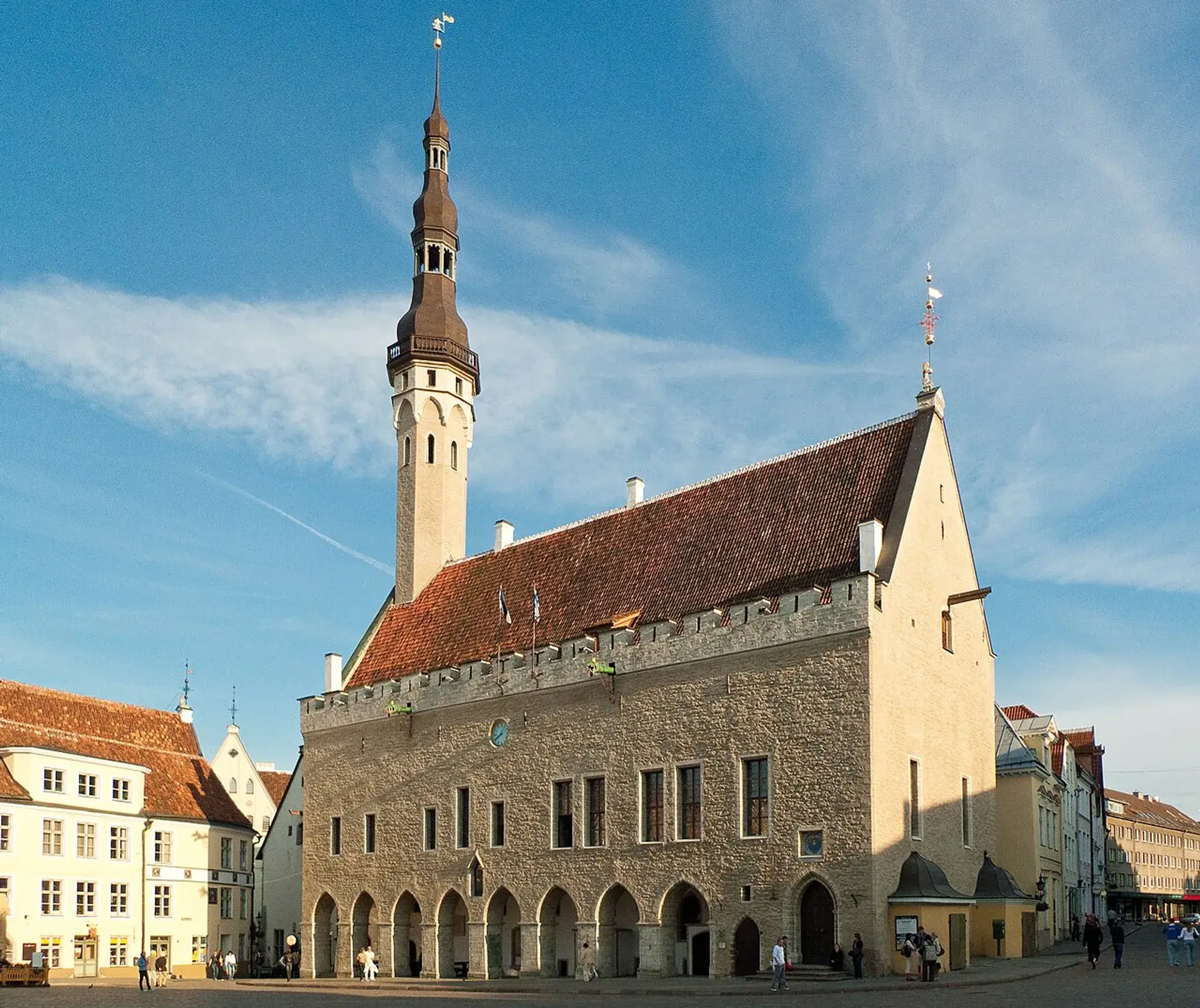
The Tallinn Town Hall is the oldest surviving Gothic town hall in all of Northern Europe and Scandinavia. Located in the heart of Tallinn's Old Town, a UNESCO World Heritage Site, this remarkable building stands as a symbol of centuries of municipal power and the city's medieval heritage. Its construction was not based on a single blueprint but was a unique synthesis of architectural ideas from across Europe, resulting in a truly distinct structure.
Architectural Evolution
The site of the Town Hall has been in use since the 13th century, initially as a meeting place and warehouse. The first explicit mention of a building, described as a 'consistorium' or meeting room, dates to 1322. As Tallinn's influence grew as a member of the Hanseatic League, a more representative building was required. Major expansion between 1371 and 1374 gave the hall its present length.
The building's current Gothic appearance was largely finalized by 1404, following a significant rebuilding project led by stonemason Ghercke. Due to its construction in several stages, the two-storey building has a slightly trapezoidal shape, measuring 36.8 meters long but tapering from 15.2 meters wide on its east wall to 14.5 meters on its west wall.
The Tower and Old Thomas
Dominating the structure is the 64-meter-high tower, topped with a Late Renaissance spire that was rebuilt in 1627 and finalized in 1781. This spire was destroyed during a Soviet air raid in 1944 but was carefully reconstructed in 1952.
Perched atop the spire is the famous weather vane, 'Old Thomas' (Vana Toomas), first installed in 1530. The figure is said to depict a peasant boy who won a crossbow competition and was subsequently made a town guard. The original 1530 vane is preserved in the Town Hall's cellar, a 1952 copy is in the Tallinn City Museum, and the current vane on the spire dates from 1996. The tower also houses an alarm bell cast in 1586 with an inscription asking for protection for the town from fire.
A Center of Civic Life
For nearly 700 years, until 1970, the Tallinn Town Hall served as the seat of the city's administration. Its role was central to the life of the Hanseatic city, functioning not only as a government building but also as a court of law from the 13th to the 19th century. It was also a commercial hub where new goods were introduced to the public.
The Town Hall Today
Currently, the Tallinn Town Hall serves as a ceremonial building for the city government, hosting official receptions and concerts. The vaulted Citizens' Hall is a popular venue for civil wedding ceremonies. During the warmer months, the building is open to visitors, who can explore historic interiors like the Trade Hall and the Council Chamber. Visitors can also climb the 115 steps to a balcony on the tower, located 34 meters high, for panoramic views of the Old Town.
FAQ
How old is the Tallinn Town Hall?
The site was used from the 13th century, and a building was first mentioned in records from 1322. The Town Hall achieved its current Gothic form following extensive rebuilding that was completed by 1404.
Can you go inside the Tallinn Town Hall?
Yes, the Town Hall is open to visitors, primarily during the warmer months. Guests can explore historic rooms like the Council Chamber and Citizens' Hall, and climb the tower for views of the Old Town.
What is the story of Old Thomas (Vana Toomas)?
Old Thomas is the name of the weather vane on the Town Hall's spire, first placed there in 1530. According to legend, it represents a peasant boy who, after winning a crossbow competition, was made a town guard. The original vane is now in the Town Hall's cellar.
Is the Tallinn Town Hall a UNESCO World Heritage Site?
The Tallinn Town Hall is a prominent landmark located within Tallinn's Old Town, which is designated as a UNESCO World Heritage Site.
Discover Tallinn like never before
Dive into Tallinn hidden stories and secret spots with Ciceru interactive tours.
Explore tour
Audioguide
Quizzes
Maps
Solo
Couples
Groups & families

© Tallinn_Town_Hall.jpg: Medvedev uploaded and derivative work by: MrPanyGoff | CC BY-SA 3.0