Kalevipoeg: Tartu War of Independence Memorial
Overview of the Memorial
The Tartu War of Independence Memorial (Tartu Vabadussõja mälestussammas), known colloquially across Estonia as Kalevipoeg, is a prominent cast-bronze monument located in central Tartu. Positioned in Freedom Boulevard park (Vabaduse puiestik) along the right bank of the Emajõgi River, it stands between the pedestrian Arch Bridge (Kaarsild) and Liberty Bridge (Vabadussild). The memorial anchors a green riverfront corridor that connects Town Hall Square (Raekoja plats) to the riverway, marking Tartu's role in the Estonian national awakening and the defense of the first republic.
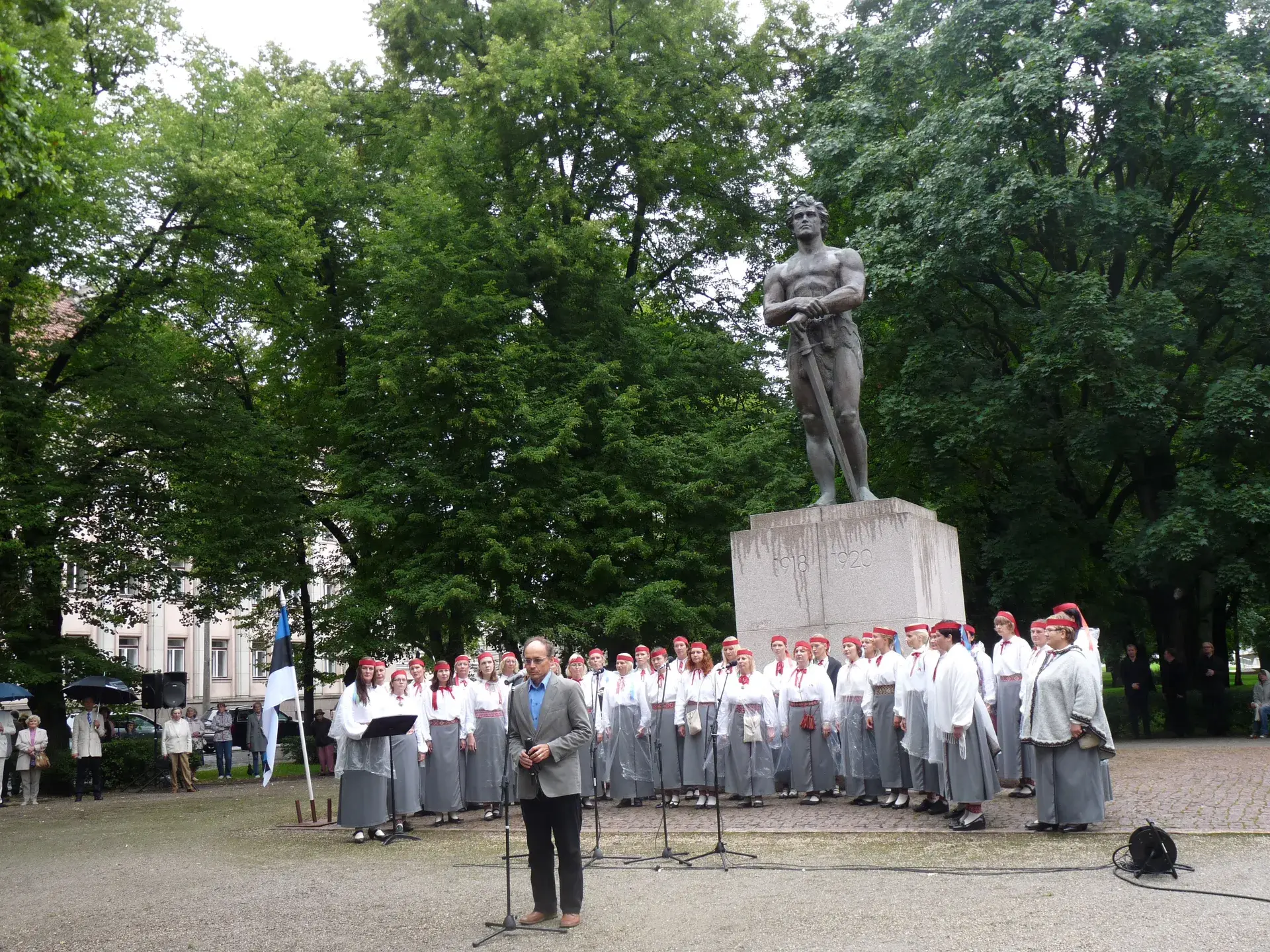
The monument depicts Kalevipoeg, the giant hero compiled from Estonian folklore by Friedrich Reinhold Kreutzwald. The bronze figure stands atop a stepped granite plinth inscribed with the dates "1918–1920." Clad at the waist in an animal hide, the hero gazes forward while resting on a grounded two-handed sword, serving as an allegorical representation of national resilience, physical strength, and self-determination.
Origins and the 1933 Original
The monument was commissioned to honor the Estonian soldiers who died during the Estonian War of Independence (1918–1920), a conflict that secured the sovereignty of the young Republic of Estonia. Sculptor Amandus Adamson created the bronze figure, while Aleksander Eller designed the original pedestal. The monument was officially unveiled on September 17, 1933.
Soviet Removal and the Kreutzwald Substitution
During the Soviet occupation, the memorial became a focal point of official censorship. In late 1940, authorities chiseled off the commemorative war dates from the plinth. In late April 1950, Soviet authorities dismantled and removed the entire statue. Local accounts indicate the bronze was moved to a depot yard on Kroonuaia Street to be melted down as scrap, alongside persistent local folklore that a bystander managed to sever and conceal the bronze head.
Despite the removal, Tartu residents and university students continued to hold quiet vigils, covertly placing candles and flowers at the vacant site. To eliminate this gathering point, Soviet authorities installed a monument to author Friedrich Reinhold Kreutzwald on the exact footprint in 1952, replacing the folkloric hero with his literary compiler.
Reconstruction and Modern Traditions
Following the restoration of Estonian statehood, initiatives began to reconstruct the fallen memorial. Because the original plaster cast had been destroyed in 1950, sculptor Ekke Väli had to remodel every anatomical contour and facial expression entirely from two-dimensional archival photographs, with consultation from sculptor Endel Taniloo. Architect Tiit Kaljundi designed the replacement granite plinth. To return the warrior to his historical site, the Kreutzwald statue was relocated slightly downstream along the park promenade. The recreated Kalevipoeg monument was unveiled on June 22, 2003, leaving both the author and his mythological character within a short stroll of one another.
Today, the site serves as the primary municipal venue for national ceremonies in Tartu. Official wreath layings and civic gatherings take place at the plinth on Independence Day (February 24) and Victory Day (June 23). During these observances, university student fraternities and sororities assemble by the monument in full academic regalia wearing traditional student caps (tekkel).
FAQ
Who created the original Kalevipoeg monument in Tartu?
The original bronze statue was created by sculptor Amandus Adamson, with a plinth designed by Aleksander Eller, and was unveiled on September 17, 1933.
What happened to the monument during the Soviet era?
The war dates were chiseled off in late 1940, and the entire monument was dismantled in late April 1950. In 1952, Soviet authorities placed a statue of author Friedrich Reinhold Kreutzwald directly on its former footprint to suppress clandestine memorial vigils.
How was the Kalevipoeg statue reconstructed in 2003?
Because the original mold was destroyed, sculptor Ekke Väli reconstructed the figure using surviving archival photographs, with input from Endel Taniloo and a pedestal designed by Tiit Kaljundi. It was reinaugurated on June 22, 2003.
What public events take place at the memorial today?
The monument hosts official municipal observances on Independence Day (February 24) and Victory Day (June 23), where local leaders and university student organizations gather in academic regalia.