Tartu Old Observatory: Science & UNESCO History
Neoclassical Architecture on Toome Hill
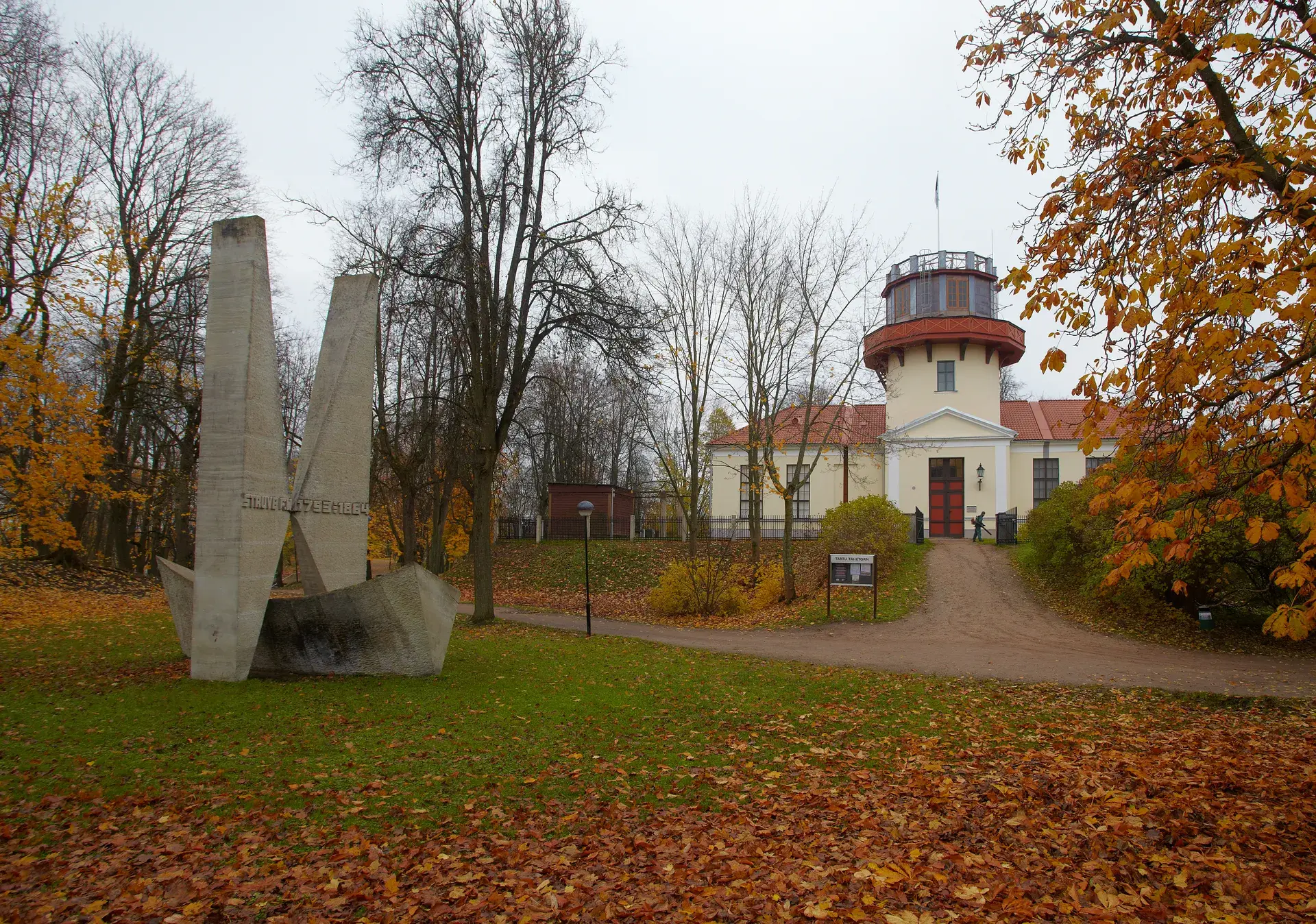
Tartu Old Observatory (Tartu Tähetorn) stands on the eastern crest of Toome Hill at Uppsala tänav 8 in Tartu, Estonia. Established on the site of a former medieval episcopal castle following the reopening of the University of Tartu in 1802, the observatory forms part of a neoclassical architectural triad designed by Johann Wilhelm Krause. Alongside the university's main building and the Cathedral library, the structure was constructed between 1808 and 1810 to establish Tartu as a center of scientific inquiry and higher education.
The building functioned as an active astronomical research facility from 1810 until 1964, at which point observational operations were transferred to the modern Tõravere Observatory.
The Fraunhofer Refractor and Astronomical Milestones
Under the direction of astronomer and geodesist Friedrich Georg Wilhelm von Struve, who worked at the observatory from 1813 and served as director from 1820 to 1839, the institution gained global renown. In 1824, the facility acquired the Great Dorpat Refractor, engineered by Bavarian optician Joseph von Fraunhofer. With a 9.6-inch lens and a clockwork-driven equatorial mount that automatically counteracted the Earth's rotation to track celestial bodies, it was the largest and most technologically advanced refracting telescope in the world at the time.
Using this instrument alongside meridian circles, Struve catalogued binary stars and completed one of the earliest reliable calculations of stellar parallax by measuring the distance to the star Vega in 1837. Later in the 19th century, observatory director Johann Heinrich von Mädler expanded the facility's legacy through detailed lunar cartography and public astronomy outreach.
Origin of the Struve Geodetic Arc
Tartu Old Observatory served as the primary baseline and operational origin for the Struve Geodetic Arc. Surveyed between 1816 and 1855, this 2,820-kilometre triangulation chain stretched from Hammerfest in Norway to the Black Sea, providing critical empirical measurements that confirmed the flattening of the Earth at its poles. The resulting survey network crosses territory that today spans ten modern nations: Norway, Sweden, Finland, Russia, Estonia, Latvia, Lithuania, Belarus, Ukraine, and Moldova.
In 2005, the Struve Geodetic Arc was inscribed as a UNESCO World Heritage Site. Tartu Old Observatory is preserved as one of three inscribed arc stations situated within Estonia, retaining an original geodetic reference marker on its grounds.
National Symbolism and Museum Collections
Beyond its scientific significance, the observatory holds a role in modern Estonian history. On February 24, 1989, during the Estonian national awakening, the blue-black-white national flag was publicly hoisted in Tartu atop the observatory tower for the first time in decades. The tower was chosen because it served as the most prominent elevated landmark visible across the city center.
Today, the building functions as a public science and astronomy museum managed by the University of Tartu Museum. The interior observation rooms retain the atmosphere of a 19th-century workshop, characterized by high ceilings, tall stone transit pillars, polished brass measuring circles, and heavy iron mountings. The museum houses the original Fraunhofer Great Dorpat Refractor, historical meridian circles, an antique Arabic celestial globe, interactive space exhibitions, and a planetarium.
FAQ
Why is Tartu Old Observatory a UNESCO World Heritage Site?
The observatory was inscribed in 2005 as a vital component of the Struve Geodetic Arc, serving as the central origin station for the 2,820-kilometre meridian survey that accurately measured the curvature and shape of the Earth.
What significant astronomical equipment is preserved at the observatory?
The museum houses the original 1824 Great Dorpat Refractor crafted by Joseph von Fraunhofer—once the largest refractor in the world—along with historic meridian circles and an antique Arabic celestial globe.
When did the observatory cease active astronomical research?
Scientific research continued at the Toome Hill site until 1964, when main observational operations moved to the newer Tõravere Observatory.