Tartu Town Hall Square: Guide to Raekoja Plats
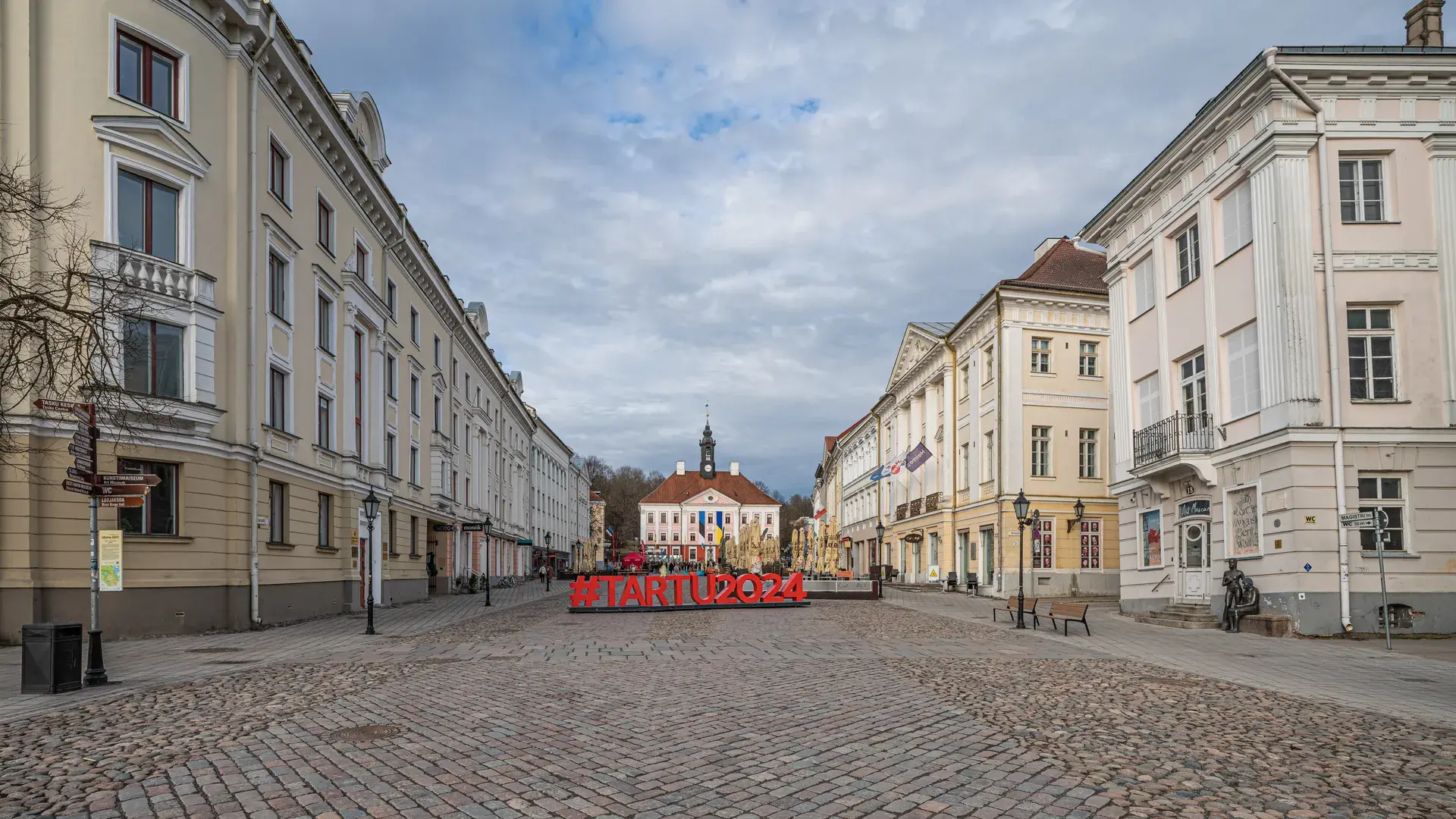
Tartu Town Hall Square (Raekoja plats) serves as the civic and social center of Tartu, Estonia. Formed in an elongated trapezoidal shape, the cobblestone square slopes gently down from the foot of Toome Hill to the banks of the Emajõgi River. This layout reflects its long-standing role as a spatial bridge linking the city's academic and defensive heights with its historical riverfront trade networks.
Architectural Rebirth After the Great Fire
In medieval times, the plaza served as Tartu's primary commercial market, connecting the stronghold atop Toome Hill directly with the busy river harbor. The district took on its current appearance after the Great Fire of 1775 swept through Tartu, destroying central wooden housing as well as earlier town halls.
In the decades following the catastrophe, city planners rebuilt the central district in durable masonry. The resulting ensemble created a cohesive urban environment framed by classicist and neoclassical facades painted in soft pastel tones of peach, cream, and pink.
The Historic Town Hall and Carillon
Presiding over the upper end of the square is the Tartu Town Hall (Raekoda), the third municipal building constructed on this site. Master builder Johann Heinrich Bartholomäus Walter of Rostock designed the structure, laying the cornerstone in 1782. The building officially opened in 1786, with interior work completed in 1789.
Walter's design blends early Classicism with a late Baroque clock tower completed in 1784 and a decorative Rococo cartouche on the main pediment. Engineered for civic administration and utility, the original layout placed a guardroom and jail in the vaulted cellar and left wing, public measuring rooms and scales with direct cart access in the right wing, and the formal council chamber (Raesaal) on the second floor.
Today, the Town Hall remains the working municipal headquarters of both the Tartu City Council and the Tartu City Government. The ground level hosts a long-operating community pharmacy alongside the Tartu Visitor Centre. Overhead, the clock tower holds Estonia's largest carillon, featuring 34 bells that chime coordinated musical selections five times every day.
The Kissing Students Fountain
Directly in front of the Town Hall stands the Kissing Students (Suudlevad tudengid) fountain, one of Tartu's most recognizable landmarks. The central bronze sculpture, created by Estonian artist Mati Karmin, depicts two students embracing beneath an umbrella and was unveiled in 1998.
The artwork has roots in a mid-century ritual: after the fountain basin was first installed in 1948, local university students and newlyweds regularly stepped into the water for good luck. This practice inspired Karmin's eventual sculpture. Surrounding the fountain, granite stones inlaid in the pavement since 2006 highlight the directions, names, and exact distances to Tartu's twin and partner cities across Europe.
The Leaning Barclay de Tolly House
Along the northern edge of the square stands the Barclay de Tolly House at Raekoja plats 18, constructed in 1793. The building is renowned for its noticeable tilt of roughly 5.8 degrees, an angle steeper than that of the Leaning Tower of Pisa.
The tilt occurred because the structure was built over two different soil conditions. One side rested securely on the remains of Tartu's medieval defensive wall, while the other side was supported by timber poles driven into the soft alluvial soil near the river. When local groundwater levels shifted, the wooden foundation settled unevenly. Stabilized in the 1980s without changing its slant, the building now houses the Tartu Art Museum (Tartmus). It also holds literary significance, as prominent Estonian writer Oskar Luts worked inside the building as an apprentice pharmacist in the late 19th and early 20th centuries.
Civic Life and Community Traditions
Raekoja plats functions as an open pedestrian venue throughout the entire year. During the warmer months, the plaza fills with outdoor café seating, open-air concerts, and major student gatherings, including events for university matriculation and the annual Tudengipäevad student festivals. In winter, the square transforms into a festive gathering space, hosting an open-air ice rink and Tartu's traditional Christmas market.
FAQ
Why does the Barclay de Tolly House lean?
Built in 1793, one side of the house was founded on Tartu's solid medieval city wall, while the other rested on timber piles in soft alluvial riverbank soil. As groundwater levels shifted, the wooden pilings subsided, leaving the structure tilted at an angle of roughly 5.8 degrees.
What inspired the Kissing Students fountain?
After the fountain basin was installed in 1948, a tradition arose where university students and newlyweds waded or swam in the water for good luck. Sculptor Mati Karmin drew upon this local tradition when designing the bronze sculpture unveiled in 1998.
When do the bells at Tartu Town Hall play?
The 34-bell carillon in the Town Hall tower plays set musical programmes five times each day, chiming at 09:00, 12:00, 15:00, 18:00, and 21:00.