Cours Mirabeau: Aix-en-Provence's Historic Avenue
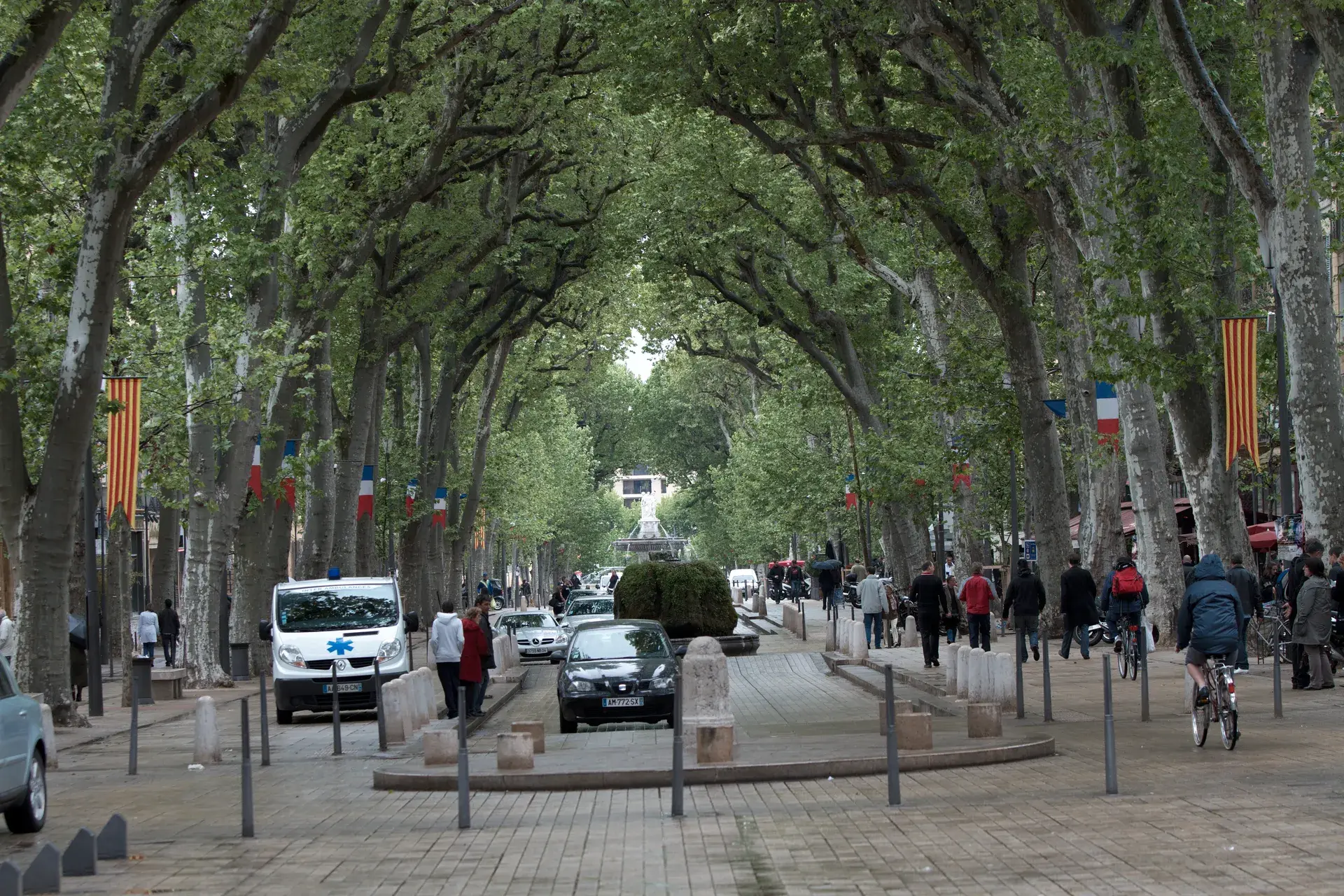
Cours Mirabeau is a 440-meter-long and 42-meter-wide boulevard running east-west through the center of Aix-en-Provence. Stretching from Place de la Rotonde in the west to Place Forbin in the east, it forms the structural boundary between the dense, irregular streets of the medieval old town to the north and the orthogonal grid of the 17th-century Mazarin district to the south. Four rows of mature plane trees flank the wide avenue, casting dappled shade across facades constructed from yellow-ochre Bibémus sandstone.
Origins and Architecture
The creation of the boulevard dates to the period between 1649 and 1651, following Archbishop Michel Mazarin's 1646 initiative to expand the city southward. Rather than constructing dense tenements over the razed medieval ramparts and moat, local authorities and bourgeois residents preserved the open strip as a grand carriage promenade.
Throughout the late 17th and 18th centuries, regional parliamentarians and nobles erected grand private mansions along the avenue. Builders enforced strict height-uniformity rules to maintain an orderly classical perspective along the thoroughfare. Originally known simply as "Le Cours," the avenue was officially renamed in 1876 to honor Honoré-Gabriel Riqueti, Comte de Mirabeau, who represented Aix-en-Provence at the Estates-General in 1789.
Notable architectural landmarks line the southern side of the avenue, including the Hôtel Maurel-de-Pontevès at No. 38. Built around 1647 for the cloth merchant Pierre Maurel, the mansion features an exterior balcony supported by two muscular stone Atlantes sculpted by Jacques Fossé. At No. 55, painter Paul Cézanne lived as a child, on the site where his father operated a hatter’s shop before transitioning into banking.
The Fountains of the Cours
Four prominent fountains punctuate the length of Cours Mirabeau, each reflecting a different period of the city's civic development:
- Fontaine de la Rotonde (1860): Standing at the western terminus, this monumental fountain marks the entrance to the promenade and is surmounted by three marble statues representing Justice, Fine Arts, and Agriculture and Commerce.
- Fontaine des Neuf-Canons (1691): Designed by Laurent Vallon, this structure features nine spouts and low, sloping basins. Despite the boulevard's elite status, it was intentionally built to serve as a public watering trough for transhumance sheep migrating across Provence.
- Fontaine Moussue (1667): The oldest fountain on the promenade is supplied by thermal spring water emerging at an approximate temperature of 18 °C. Over time, mineral deposits and moss have encased it in a large, rounded mound of calc-tufa. On cold mornings, the warm thermal water produces visible plumes of vapor.
- Fontaine du Roi René (1823): Located at Place Forbin on the eastern end, this monument features a marble statue sculpted by David d'Angers. The monarch is depicted holding a cluster of Muscat grapes, commemorating the tradition that he introduced the grape variety to Provençal viticulture.
Civic and Cultural Life
During the 19th and 20th centuries, the ground floors of the avenue's historic mansions evolved into commercial establishments, banks, and cafés. Among these was Café Les Deux Garçons at No. 53 bis, housed inside the 1660 Hôtel de Gantès, which served as a regular meeting place for Paul Cézanne and Émile Zola. The café's historic interior was gutted by a fire in November 2019, leaving the establishment closed for extended reconstruction.
Cours Mirabeau remains the central pedestrian and civic corridor of Aix-en-Provence. The northern side of the boulevard is lined with open-air café terraces, brasseries, and boutiques, while morning open-air markets selling textiles and clothing regularly occupy the broad walkways.
FAQ
Why was the Fontaine des Neuf-Canons designed with low basins?
Although surrounded by aristocratic residences, the 1691 fountain was deliberately built with low, sloping basins to function as a drinking trough for transhumance sheep herds traversing Provence.
Why does the Fontaine Moussue release steam during winter mornings?
The fountain is fed by a natural thermal spring that flows at a constant temperature of roughly 18 °C (64 °F), creating visible vapor plumes when contrasting with cold morning air.
Who is Cours Mirabeau named after?
Known as "Le Cours" until 1876, the boulevard was renamed to honor Honoré-Gabriel Riqueti, Comte de Mirabeau, who represented Aix-en-Provence at the 1789 Estates-General during the French Revolution.