Halle aux Grains: Aix's Historic Grain Exchange
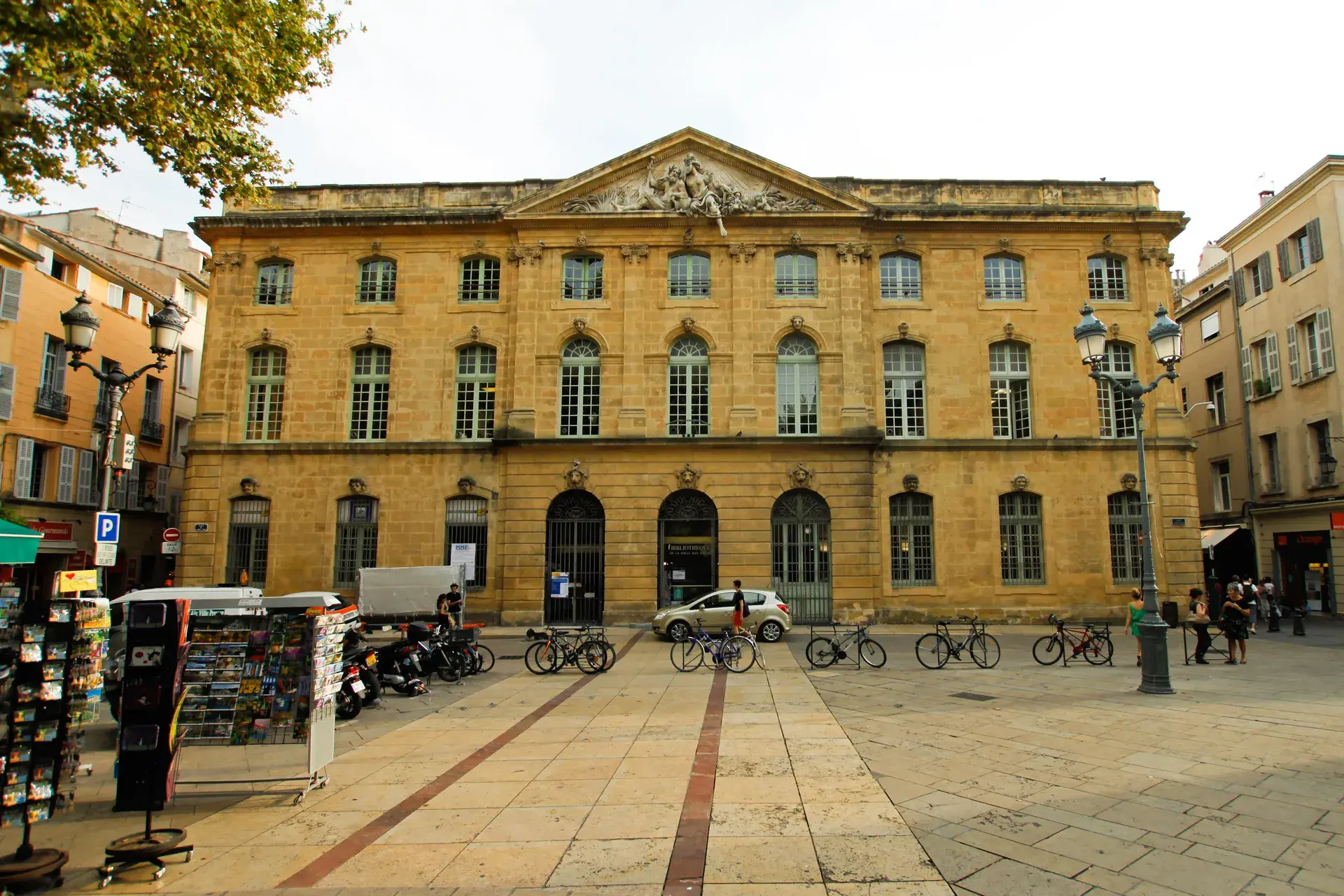
Standing between Place de l'Hôtel de Ville and Place Richelme in the historic center of Aix-en-Provence, the Halle aux grains is an 18th-century classical civic building that once anchored the regional agricultural economy. Commissioned by the municipal council, the structure was built between 1759 and 1766–1767 to expand an earlier 1718 storehouse. City architect Georges Vallon designed the exchange, developing the site previously drafted by his father, Laurent Vallon. Constructed from local honey-colored limestone, the building's facades and roof were designated as a French Monument Historique on March 21, 1983.
Architectural Grandeur and Dual Facades
The Halle aux grains functions as an urban pivot connecting the civic sphere of Place de l'Hôtel de Ville to the commercial activity of Place Richelme. Built during an 18th-century civic embellishment movement that applied classical grandeur to utilitarian structures, the building was designed with two distinct architectural treatments.
Facing north toward the town hall, the facade presents a monumental classical elevation ordered specifically to balance the Baroque Hôtel de Ville across the square. In contrast, the southern facade overlooking Place Richelme features rustic carvings depicting wheat sheaves, olives, and fruit. This southern elevation aligns directly with the daily open-air market, where stalls selling fresh herbs, cheese, fruit, and flowers stand against the limestone walls.
The Allegorical Pediment and the Dangling Foot
The northern facade is crowned by an elaborate triangular pediment sculpted by Jean-Pancrace Chastel. The sculpture centers on an allegorical composition celebrating Provence’s waterways and agricultural wealth. It pairs Saturn holding an oar, representing the calm, navigable Rhône River, with the goddess Cybele, adorned with ears of wheat and cornucopias to personify the fertilizing Durance River.
Chastel included a deliberate subversion of classical framing in Cybele’s depiction: her bare foot extends past the base of the scene and dangles over the lower cornice into empty space. This sculptural detail symbolizes the turbulent nature of the Durance and its historical propensity to flood and break its banks. The unruly motif connects to an old Provençal adage naming the Parliament, the Mistral wind, and the Durance River as the three scourges of Provence.
Evolution from Grain Exchange to Civic Hub
Until the French Revolution, the building served as a depot, weighing hall, and trading exchange for grain. It played an essential administrative role in collecting the piquet, a municipal tax levied on wheat that provided a major source of revenue for the city treasury.
Following the decline of the grain exchange, the structure adapted to various civic uses. Between 1896 and 1922, it housed the Aix Labor Exchange (Bourse du Travail). In 1923, architect Armand Liautaud directed its conversion into the city's central post office. Later, in 1971, a municipal library branch opened within the ground floor's heavy stone groin vaults. Today, the Halle aux grains operates as a multi-use civic building containing a branch of La Poste, municipal offices, and the Bibliothèque Méjanes – Halle aux Grains.
FAQ
What was the original purpose of the Halle aux grains?
It was constructed in the 18th century as a municipal grain depot, weighing hall, and trading exchange, as well as a collection point for the city's wheat taxes.
What does the sculpture on the northern pediment represent?
Sculpted by Jean-Pancrace Chastel, the pediment features allegories of Provence's primary waterways: Saturn holding an oar represents the navigable Rhône, and Cybele adorned with wheat represents the fertilizing Durance River.
Why does a sculpted foot dangle off the pediment ledge?
The sculptor carved Cybele's bare foot extending past the bottom cornice into empty space to symbolize the Durance River's tendency to overflow its banks.
What functions does the building serve today?
The building houses a branch of the French postal service (La Poste), municipal administrative offices, and the Bibliothèque Méjanes public library branch located beneath the vaulted ground floor.