Cathédrale Saint-Sauveur in Aix-en-Provence
Cathédrale Saint-Sauveur d'Aix-en-Provence, formally the Cathedral of the Holy Savior, stands as an architectural record of the city's evolution from antiquity to the modern era. Situated at Place des Martyrs de la Résistance along the path of the ancient Roman Via Aurelia, the complex anchors the northern boundary of the historic pedestrian center. Classified as a French Monument Historique in 1840, the building serves as the mother church of the Archdiocese of Aix and Arles and continues to host an active parish community.
Subterranean remains beneath the cathedral and its courtyard align with the civic forum of Roman Aquae Sextiae. While regional traditions suggest an initial Christian sanctuary founded by Saint Maximinus or erected over a pagan temple to Apollo, the earliest confirmed structural layer is an octagonal Early Christian baptistery constructed between the 5th and 6th centuries.
Three Parallel Naves Under One Roof
Most medieval cathedrals in Europe developed vertically, clearing older stonework to erect larger structures in contemporary styles. Cathédrale Saint-Sauveur expanded horizontally instead. Over several centuries, builders constructed three distinct naves side by side, leaving each phase intact under a single unified roofline.
The southern nave represents the 12th-century Romanesque cathedral, characterized by heavy stone barrel vaults, antique-inspired decorative friezes, and Corinthian capitals. Adjacent to it stands an expansive Flamboyant Gothic central nave, begun in 1285 and completed in the early 16th century with high ribbed vaults and lateral chapels. In the 17th century, architects Laurent and Jean Vallon balanced the complex by adding a Classical Baroque nave along the northern side.
The Merovingian Baptistery and Cloister
The cathedral's early Christian heritage centers on its 5th-to-6th-century octagonal baptistery. Built during the Merovingian era, the chamber incorporates eight repurposed Roman Corinthian marble columns. At its center lies a sunken basin designed for baptism by total immersion, historically connected to ancient Roman conduit systems.
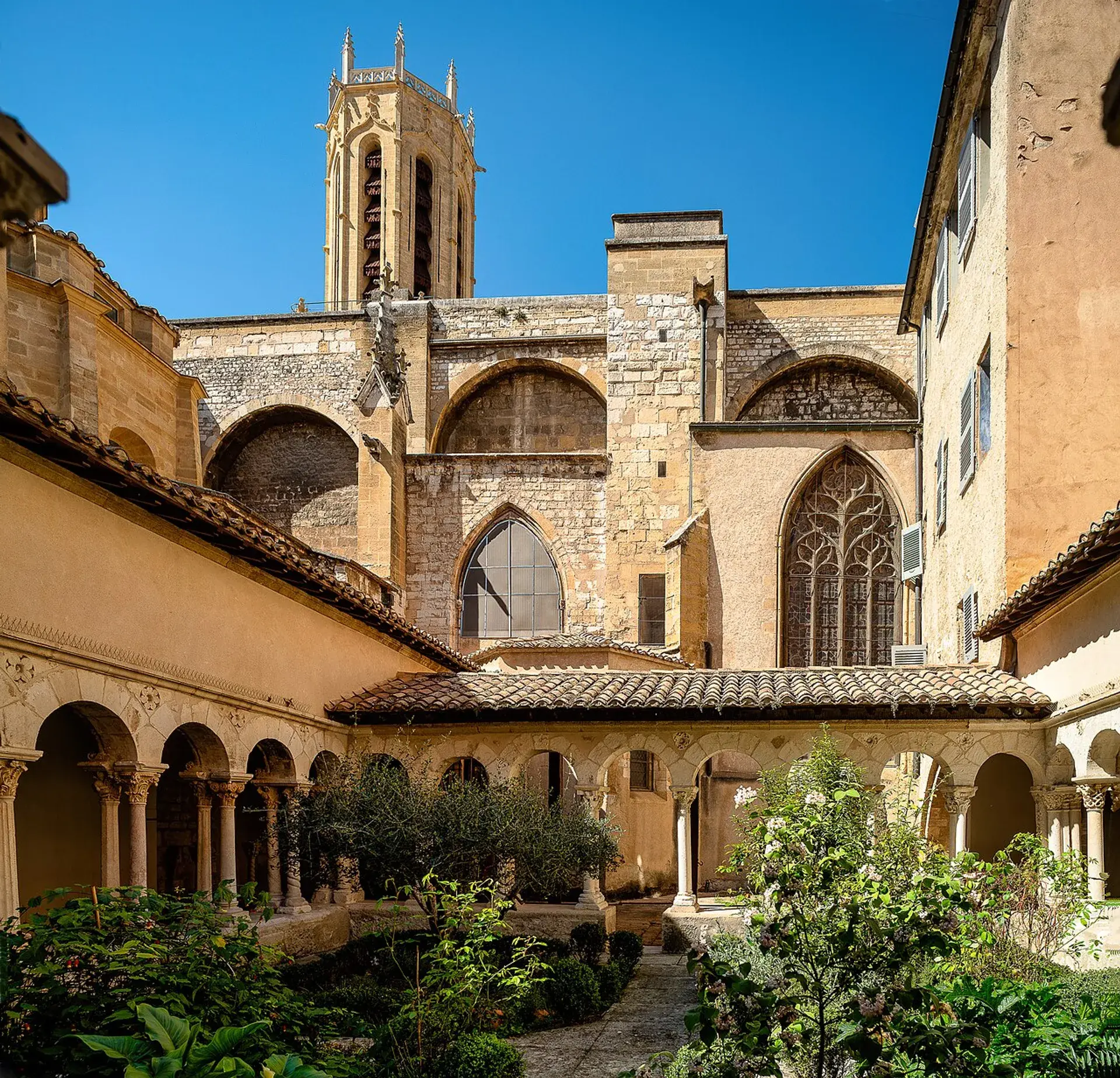
Adjoining the southern Romanesque nave is a late 12th-century cloister. This secluded quadrangle features carved stone capitals and covered galleries that offered quiet domestic and reflective space for the cathedral's resident canons.
Carved Portals and Artistic Treasures
The western facade showcases a Flamboyant Gothic portal complemented by an octagonal bell tower constructed between 1323 and 1425. Set into the main entrance are intricately carved walnut doors crafted between 1500 and 1508 by Toulon sculptor Jean Guiramand. Protected behind folding exterior shutters, these panels juxtapose four Old Testament prophets with twelve pagan Sibyls, capturing the Renaissance humanist belief that ancient prophetesses anticipated the Nativity. While most facade statues were damaged during the French Revolution—leaving only the central trumeau Virgin and the figure of Saint Michael—replacements were installed during 19th-century restoration campaigns.
Inside, the cathedral preserves significant works of religious art, most notably Nicolas Froment’s 15th-century triptych, The Burning Bush (Le Buisson Ardent). Commissioned around 1475 by King René of Anjou and Queen Jeanne de Laval, the painting depicts the Virgin and Child framed by the burning bush above Moses. To protect its pigments, the triptych's shutters remain closed except during designated viewing times. The cathedral also preserves modern cultural ties; post-impressionist painter Paul Cézanne was baptized in the cathedral in 1839, and his funeral was held beneath its vaults in October 1906.
Visiting and Practical Details
Cathédrale Saint-Sauveur is open daily throughout the year with free admission. In addition to serving as a heritage monument, it remains a working house of worship, holding daily morning services and Sunday masses. The Romanesque cloister can be visited according to posted management schedules, and on-site digital integration through the Aix Cathédrale Connect system provides interpretive historical markers throughout the interior.
FAQ
What makes the architecture of Cathédrale Saint-Sauveur unique?
The cathedral grew horizontally rather than vertically. It features three complete, distinct naves standing side by side under one roof: a 12th-century Romanesque south nave, a Flamboyant Gothic center nave, and a 17th-century Baroque north nave.
What is the history of the cathedral's baptistery?
Dating to the 5th or 6th century, the octagonal baptistery is an Early Christian structure that incorporates eight reused Roman Corinthian columns and a sunken basin designed for baptism by immersion, originally connected to Roman water networks.
Which famous artwork is housed in Cathédrale Saint-Sauveur?
The cathedral houses Nicolas Froment's 15th-century triptych 'The Burning Bush' (Le Buisson Ardent), commissioned by King René of Anjou. Its panels are typically kept closed for conservation except during scheduled viewing periods.
How is Paul Cézanne connected to the cathedral?
The Aix-born painter Paul Cézanne was baptized at Cathédrale Saint-Sauveur in 1839, and his funeral service was conducted inside the cathedral in October 1906.