Fontaine de la Rotonde: Aix's Grand Gateway
A Monumental Entrance to Aix-en-Provence
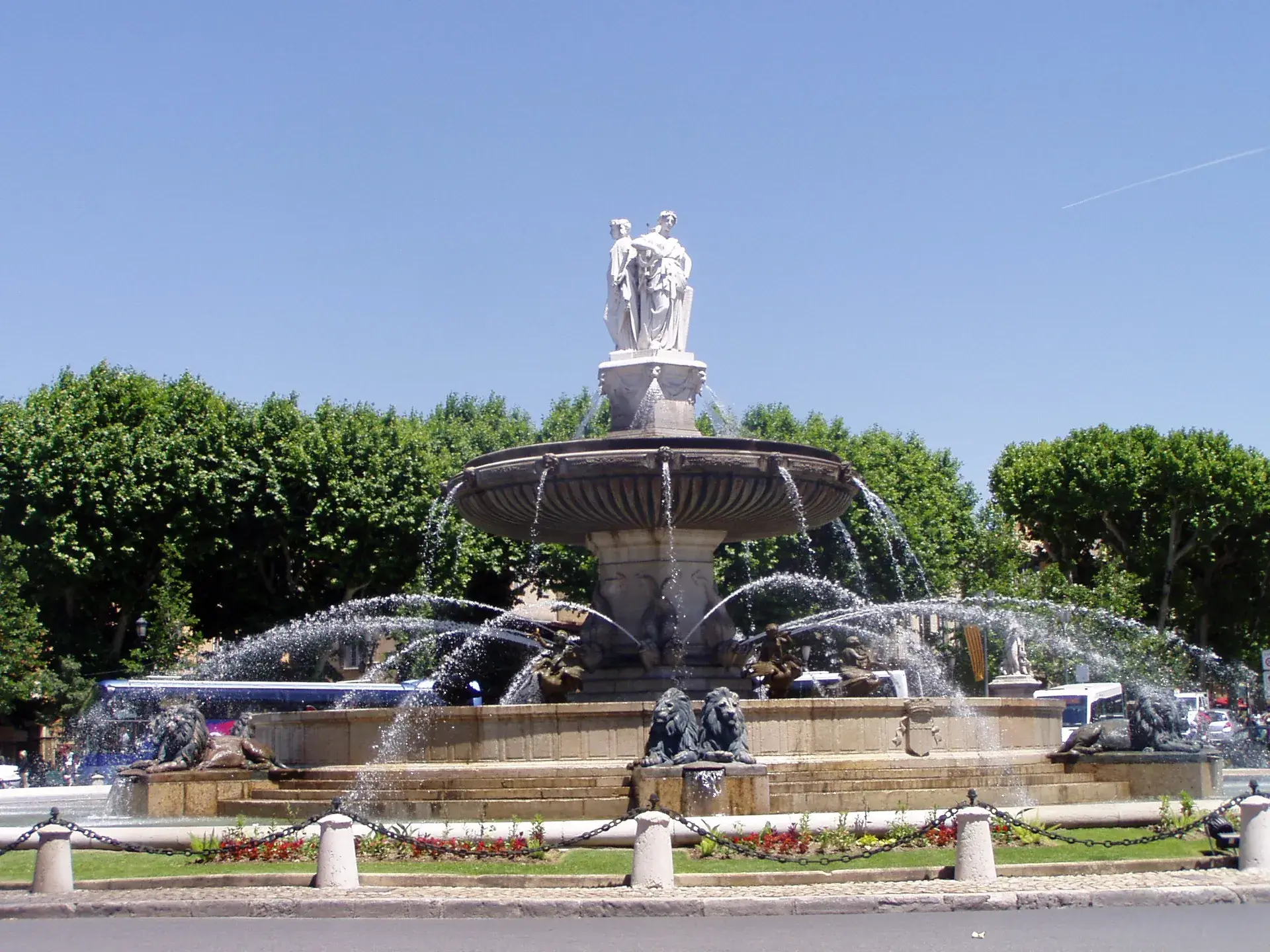
The Fontaine de la Rotonde stands at the Place du Général de Gaulle, marking the western terminus of the Cours Mirabeau. Constructed between 1840 and 1860, the fountain was built on the open expanse created after the removal of the city's medieval ramparts. It was conceived as a monumental threshold to welcome travelers arriving into the newly unfortified city.
Inaugurated in 1860 under Emperor Napoleon III, the fountain's founding is recorded directly on its structure. The pedestal supporting the central basin features the inscription: "Cette fontaine a été élevée en MDCCCLX sous le règne de S.M. l'empereur Napoléon III." Today, the fountain acts as a central roundabout, pedestrian hub, and visual anchor connecting modern Aix-en-Provence with the Mazarin Quarter and the historic center.
The Three Allegories and Basin Sculptures
Designed by engineers Théophile de Tournadre and Sylvestre, the monument reaches a height of approximately 12 meters, resting inside a 32-meter-diameter central basin. The fountain is crowned by three distinct marble allegories, each sculpted by a different artist and oriented toward a key regional direction:
- Justice, sculpted by Joseph-Marius Ramus, faces east along the Cours Mirabeau toward the law courts.
- Agriculture and Commerce, sculpted by Louis-Félix Chabaud, points south toward Marseille.
- Fine Arts, sculpted by Hippolyte Ferrat, looks north toward Avignon.
Because of these three summit figures, the monument is frequently referred to locally as the "Fontaine des Trois-Grâces." The original preparatory clay models for these figures are preserved nearby in the sculpture gallery of the Musée Granet. On the lower levels, the fountain displays bronze and stone works by sculptor François Truphème, featuring water-spouting lions, dolphins, and cherubs riding swans.
Engineering and Water Infrastructure
Aix-en-Provence traces its name and identity back to its Roman origins as Aquae Sextiae, known for its natural water sources. While the city's historic streets feature older, moss-draped thermal fountains, the Rotonde stands as the grandest and largest water monument in Aix.
The fountain was constructed to celebrate the arrival of fresh water transported via the Zola Canal, an infrastructure project opened in 1854 and engineered by François Zola, the father of the novelist Émile Zola. Initially supplied intermittently, the fountain's water feed was converted to a continuous flow in 1875 by the Verdon Canal, and it is supplied today by the Canal de Provence. The multi-tiered spouts and jets produce a steady roaring sound, providing an acoustic buffer against the traffic circulating the surrounding roundabout.
FAQ
Why is the monument called the Fontaine des Trois-Grâces?
Locals often refer to the monument as the Fontaine des Trois-Grâces because it is crowned by three marble allegories representing Justice, Agriculture and Commerce, and Fine Arts.
What is the connection between the fountain and author Émile Zola?
The canal that originally supplied fresh water to the fountain at its 1860 opening was designed and built by civil engineer François Zola, the father of Émile Zola.
Where can the original preparatory models of the statues be found?
The original preparatory clay models for the three crowning marble statues are displayed in the sculpture gallery of the nearby Musée Granet.