Fontaine Moussue: Aix's Historic Mossy Fountain
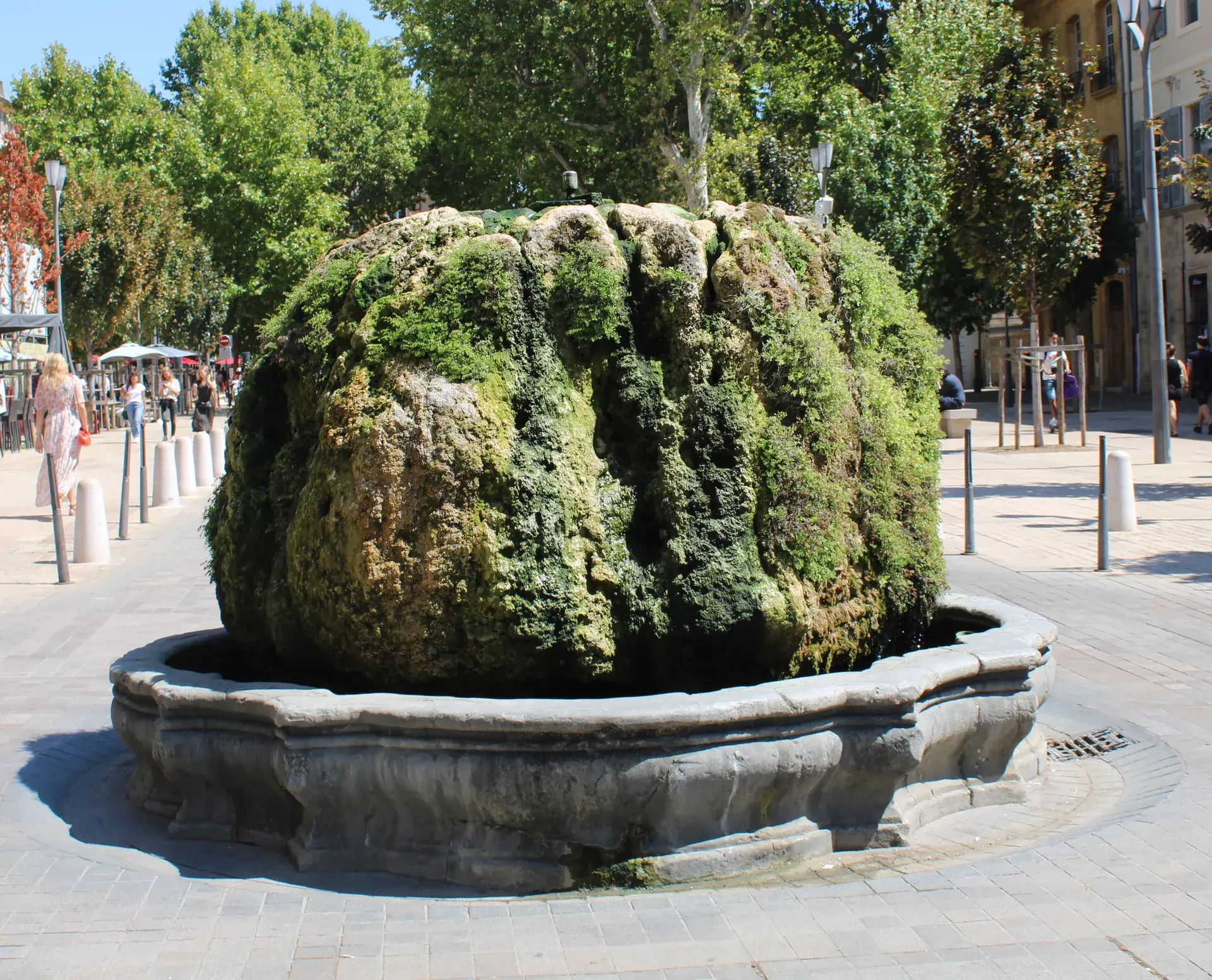
Standing along the pedestrianized boulevard of the Cours Mirabeau near Rue Clemenceau, the Fontaine Moussue is one of the most distinctive landmarks in Aix-en-Provence. Rather than presenting classical exposed stonework, this landmark resembles a dripping, verdant mound. Fed continuously by a natural thermal spring, it maintains a unique appearance that blurs the boundary between public art and natural geology.
The Entombment of 17th-Century Sculpture
Built between 1666 and 1667 under the direction of architect Jacques Fossé, the fountain was the first monument erected along the Cours following the 17th-century expansion of Aix-en-Provence. Its surrounding stone basin underwent further modifications in 1734. The initial decorative concept envisioned a sculpted triton, but around 1669 the plan changed to feature four sculpted children holding an upper basin.
Roughly a decade after its completion, thermal water previously channeled to Rue des Chaudronniers was diverted into the fountain. The water carried high concentrations of calcium carbonate. Over the course of the 18th and 19th centuries, progressive mineral deposits formed thick layers of limestone and tufa that gradually fused the sculpted elements. By the 20th century, the carved stone children were fully encased, sealed permanently beneath calcite encrustations and organic growth.
Thermal Waters and a Living Micro-Ecosystem
The fountain draws non-potable water from the Bagniers natural spring, which emerges at a constant temperature of approximately 18°C (64–65°F) throughout the year. The constant warmth and mineral spray have created an isolated habitat that functions as an independent micro-ecosystem. Botanical documentation by Aix naturalist Émile Lèbre revealed that the mound hosts three distinct varieties of moss, a specialized filamentous alga, and multiple species of diatoms.
This continuous thermal flow produces striking seasonal contrasts. On cold winter mornings, the 18°C water meets the chilly Provencal air, sending visible steam and light fog rising from the greenery. During rare, severe cold snaps, stalactites of ice can form around the outer rim of the basin while steam continues to ascend from the central fountain flow.
Civic Heritage and Daily Life
The presence of the thermal spring ties directly into the antiquity of Aix-en-Provence, founded in 122 BC as Aquae Sextiae by Roman consul Gaius Sextius Calvinus, who selected the settlement site specifically for its warm waters. Today, the Fontaine Moussue is one of four historic fountains punctuating the Cours Mirabeau, alongside the Fontaine de la Rotonde, the Fontaine des Neuf-Canons, and the Fontaine du Roi René.
In earlier centuries, the basin served practical domestic purposes. Because the water remained warm through sub-freezing winters, nearby residents regularly filled buckets from the fountain to scrub doorsteps, hallways, and stone floors. The practice became so intensive that municipal authorities ultimately barred washerwomen from using the basin as a communal wash tub. Known to residents as the Fontaine d'eau chaude and colloquially referred to as the "big green sponge," the landmark remains accessible to the public 24 hours a day.
FAQ
Why is the Fontaine Moussue covered in moss?
The Bagniers thermal spring feeding the fountain is rich in calcium carbonate, which built up thick layers of limestone and tufa over centuries. This warm, moist surface created an ideal environment for moss, specialized algae, and diatoms to grow over the structure.
Can you drink the water from the Fontaine Moussue?
No, the thermal mineral water that bubbles up in the fountain is non-potable.
Is there a sculpture inside the moss mound?
Yes. Beneath the thick layers of mineral deposits and moss lies a 17th-century sculpture of four children holding an upper basin, which was gradually entombed by calcification over the 18th and 19th centuries.