Place des Quatre-Dauphins in Aix-en-Provence
The Heart of the Quartier Mazarin
Place des Quatre-Dauphins stands at the intersection of Rue Cardinale and Rue du Quatre-Septembre in Aix-en-Provence. Conceived in the mid-17th century, the square is the focal point of the Quartier Mazarin. In 1645 and 1646, Archbishop Michel Mazarin obtained permission from King Louis XIV to tear down the city's southern medieval ramparts and establish a southern urban extension.
Unlike the irregular, winding layout of medieval Aix, the new district was planned on a strict geometric grid by architect Jean Lombard and developer Henri Hervard d'Hevinquem. Today, the square acts as a tranquil link between the lively commercial thoroughfare of Cours Mirabeau and nearby cultural landmarks, such as the Musée Granet and the Church of Saint-Jean-de-Malte.
Origins of the Dolphin Fountain
Initially designated as Place Saint-Michel or Place Mazarine, the square was intended to host a monument honoring the archbishop's brother, Cardinal Jules Mazarin. However, the project encountered resistance from local nobility and magistrates. Following Michel Mazarin's death in 1648, the proposal for the personal monument was abandoned.
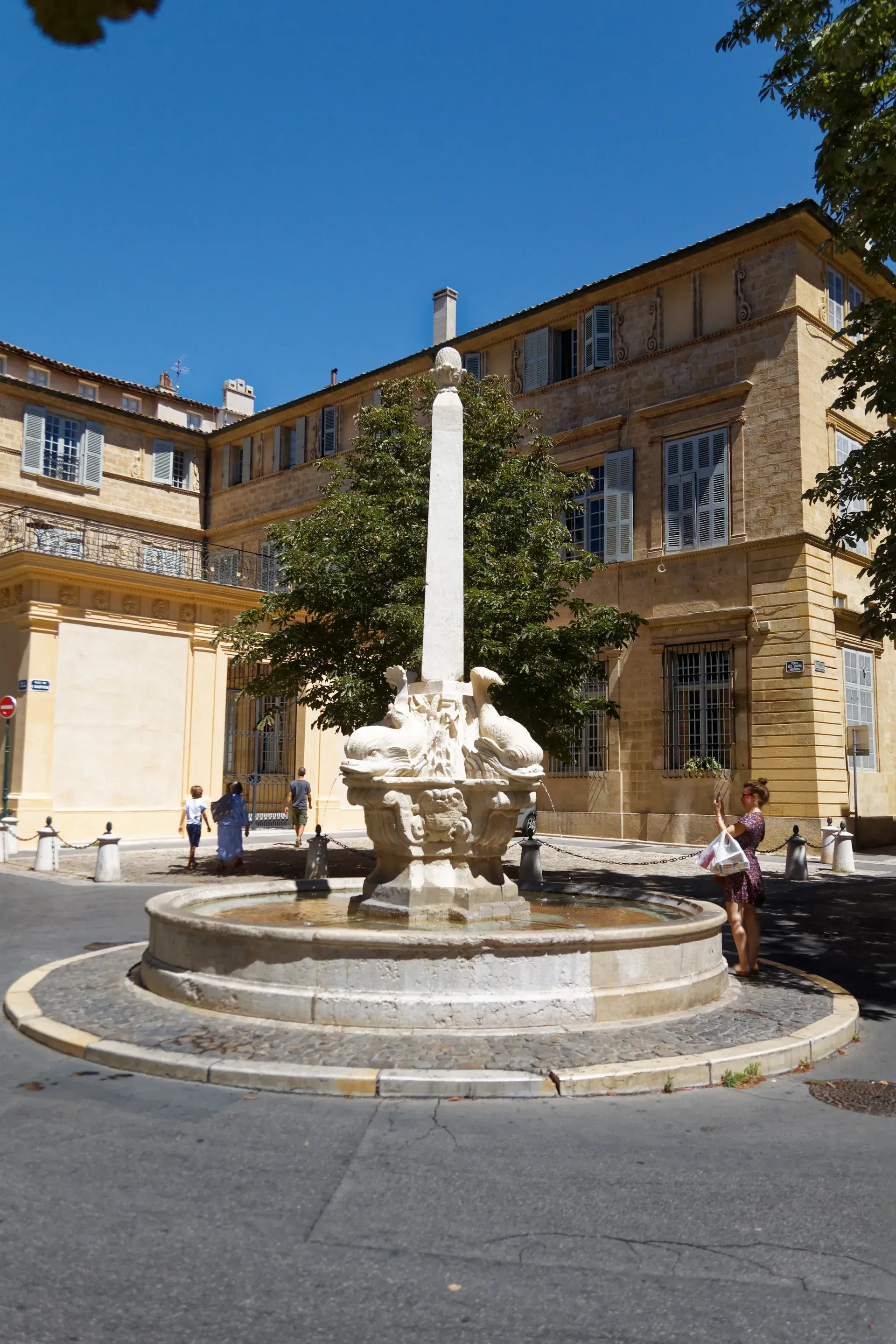
In 1667, the city commissioned a civic monument instead: the Fontaine des Quatre-Dauphins, sculpted by local artist Jean-Claude Rambot. The fountain quickly captured the public imagination, and popular reference to its aquatic statues led to the square's permanent official renaming.
Baroque Engineering and Symbolism
Carved from local Calissanne limestone with a circular basin composed of Sainte-Baume stone, the Baroque fountain was engineered with transportation in mind. It was the first fountain in Aix-en-Provence created "in the round," specifically structured to allow horse-drawn carriages to circulate around its perimeter like an early Baroque roundabout.
The monument depicts four water-spouting dolphins supporting a central obelisk. Each dolphin is oriented toward one of the four cardinal directions, reinforcing the strict grid system of the surrounding avenues. Over the centuries, the apex of the obelisk was altered several times, displaying successively a statue of Saint Michael, a royal fleur-de-lis, and a Maltese cross before being capped with a carved stone pinecone.
Surrounding Mansions and Present Atmosphere
The square is bordered by four symmetrical 17th-century hôtels particuliers. Among them is the Hôtel de Boisgelin, designed by architect Pierre Pavillon around 1655 on the northeast corner. Historically, the area was also noted for a hackberry tree measuring 4.8 meters in circumference, documented by naturalists Jean-Baptiste Lamarck and Augustin Pyrame de Candolle before it was felled in 1860.
The fountain was officially classified as a Monument historique in 1905 and underwent municipal restoration in 2015. Free from commercial storefronts and cafes, the surrounding mansions hold private residences, medical practices, and legal offices. Low-speed vehicular traffic still circles the basin, while the quiet intersection is marked by the steady sound of water trickling from the dolphins.
FAQ
Who designed the Fontaine des Quatre-Dauphins?
The fountain was sculpted by local artist Jean-Claude Rambot and completed in 1667.
Why was the fountain built in the round?
It was designed in the round to allow horse-drawn carriages to circulate freely around the central basin, functioning as an early roundabout.
What ornaments have topped the central obelisk over time?
The summit has featured a statue of Saint Michael, a fleur-de-lis, a Maltese cross, and a pinecone.