Palais de l'Isle: Annecy's Historic Island Castle
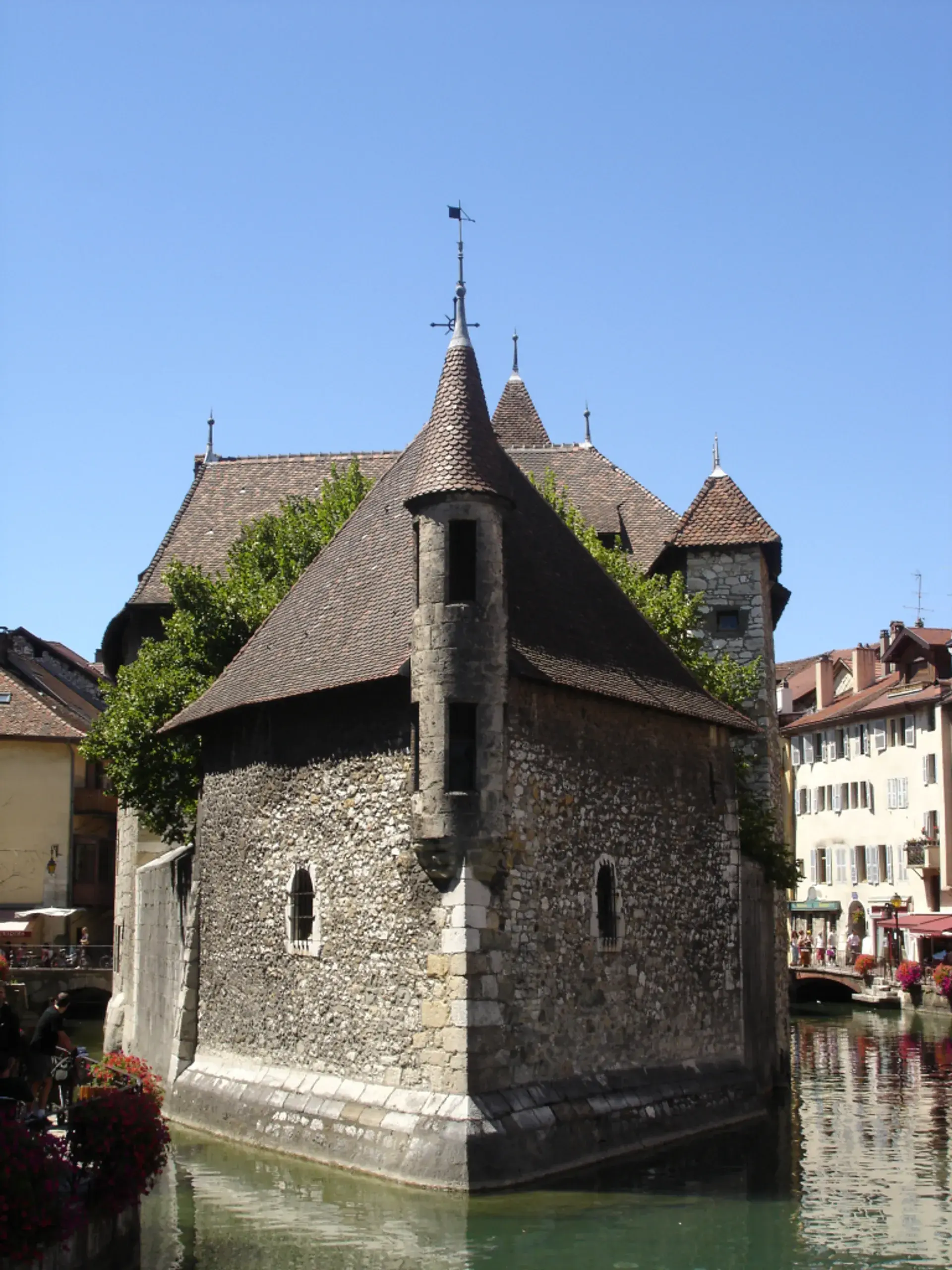
The Palais de l'Isle is one of Annecy's most photographed landmarks, an iconic fortified house seemingly afloat on a natural rocky island in the Thiou River. Its distinctive triangular form, often likened to the prow of a ship, makes it a powerful emblem of the city's medieval past and contributes to Annecy's nickname, "Venice of the Alps."
A Multifaceted Medieval History
The earliest structures of the Palais de l'Isle date to the 12th century, when it served as a fortified house controlling river passage and a toll point. Its role evolved over the centuries, and by 1325, it was first documented as a prison. This grim function was punctuated by other uses; in 1355, Count Amédée III of Geneva received permission from Emperor Charles IV to establish a minting workshop within the building, which produced gold and silver coins until 1392.
During the 15th and 16th centuries, the building's purpose continued to shift. Janus of Savoy acquired the property in 1473, and his wife, Hélène of Luxembourg, is credited with adding its chapel. By the 16th century, under the Dukes of Genevois-Nemours, it became a courthouse and an administrative center for the Genevois region, while simultaneously continuing its function as a prison.
From Prison to Landmark
The building's long history as a prison largely ended in 1864 with the opening of a new facility. It was then repurposed as a home for the elderly from 1865 to 1880. Despite its long service to the city, the Palais de l'Isle faced demolition in the late 19th century when the municipal council proposed replacing it with public baths.
The structure was saved through the public advocacy of novelist André Theuriet and Inspector of Historic Monuments Charles Suisse. Their intervention was successful, and the French State officially listed the Palais de l'Isle as a historic monument on February 16, 1900. It even briefly reverted to its role as a prison during World War II. The building underwent significant restoration campaigns from 1983 to 1985 and again from 2016 to 2017.
The Palais de l'Isle Today
Since 2005, the Palais de l'Isle has operated as the Centre for Architecture and Heritage (CIAP). It serves as a museum, hosting permanent exhibitions that detail the urban history, architecture, and heritage of Annecy and the surrounding region. Visitors can explore the former judicial chambers, the old dungeons and individual jail cells, and the historic chapel. The center also regularly features temporary art and thematic exhibitions.
FAQ
What was the Palais de l'Isle originally used for?
The Palais de l'Isle began in the 12th century as a fortified house controlling a toll point on the Thiou River. Its first documented use as a prison dates to 1325, and it has also served as a mint, a courthouse, and an administrative center throughout its history.
Why is the Palais de l'Isle shaped like a ship?
The building's distinctive triangular form, often compared to the prow of a ship, is a result of its construction on a natural, triangular-shaped rocky island in the middle of the Thiou River.
Is the Palais de l'Isle still a prison?
No, the Palais de l'Isle is no longer a prison. Today, it functions as a museum and the Centre for Architecture and Heritage (CIAP), hosting exhibitions on the history and architecture of the Annecy region.
Was the Palais de l'Isle always a protected monument?
No, in the late 19th century, the Annecy Municipal Council planned to demolish it to build public baths. It was saved by preservation efforts and was officially classified as a historic monument in 1900.