Palais des Papes: Avignon's Gothic Papal Palace
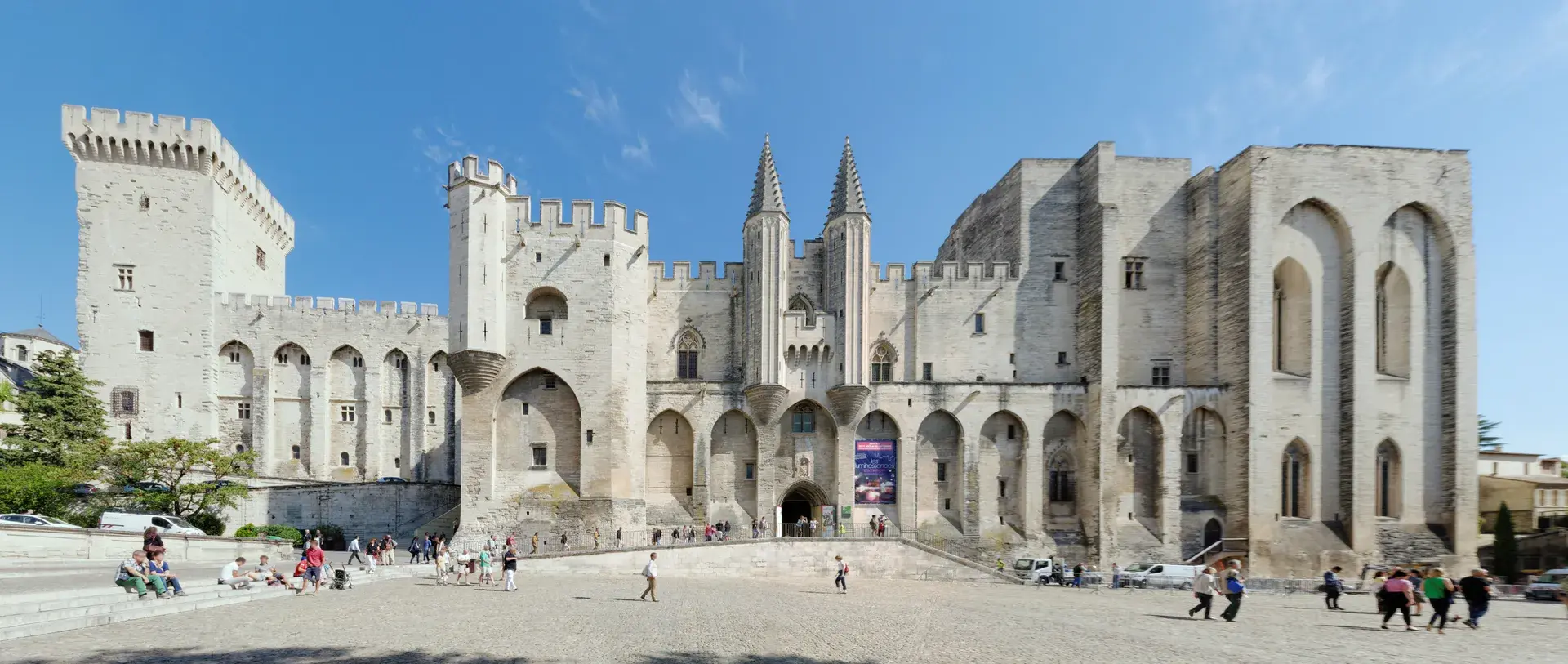
The Palais des Papes in Avignon, France, stands as an imposing Gothic fortress that was the center of Western Christendom during the 14th century. As the largest Gothic palace in the world and a UNESCO World Heritage site since 1995, this monument embodies the immense temporal and spiritual power of the papacy during a pivotal era in European history.
A Monumental Construction
The construction of this massive complex, equivalent in volume to four cathedrals, occurred in two principal phases. The first, known as the 'Palais Vieux' (Old Palace), was initiated in 1335 by the austere Pope Benedict XII, who demolished the existing episcopal palace to build a heavily fortified residence. His architect was Pierre Poisson.
Beginning in 1342, the more flamboyant Pope Clement VI commissioned a grander extension, the 'Palais Neuf' (New Palace). Architect Jean de Louvres oversaw this lavish addition, which was largely completed under Pope Urban V by 1363. The primary construction of the entire complex was finished in less than 20 years, a remarkable feat for the time.
The Seat of the Papacy
The Avignon Papacy began in 1309 when Pope Clement V, citing political instability in Rome and his own poor health, settled in the city. Nine popes, including Benedict XII and Clement VI, would eventually reside in Avignon, making the palace the official seat of Western Christianity. Six papal conclaves were held within its fortified walls.
In 1348, Clement VI solidified the papacy's control by purchasing the city of Avignon for 80,000 florins. The palace also housed the largest library in Europe at the time, with over 2,000 volumes, attracting prominent scholars like Petrarch. The grandeur of the court was matched by a fear of intrigue; a silver bell would sound before papal meals, signaling for everyone to evacuate the palace to prevent poisoning attempts.
From Schism to Revolution
After Pope Gregory XI returned the papacy to Rome in 1378, the Great Western Schism began, a period where rival popes vied for control. During this time, antipopes Clement VII and Benedict XIII resided in the Avignon palace.
Centuries later, during the French Revolution, the palace's role shifted dramatically. It was converted into a prison and military barracks. This era saw a dark event known as the 'Massacre de la Glacière,' where approximately sixty political prisoners were executed within the palace.
The Palace in Modern Times
Classified as a historic monument in 1840, the Palais des Papes is now one of the most visited sites in France, welcoming 774,325 visitors in 2023. Since 1947, its main courtyard, the Cour d'Honneur, has been transformed each July into a spectacular open-air theatre, serving as a primary venue for the world-renowned Festival d'Avignon, initiated by Jean Vilar.
Beyond the festival, the palace functions as a congress center and regularly hosts temporary art exhibitions. Visitors can also enjoy the recently restored pontifical gardens, which offer a public space for relaxation with an urban orchard. The building has numerous stairs, which may limit accessibility for some visitors.
FAQ
Why was the Palais des Papes built in Avignon?
The papacy relocated to Avignon in 1309 under Pope Clement V due to political instability in Rome. The construction of the palace began in 1335 to serve as the new, fortified seat of Western Christianity.
How long did the Popes live in the Palais des Papes?
The Avignon Papacy, during which seven French Popes resided in the city, lasted from 1309 until 1378. The palace was later occupied by two antipopes during the Great Western Schism.
What is the Palais des Papes used for today?
Today, it is a major tourist attraction, a UNESCO World Heritage site, a congress center, and a venue for art exhibitions. Its main courtyard, the Cour d'Honneur, becomes an open-air theatre for the annual Festival d'Avignon.
How long did it take to build the Palais des Papes?
The primary construction of the immense Gothic complex, combining the Palais Vieux and Palais Neuf, was completed in a remarkably short period of less than 20 years, from 1335 to 1352.