Place de la Bourse & Miroir d'Eau in Bordeaux
The Royal Opening to the Garonne
Place de la Bourse stands as the architectural anchor of Bordeaux's central riverfront promenade, where the historic Saint-Pierre district meets the quayside of the Garonne. Initiated around 1720 under Royal Intendant Claude Boucher, the construction required dismantling Bordeaux's medieval river walls. This bold urban decision tore down centuries-old fortifications to open the city directly to maritime trade and present an imposing face to Atlantic shipping.
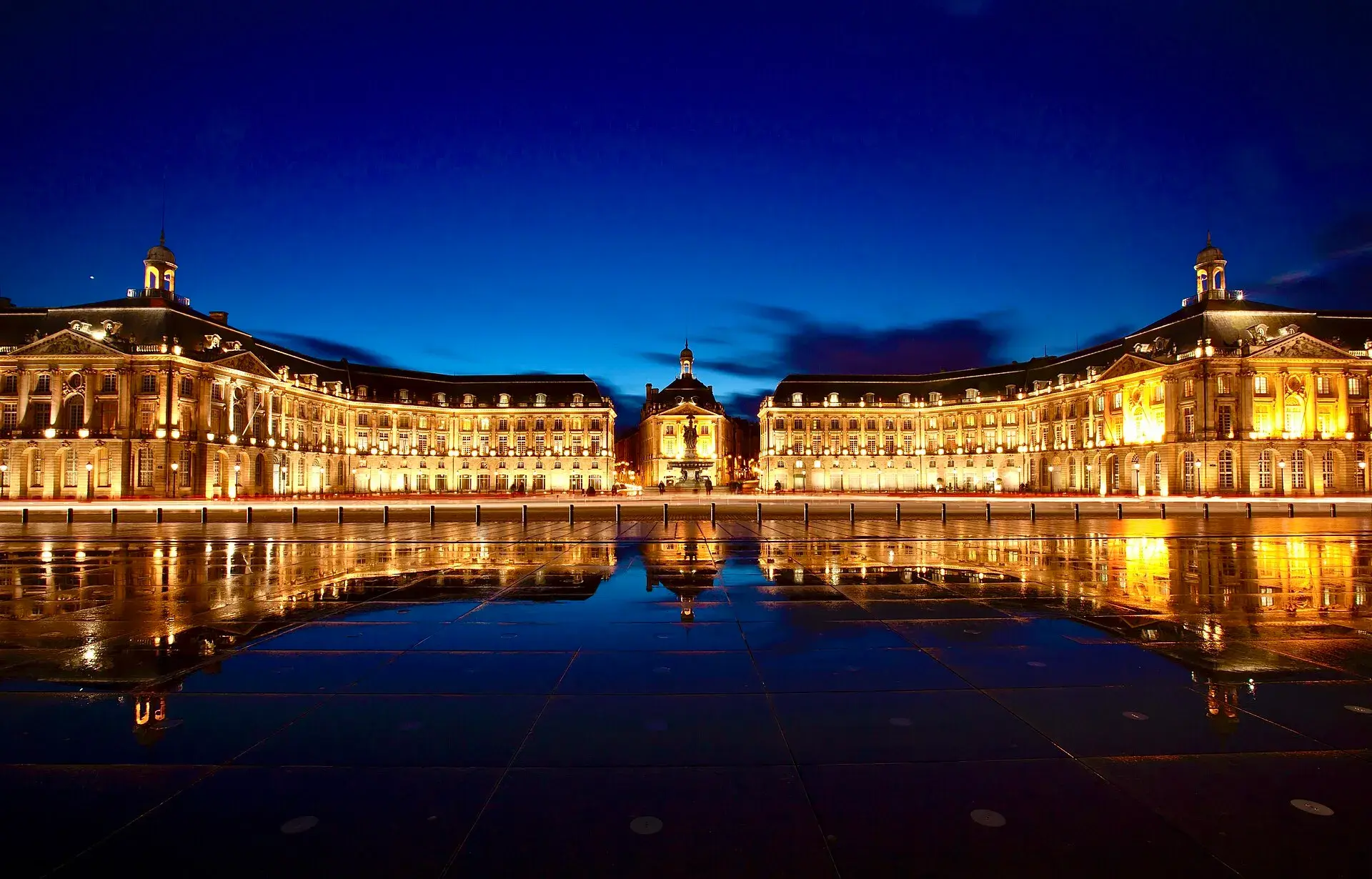
Designed by royal architect Jacques Gabriel and finished by his son Ange-Jacques Gabriel between 1730 and 1755, the classical horseshoe-shaped square officially opened in 1749. The composition consists of two symmetrical wings flanking a central pavilion: the Palais de la Bourse to the north and the Hôtel des Fermes to the south. Today, this monumental ensemble forms a central component of Bordeaux's UNESCO World Heritage site, the Port of the Moon.
Self guided walking tour of Bordeaux with audio guide
2 hours8 stopsAudio guideStart any day, at your own paceTicket on your phone · 30-day refundShifting Symbols and the Three Graces
Originally designated as Place Royale, the square was anchored in 1743 by a bronze equestrian statue of King Louis XV. During the French Revolution, authorities dismantled the royal likeness and melted it down to produce cannons, temporarily replacing it with a Tree of Liberty. The square’s name evolved alongside France's political shifts, alternating between Place de la Liberté and Place Impériale before being designated Place de la Bourse in the 19th century.
In 1869, the city installed the Fontaine des Trois Grâces at the center of the plaza. Designed by Louis Visconti and sculpted by Charles Gumery, the bronze monument depicts the daughters of Zeus—Aglaia, Euphrosyne, and Thalia. The unveiling was not without controversy; in May 1869, the parish priest of the neighboring Saint-Pierre church reportedly refused to bless the fountain, scandalized by the figures' nudity and exposed backs.
Architectural Allegories and Mascarons
The facades of Place de la Bourse celebrate Bordeaux’s maritime and commercial dominance through stone carvings. Sculpted triangular pediments atop the pavilions display elaborate allegories of river navigation and merchant seafaring.
Along the ground-floor arches, the keystones are decorated with sculpted stone faces known as mascarons. These carvings feature mythological deities such as Mercury, symbolizing commerce, and Minerva, representing the arts, displayed alongside portraits representing international trade routes.
The Miroir d'Eau
Directly across the roadway from the historic square lies the Miroir d'eau. Unveiled in 2006 as part of Bordeaux's waterfront renewal, the installation was created by landscape architect Michel Corajoud, fountain engineer Jean-Max Llorca, and architect Pierre Gangnet. Covering between 3,450 and 3,850 square meters of polished dark granite, it is recognized as the largest reflecting pool in the world.
The installation operates on a programmed cycle. Solenoid valves fill the granite surface with roughly two centimeters of water, creating an uninterrupted mirror that reflects the 18th-century facades and passing visitors. When the water drains into an 800-cubic-meter underground reservoir, nearly 900 micro-nozzles spray a dense, two-meter-high mist across the stone before the cycle repeats.
Modern Civic Use and Infrastructure
The buildings framing Place de la Bourse retain important civic roles. The Palais de la Bourse houses the Bordeaux Chamber of Commerce and Industry and hosts conferences and major events, while the Hôtel des Fermes accommodates the Interregional Customs Directorate and the Musée National des Douanes.
The Miroir d'eau functions as a gathering and cooling space from spring through autumn, draining during the winter months to protect underground machinery from freezing. To preserve unobstructed sightlines between the classical facades and the riverfront reflecting pool, Bordeaux's Line C tramway runs across the quays without overhead catenary wires, relying instead on a ground-level power supply system.
FAQ
What is the Miroir d'eau and how does it work?
The Miroir d'eau is the world's largest reflecting pool, covering up to 3,850 square meters of dark granite slabs. A subterranean system featuring an 800-cubic-meter reservoir, pumps, and computer-regulated valves alternates between flooding the granite with two centimeters of water and spraying a cooling, two-meter-high mist through nearly 900 micro-nozzles.
Why was Place de la Bourse originally built?
Initiated in the 1720s under Royal Intendant Claude Boucher, the square was created by dismantling Bordeaux's medieval defensive walls. The project aimed to modernize the city, open it to Atlantic maritime commerce, and display commercial wealth to incoming ships.
Does the Miroir d'eau operate throughout the entire year?
No. The reflecting pool runs cyclically from spring through autumn and is drained during the winter months to prevent freezing in its underground pipes and mechanisms.
What statue stands in the center of Place de la Bourse?
The center of the square features the Fontaine des Trois Grâces, installed in 1869. Designed by Louis Visconti and sculpted by Charles Gumery, it depicts Zeus's daughters Aglaia, Euphrosyne, and Thalia.
More places in Bordeaux
bordeaux, france
Maison Gobineau: the flatiron of the wine trade
Maison Gobineau: the flatiron of the wine trade
bordeaux, france
Grand Théâtre: the temple of the twelve muses
Grand Théâtre: the temple of the twelve muses
bordeaux, france
Monument aux Girondins: the fountain of bronze horses