Basilique Saint-Nazaire: Jewel of Carcassonne
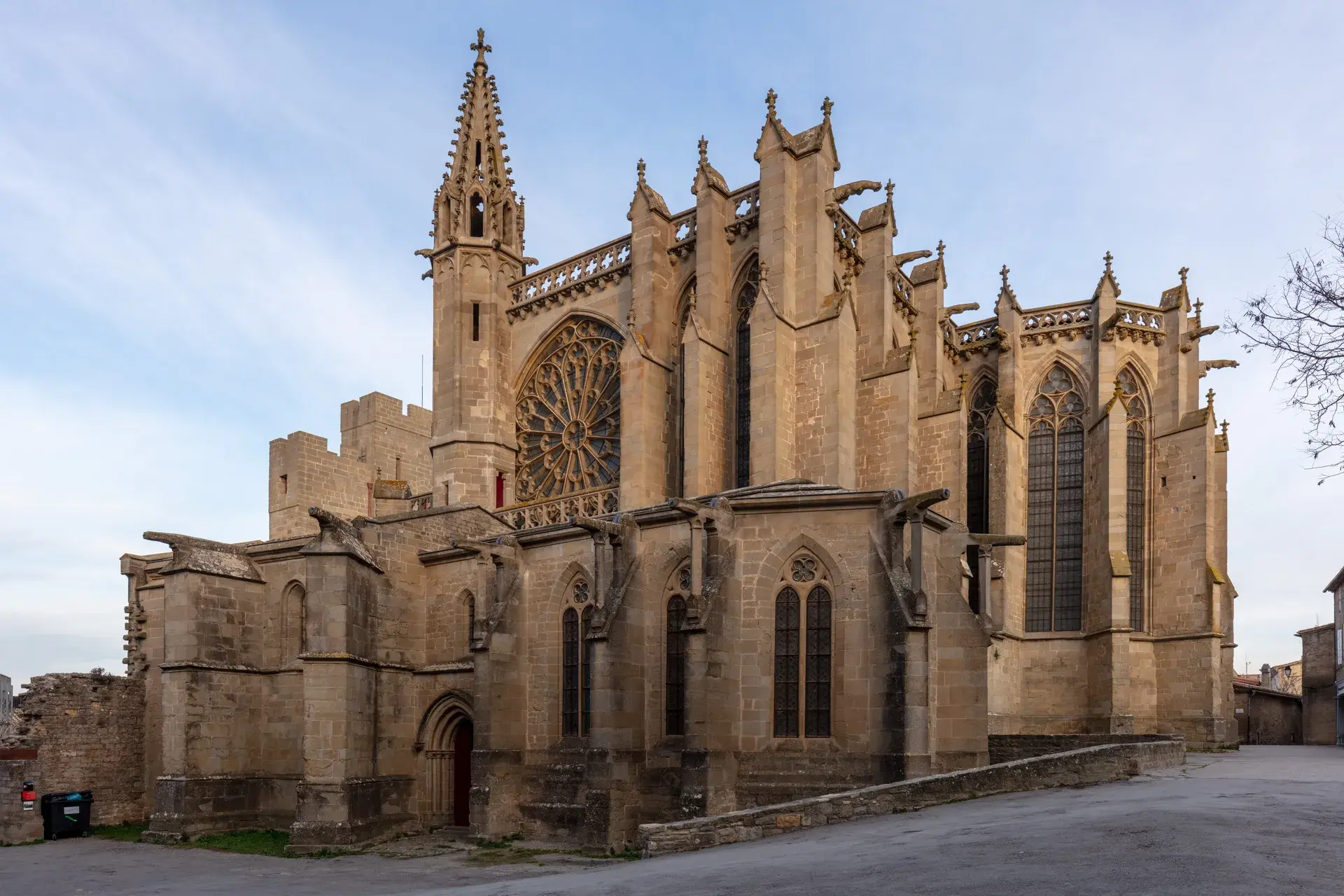
Known locally as "Le Joyau de la Cité" (The Jewel of the Citadel), the Basilica of Saints Nazarius and Celsus (Basilique des Saints Nazaire et Celse) is a Roman Catholic minor basilica and French national monument. Positioned in the southern quarter of Carcassonne's fortified citadel near the Château Comtal, the church long served as the historical spiritual counterpart to the fortress's military defenses.
Today, the monument stands out for its dramatic visual hybridity, freezing two distinct medieval architectural eras into a single stone structure.
An Architectural Collision: Romanesque Meets Gothic
The defining feature of Basilique Saint-Nazaire is the direct juxtaposition of an 11th- to 12th-century Romanesque nave with a late 13th- to early 14th-century Rayonnant Gothic choir and transept. Within the interior, heavy stone barrel vaults resting on alternating round and square piers create an enclosed, dimly lit hall. This subdued Romanesque atmosphere yields abruptly to the lofty, luminous Gothic crossing, defined by ribbed vaulting, slender columns, and expansive clerestory walls.
This striking transition was never part of an original design scheme. Instead, the hybrid layout was an accidental outcome of shifting resources. Medieval builders demolished the original Romanesque apse to erect a larger, modern Gothic structure, but reconstruction halted before the western Romanesque nave was dismantled, leaving the two opposing styles joined side by side.
Centuries of Construction and Restoration
Documented as an established cathedral site from the 10th century, the church's Romanesque phase officially began on June 12, 1096. While traveling through southern France to preach the First Crusade, Pope Urban II blessed the building materials gathered by the Trencavel viscounts, leading to the completion of the Romanesque structure in the first half of the 12th century.
Following the Albigensian Crusade and the incorporation of Carcassonne into the French royal domain, Bishop Pierre de Rochefort and the French crown initiated a grand Rayonnant Gothic rebuilding between 1269 and the 1330s, importing northern Île-de-France architectural forms.
The basilica held the seat of the Diocese of Carcassonne until 1801, when cathedral status was transferred to the lower town. In the 1840s, architect Eugène Viollet-le-Duc led comprehensive restorations of the structure as part of his wider conservation program across the Cité. Decades later, in 1898, Pope Leo XIII elevated the church to the rank of minor basilica.
Medieval Stained Glass Masterpieces
Basilique Saint-Nazaire houses some of the best-preserved medieval stained glass in southern France, dating from the late 13th century through the early 16th century. Stained-glass lancets and dramatic rose windows illuminate the choir and transepts with vibrant filtered light.
Among the glazing schemes are two paired theological windows in the transept. One window portrays the Tree of Jesse, tracing the ancestral genealogy of Christ, while its counterpart illustrates the Tree of Life, depicting scenes of the Passion.
The Pierre du Siège and Wartime Relics
Mounted in the south transept is the Pierre du Siège ("Siege Stone"), a 13th-century carved stone relief. The panel depicts medieval siege warfare in graphic detail, portraying crossbowmen, attacking forces advancing on battlements, and defenders firing a trebuchet artillery engine.
Historians associate this relief with the 1218 Siege of Toulouse, where Crusade commander Simon de Montfort was killed in battle. Following his death, Montfort was temporarily buried inside Basilique Saint-Nazaire before his remains were exhumed and reinterred near Paris three years later.
Modern Visits and Parish Life
Basilique Saint-Nazaire remains open year-round as a national historic monument and an active Roman Catholic church under the Diocese of Carcassonne and Narbonne. In addition to accommodating visitors along the inner ramparts of the citadel, it continues its religious traditions with regular weekly Sunday Mass celebrated at 11:00 am.
FAQ
Why does Basilique Saint-Nazaire feature two different architectural styles?
The hybrid style was accidental. Medieval clergy and the French crown replaced the church's original Romanesque apse with a soaring Rayonnant Gothic choir and transept between 1269 and the 1330s, but plans halted before the Romanesque nave could be replaced, leaving both styles joined together.
What is the Pierre du Siège inside the church?
The Pierre du Siège is a 13th-century stone carving in the south transept depicting medieval combat, including crossbowmen and a trebuchet. It is widely connected to the 1218 Siege of Toulouse, where Crusade leader Simon de Montfort died before being temporarily buried in the basilica.
Is Basilique Saint-Nazaire still used for services?
Yes, it functions both as a public national monument and as an active parish within the Diocese of Carcassonne and Narbonne, hosting Catholic Sunday Mass weekly at 11:00 am.