Église Sainte-Croix de Nantes: History & Architecture
Topping a 17th-century church with an 8-tonne civic bell, Église Sainte-Croix de Nantes physically merges the religious and municipal history of the city. Located on Place Sainte-Croix in the historic Bouffay quarter, this active Catholic parish church serves as a prominent landmark connecting the medieval lanes of Nantes to the Castle of the Dukes of Brittany and Nantes Cathedral.
A Hybrid Architectural Marvel
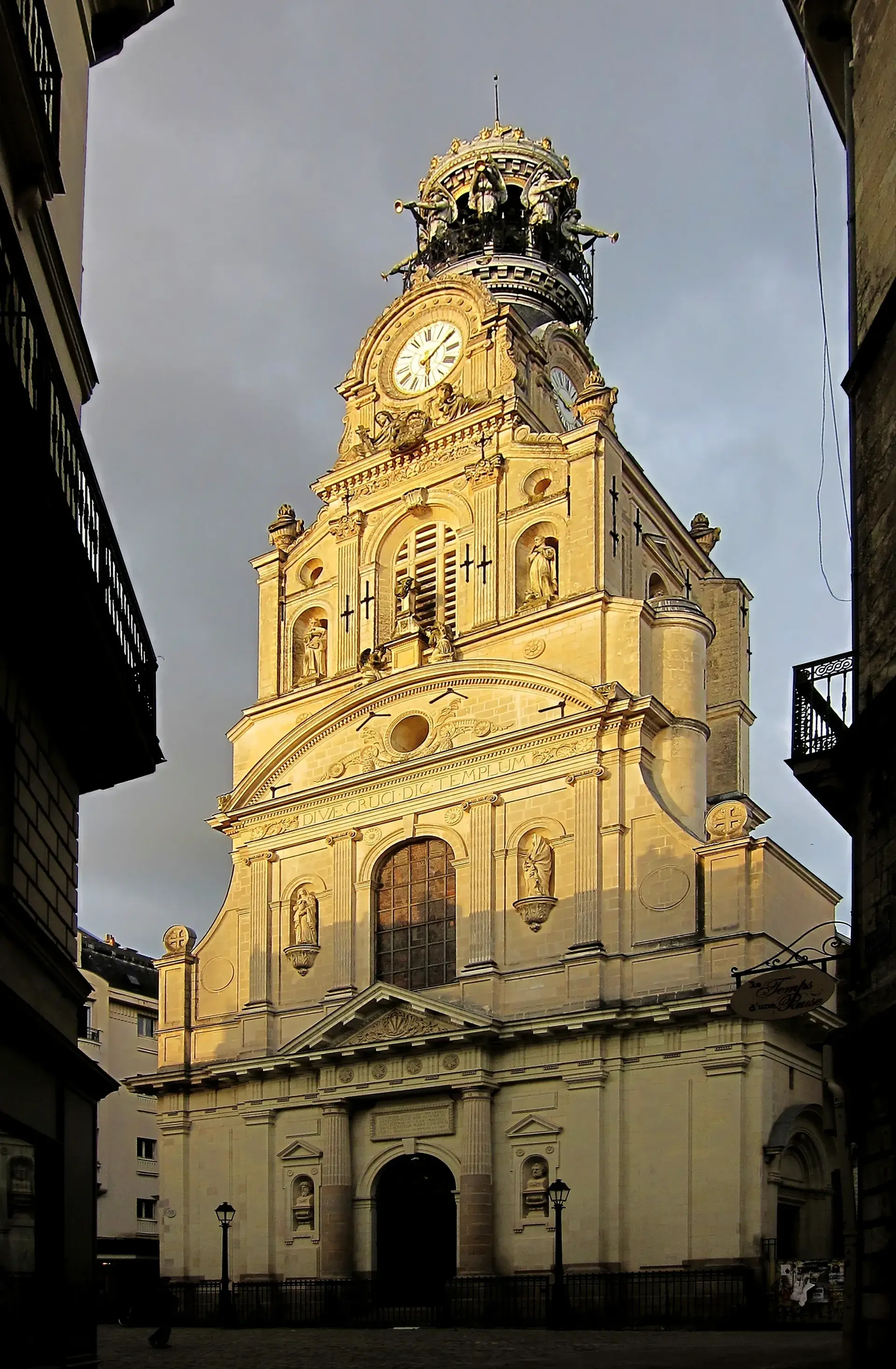
The architecture of Église Sainte-Croix is a blend of evolving styles. A major reconstruction began in 1669, resulting in a Flamboyant Gothic nave that took sixteen years to complete. In 1685, architect Jean Jagueneau designed the church's classical white tuffeau facade, which rests on a sturdy granite base. The structure was expanded again with the addition of a Neo-Gothic choir in 1839.
Between 1859 and 1861, municipal architect Henri-Théodore Driollet introduced the upper tower and its distinctive metal belfry. The peak of this belfry features a lantern crowned by a ring of sculpted, gilded angels blowing trumpets toward the four cardinal directions.
The Civic Bell and Clock
The public clock and the massive 8-tonne bell atop the church facade were not originally created for Sainte-Croix. Cast in 1663, the bell known as "La Bouffay" originally belonged to the city's medieval civic fortress. When the old town tower was demolished, the civic clock and bell were salvaged and installed on the church in 1860.
Centuries of History and Curiosities
The site traces its origins to an 11th-century Benedictine priory linked to Marmoutier Abbey. The original chapel served the neighboring Château du Bouffay, an early residence of the Dukes of Brittany. During the French Revolution, the church was nationalized and repurposed as a prison, with its pulpit repurposed as a stage for revolutionary speeches.
In May 1800, a massive explosion at the powder magazine of the nearby Castle of the Dukes of Brittany sent shockwaves through the city, shattering the church's glass windows during a Mass. Decades later, the church hosted a quieter historical milestone when famed science-fiction author Jules Verne was baptized there on February 8, 1828.
Modern Role and Surrounding Culture
Today, Église Sainte-Croix functions as an active place of worship within the Diocese of Nantes. The church interior houses ex-voto plaques and a 19th-century marble statue of Our Lady of Good Help, which was crowned in 1932 under the authorization of Pope Pius XI. The adjacent former priory now serves the public as the Passage Sainte-Croix, a cultural, artistic, and exhibition space established in 2011.
FAQ
Where is Église Sainte-Croix located?
The church is located on Place Sainte-Croix in the historic Bouffay quarter, the oldest medieval district of Nantes.
Why does Église Sainte-Croix have a civic bell?
The 8-tonne bell, known as "La Bouffay," and the public clock were salvaged from Nantes' demolished medieval civic fortress and installed on the church's belfry in 1860.
Was Jules Verne baptized at Église Sainte-Croix?
Yes, the famous science-fiction author Jules Verne was baptized in the church on February 8, 1828.