Passage Pommeraye: Historic Arcade in Nantes
Embodying the 19th-century prosperity of Nantes as an industrial sugar capital and maritime port, Passage Pommeraye is a historic covered arcade built between late 1840 and June 1843. The ambitious project was led by property developer Louis Pommeraye, who envisioned transforming a steep, unsafe area into an upscale commercial thoroughfare for the city's bourgeoisie.
Today, it serves as an essential pedestrian anchor on the classic downtown walking path connecting Rue Crébillon, Place Royale, and Place Graslin.
Overcoming a Steep Elevation
Connecting Rue Santeuil at the top with Rue de la Fosse at the bottom required architects Jean-Baptiste Buron and Hippolyte Louis Théophile Durand-Gasselin to navigate a severe 9.4-meter drop on a hillside of sand and rock. Rather than disguising the massive elevation change, the architects made the vertical climb the visual focal point.
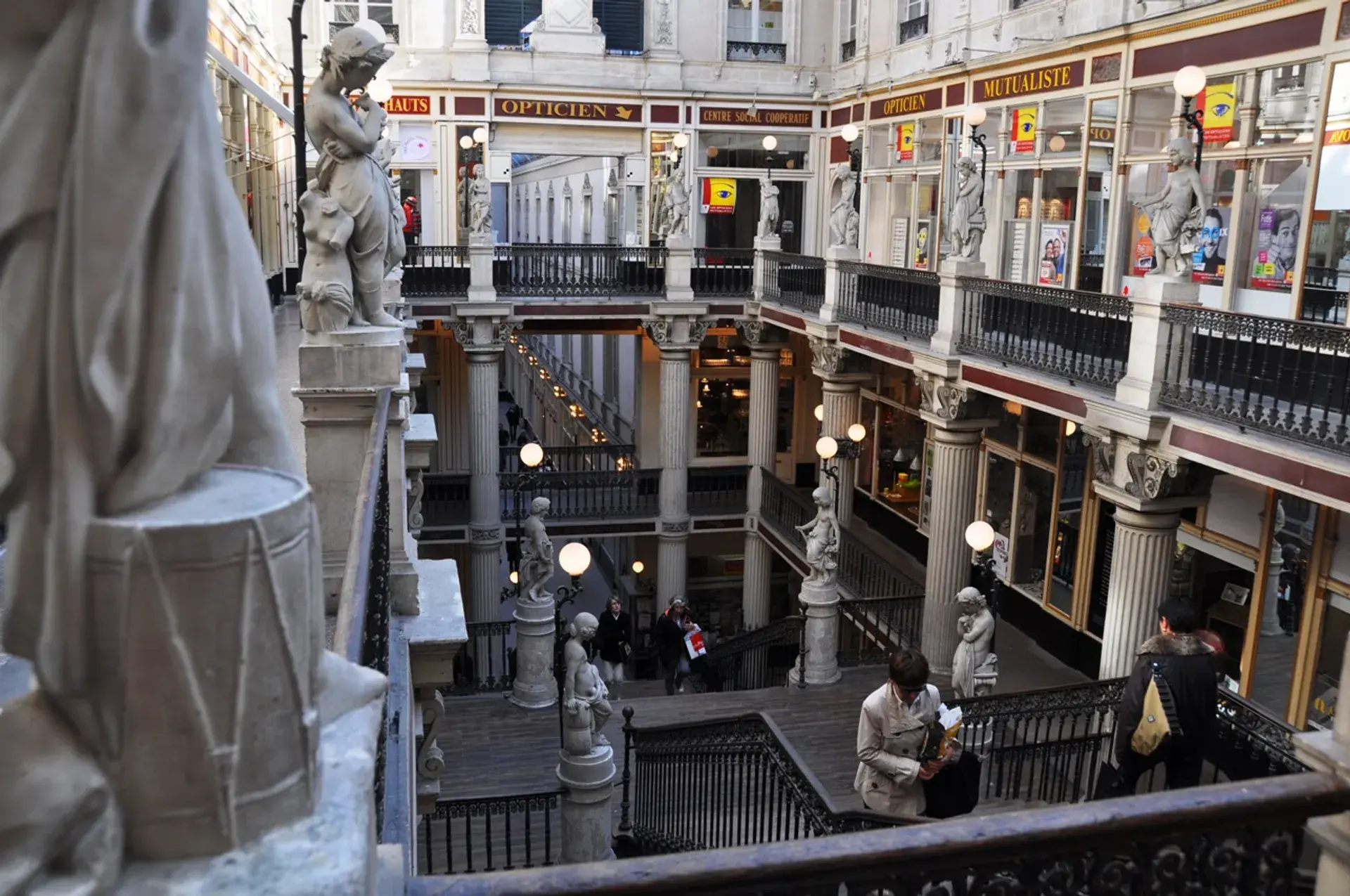
They constructed a grand, multi-flight central staircase out of wood and iron. As the staircase ascends, its ornamental detailing becomes increasingly intricate, creating a striking visual progression.
19th-Century Wealth and Hardship
The construction of Passage Pommeraye was heavily financed by Pommeraye alongside major local sugar refiners. It was celebrated as a symbol of luxury and modernity upon its inauguration in July 1843.
However, the success of its design did not guarantee long-term stability for its creators. The economic crisis of 1848, combined with management difficulties, forced the financial ruin and subsequent liquidation of Pommeraye's operating company by February 1849.
Architectural Detail and Cinematic Fame
The interior of the arcade is defined by soft natural daylight that filters through a high vaulted glass roof. This light illuminates carved oak banisters, white limestone archways, and intricate wrought-iron balconies.
Sculptor Jean Debay crafted the youthful allegorical statues flanking the central staircase, representing Commerce, Industry, Fine Arts, Science, Agriculture, and Navigation. Additional wall medallions were created by Guillaume Grootaers.
The neoclassical architecture and grand staircase eventually caught the attention of major French filmmakers. Passage Pommeraye served as a cinematic backdrop for Jacques Demy's Lola (1961), Les Parapluies de Cherbourg (1964), and Une chambre en ville (1982), as well as Agnès Varda's Jacquot de Nantes (1991). The site was officially classified as a French Monument Historique in 1976.
Modern Retail and Restoration
The passage remains open daily as a free pedestrian shortcut and a thriving urban shopping arcade. Spread across its three levels are approximately 30 independent boutiques, specialty shops, and cafes.
To preserve its architectural integrity, Passage Pommeraye underwent an extensive restoration that concluded in 2015. Supervised by France's heritage authorities, the project fully repaired the arcade's statuary, woodwork, facades, lighting, and glass roof, ensuring the 19th-century masterpiece remains structurally sound for future generations.
FAQ
When was Passage Pommeraye built?
Construction began in late 1840, and the passage opened in June 1843. It was officially inaugurated in July 1843.
Are there shops inside Passage Pommeraye?
Yes, the arcade functions as an active retail space housing approximately 30 independent boutiques, specialty shops, and cafes across its three levels.
What do the statues in Passage Pommeraye represent?
The statues flanking the central staircase are allegorical figures sculpted by Jean Debay. They represent themes of Commerce, Industry, Fine Arts, Science, Agriculture, and Navigation.
Did any movies film in Passage Pommeraye?
Yes, the arcade was a filming location for several prominent French films, including Jacques Demy's Lola (1961) and Les Parapluies de Cherbourg (1964), as well as Agnès Varda's Jacquot de Nantes (1991).