Place Royale: Nantes' Monumental Central Square
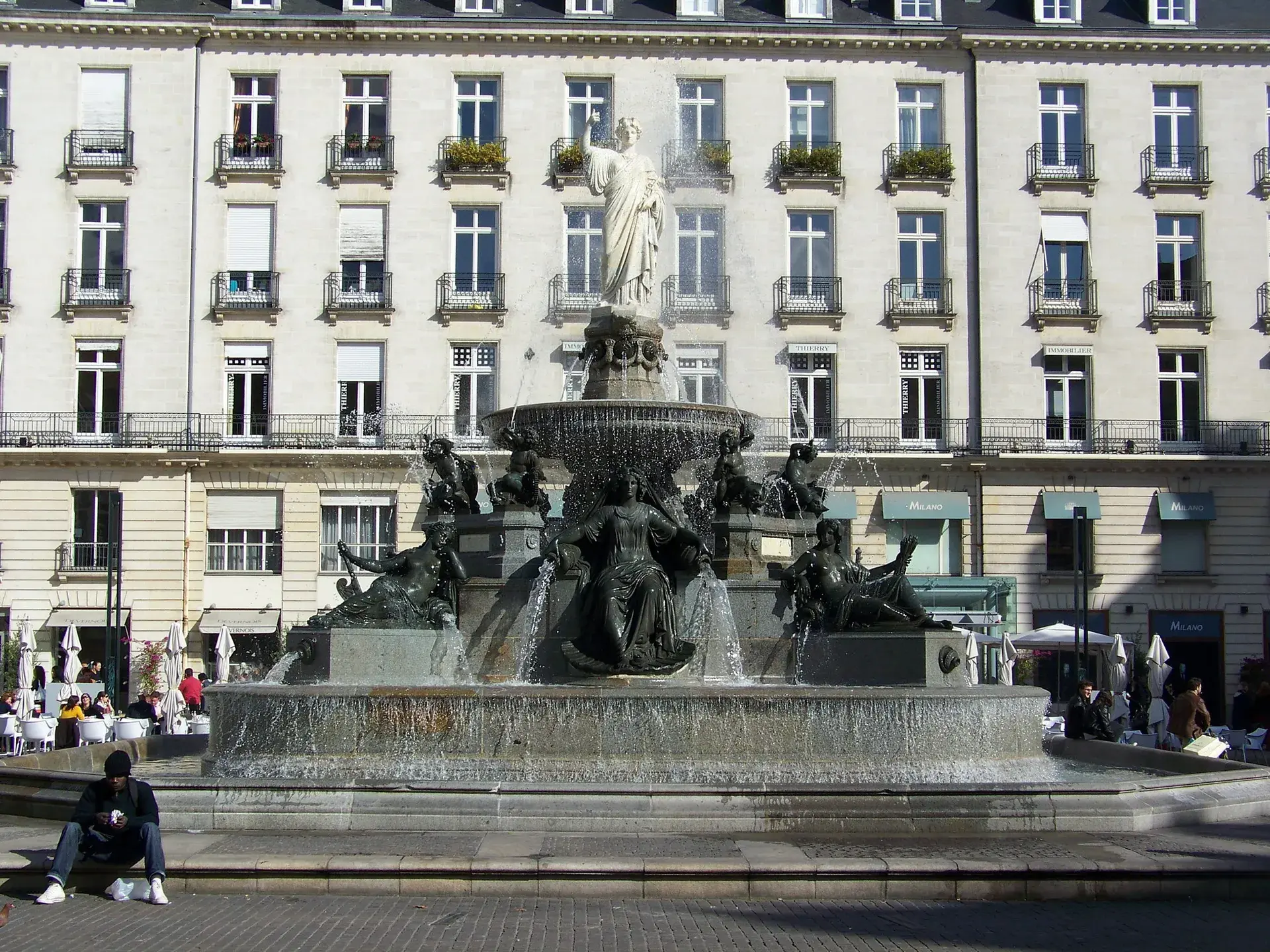
Place Royale presents a grand scale, anchored by an ornate central fountain celebrating local rivers and mythology. Despite its royal name, this monumental square has never hosted a statue of a king, distinguishing it from other royal squares across France and instead crowning the city of Nantes itself.
A Neoclassical Urban Transformation
Designed in 1786 by Mathurin Crucy and constructed in 1790, Place Royale was built over former medieval ramparts. The square was part of a broader urban push to modernize Nantes with open commercial thoroughfares, illustrating the city's transition into a prosperous maritime river port and industrial hub.
The entirely granite-paved square sits at one of the lowest elevations in central Nantes, acting as a major intersection for nine surrounding streets. Its unique ground layout, combining a rectangular section with a semicircular western end, is traditionally described as a "toilet mirror" (miroir de toilette). It anchors a classic walking route connecting central historic landmarks like Rue Crébillon, Passage Pommeraye, and Place Graslin.
The Monumental Fountain
The center of the square is dominated by a three-tiered monumental granite and marble fountain. Inaugurated in 1865 and designed by Henri-Théodore Driollet, the structure glorifies the local maritime and industrial economy.
The fountain's crowning statue is a white marble allegory of Nantes, depicted as a crowned woman holding a trident. Surrounding bronze figures sculpted by Daniel Ducommun de Locle and Guillaume Grootaërs represent the Loire River and four of its tributaries (the Erdre, Sèvre, Cher, and Loiret), alongside eight genies riding water-spouting dolphins to symbolize local trade. The bronze elements were cast by Jean-Simon Voruz, the same founder responsible for the cast-iron staircase in the nearby Passage Pommeraye. The rushing water and mist from the fountain stand in stark contrast to the pale, uniform neoclassical stone facades surrounding the square.
History and Modern Use
The square underwent several name changes to reflect France's shifting political regimes, serving as Place Impériale and Place de l'Égalité before permanently becoming Place Royale in 1852. After suffering heavy aerial bombing during World War II, the neoclassical facades and the square itself underwent meticulous reconstruction from 1945 to 1961.
For much of the later 20th century, Place Royale operated as a busy motor vehicle roundabout. Following complete pedestrianization between 2007 and 2011, it now functions as a primary public gathering space for civic events, political demonstrations, and leisure. Lined with active retail shops, cafés, and restaurants, the square regularly hosts contemporary art installations, including works for the annual Le Voyage à Nantes festival.
FAQ
Why is it called Place Royale if there is no statue of a king?
The square was permanently named Place Royale in 1852 after cycling through names like Place Impériale and Place de l'Égalité. Despite the royal designation, it has never contained a statue of any French monarch, featuring instead an allegorical statue of the city of Nantes.
What do the statues on the Place Royale fountain represent?
The crowning white marble statue represents the city of Nantes. The surrounding bronze figures allegorize the Loire River and four of its tributaries, while eight genies riding water-spouting dolphins symbolize local maritime trade and industrial power.
When was Place Royale in Nantes constructed?
The square was designed in 1786 by Mathurin Crucy and constructed in 1790 over former medieval ramparts. Its famous central monumental fountain was added decades later and inaugurated in 1865.